Welcome to Lappe's Bee Supply's blogs section. We are a trusted beekeeping company in the USA. We give relevant insights, seasonal guidance, and professional advice for beekeepers of all experience levels. From hive management and bee wellness to honey production and equipment guides, we have it all that you will require to thrive. Get updated, motivated, and connected with the beekeeping community through regular news from Lappe's Bee Supply.
The Queen Mother: The Queen Bee
The Buzz About This Post
- What should you know first about queen honey bees?
- What are the most important queen honey bee quick facts?
- What is a queen honey bee at a glance?
- What topics does this queen bee guide cover?
- What is a queen honey bee?
- How does a queen honey bee develop?
- How does a queen bee mate?
- What does a queen bee do inside the hive?
- How are queens, workers, and drones different?
- How do honey bees replace a queen?
- How can beekeepers read queen quality during an inspection?
- Why are queen bees important for beekeeping, agriculture, and ecosystems?
- What threats affect queen bees and colony health?
- How can beekeepers support queen health?
- Frequently asked questions about queen honey bees
- What sources support this queen honey bee guide?
- FAQs
Queen Honey Bees Explained: Life Cycle, Hive Role, Replacement, and Colony Importance
Author: Lappe’s Bee Supply
Published: April 3, 2025
Last updated: June 9, 2026
Editorial standards: This guide is written for beekeepers and bee-curious readers using university extension guidance, honey bee research references, and practical apiary experience. Local conditions vary, so always compare colony observations with your regional extension office, state apiary program, and current beekeeping regulations.
A queen honey bee is the colony’s primary reproductive female. She lays most of the colony’s eggs and produces pheromone signals that help workers recognize queen presence, maintain brood care, and preserve reproductive stability.
What should you know first about queen honey bees?
- A queen honey bee is the colony’s primary reproductive female.
- Most healthy honey bee colonies have one active laying queen.
- Queens and workers both develop from fertilized eggs, but queen-destined larvae receive continuous royal jelly.
- A queen honey bee typically emerges about 16 days after the egg is laid.
- A mated queen stores sperm in her spermatheca and uses it to fertilize eggs over time.
- Colonies replace queens through supersedure, emergency queen rearing, or swarming preparation.
- Queen quality affects brood production, colony strength, pollination performance, and honey production potential.
What are the most important queen honey bee quick facts?
- Queens develop from fertilized eggs fed continuous royal jelly.
- Queens typically emerge about 16 days after the egg is laid.
- Most colonies have one active laying queen.
- Queens mate with multiple drones and store sperm for future egg fertilization.
- Queen quality directly affects colony population and productivity.
What is a queen honey bee at a glance?
| Question | Direct Answer |
|---|---|
| What is a queen bee? | The colony's primary reproductive female. |
| How long does queen development take? | About 16 days from egg to adult. |
| How many queens are usually in a hive? | Usually one active laying queen. |
| What does a queen bee do? | She lays eggs and produces pheromones. |
| How do bees replace a queen? | Through supersedure, emergency rearing, or swarm preparation. |
What is a queen honey bee?
A queen honey bee is the colony’s main reproductive female, laying eggs and producing pheromones that help organize hive behavior.
- Most healthy honey bee colonies have one active laying queen.
- The queen is female and develops from a fertilized egg.
- Her main role is reproduction, not command.
- Worker bees feed, groom, protect, and guide the queen.
- Queen pheromones help signal her presence and reproductive condition.
The queen bee is the reproductive center of a honey bee colony. She does not personally forage, build comb, guard the entrance, or raise every young bee. Those jobs belong to worker bees. Her importance comes from egg laying and chemical communication. When the queen is healthy, well-mated, and actively laying, the colony can maintain a steady population of workers. When queen performance drops, brood production often declines, colony organization may weaken, and workers may begin raising a replacement queen.
How does a queen honey bee develop?
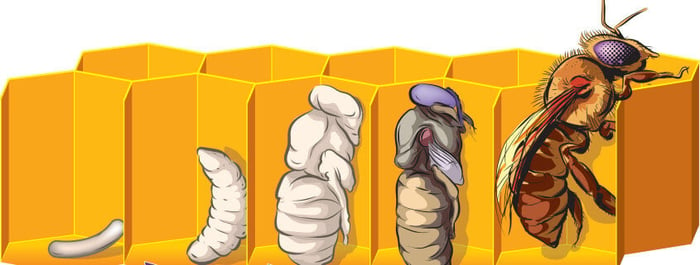
A queen develops from a fertilized egg fed royal jelly continuously, creating a reproductive adult in about 16 days after laying.
- Queen and worker bees both begin as fertilized eggs.
- Eggs hatch into larvae after about three days.
- Queen-destined larvae are fed royal jelly throughout larval development.
- Future queens develop inside larger, vertical queen cells.
- A queen usually emerges about 16 days after the egg is laid.
Queen development is one of the clearest examples of how nutrition shapes honey bee biology. A young female larva does not start life as visibly royal. Worker bees create that outcome by selecting suitable larvae and feeding them a continuous queen diet. This diet supports the development of a larger body, functional ovaries, and the reproductive capacity needed to supply the colony with eggs.
Beginner beekeeper note
Queen cells are not automatically a bad sign. Their meaning depends on timing, location, colony condition, and whether the hive is preparing to swarm, replacing a failing queen, or responding to queen loss.
How does a queen bee mate?
A queen mates in flight with multiple drones, then stores sperm in her spermatheca to fertilize eggs throughout her life.
- New queens take mating flights after emergence and maturity.
- Mating occurs outside the hive, usually in drone congregation areas.
- Queens commonly mate with multiple drones.
- Stored sperm allows the queen to lay fertilized eggs long after mating flights end.
- Strong mating success supports colony productivity and genetic diversity.
After emergence, a virgin queen must leave the hive to mate. She flies to areas where drones gather and mates in the air with multiple males. The sperm she receives is stored in a specialized organ called the spermatheca. This stored sperm allows her to fertilize eggs over time without repeated mating. Fertilized eggs become female workers or queens, while unfertilized eggs become drones. Weather, drone availability, queen health, and mating timing can all affect queen performance later in the season.
What does a queen bee do inside the hive?
Inside the hive, a queen lays eggs and releases pheromones that help workers maintain brood care, order, and colony stability.
- The queen’s main daily task is laying eggs in prepared brood cells.
- Workers inspect, clean, and prepare cells before eggs are laid.
- Queen mandibular pheromone helps workers recognize queen presence.
- Queen signals help suppress worker reproduction in a queenright colony.
- Egg laying rises and falls with season, nutrition, colony strength, and available comb.
Inside the hive, the queen spends much of her time moving across brood comb. Worker bees surround her in a retinue, feeding and grooming her while also distributing her pheromones through the colony. During strong spring buildup, a healthy queen may lay large numbers of eggs when nectar, pollen, nurse bees, and brood space are available.
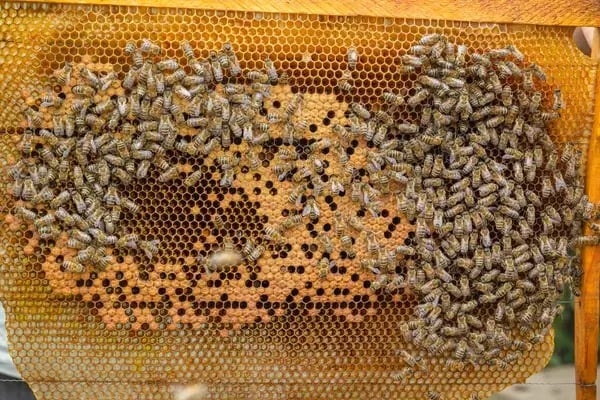
Her laying pattern gives beekeepers important clues. A compact, even brood pattern often suggests good queen performance. Scattered brood, drone-heavy brood, or a sudden lack of eggs may signal queen trouble, disease, poor mating, or environmental stress.
How are queens, workers, and drones different?
Queens reproduce, workers maintain the hive, and drones mate with virgin queens, creating a caste system that supports colony survival.
| Feature | Queen Bee | Worker Bee | Drone Bee |
|---|---|---|---|
| Sex | Female | Female | Male |
| Primary role | Egg laying and pheromone signaling | Brood care, foraging, cleaning, guarding, wax work, and hive maintenance | Mating with virgin queens |
| Egg origin | Fertilized egg | Fertilized egg | Unfertilized egg |
| Typical number in colony | Usually one active queen | Thousands during active season | Seasonal, often hundreds when conditions support drone production |
| Stinger | Smooth stinger | Barbed stinger | No stinger |
| Inspection clue | Eggs, brood pattern, and queen sighting | Population, temperament, and task behavior | Drone brood, drone presence, and mating season timing |
A honey bee colony works because each caste fills a specialized role. Workers do the visible labor of the hive: feeding larvae, drawing comb, cleaning cells, processing nectar, guarding the entrance, and foraging. Drones do not collect nectar or pollen. Their biological role is mating with queens from other colonies. The queen’s role is narrower but essential. Without a productive queen, the workforce cannot be replaced at the rate needed for long-term colony survival.
How do honey bees replace a queen?
Honey bees replace queens through supersedure, emergency queen rearing, or swarm preparation when colony conditions require a new laying queen.
Colonies have built-in queen replacement systems. If the queen dies unexpectedly, workers may raise an emergency queen from a young worker larva. If the queen is still present but failing, workers may start supersedure cells and gradually replace her. If the colony is crowded and preparing to swarm, queen cells may be part of reproductive swarming behavior.
Beekeepers should avoid treating every queen cell the same way. The best response depends on the season, colony strength, queen status, cell location, and management goals.
How can beekeepers read queen quality during an inspection?
Beekeepers read queen quality by checking eggs, brood pattern, population, temperament, and replacement-cell signs in the hive.
- Fresh eggs show that a queen was recently laying, even if she is not seen.
- A solid worker brood pattern often suggests good laying performance.
- Patchy brood may indicate queen issues, disease, poor nutrition, or brood disturbance.
- Excess drone brood in worker cells can signal queen failure or laying workers.
- Queen cells should be interpreted with colony context, not panic.
Simple queen check checklist
- Look for eggs or very young larvae.
- Check whether brood is mostly worker brood rather than scattered drone brood.
- Review the brood pattern for consistency.
- Note queen cells and where they are located.
- Compare colony temperament with previous inspections.
- Confirm the colony has enough food, bees, and brood space.
You do not always need to see the queen to know a colony is queenright. Eggs, young larvae, and normal worker brood usually tell the story. During inspections, look for one egg per cell centered at the bottom of the cell, a balanced brood nest, and enough bees to cover brood. A queen problem is more likely when the colony has no eggs, no young larvae, roaring behavior, scattered brood, unusual aggression, or multiple eggs stuck to cell walls.
Why are queen bees important for beekeeping, agriculture, and ecosystems?
Queen health shapes colony population, pollination strength, honey potential, winter survival, and recovery from seasonal stress.
- Queen health affects colony population size.
- Colony population affects foraging strength and pollination capacity.
- Many food crops benefit from animal pollination.
- Strong colonies are better positioned to manage seasonal nectar flows.
- Queen problems can reduce colony growth before beekeepers notice honey losses.
The queen’s impact reaches beyond the brood nest. A productive queen helps build the worker population needed for nectar collection, pollen gathering, brood care, and pollination. Honey bees are not the only pollinators, but managed honey bee colonies play a major role in agricultural pollination. For beekeepers, queen quality often influences whether a colony builds quickly, overwinters well, produces surplus honey, and recovers from stress.
What threats affect queen bees and colony health?
Queen bees face risks from Varroa mites, viruses, poor nutrition, pesticide exposure, weather stress, and poor mating conditions in season.
- Varroa mites are one of the most serious threats to managed honey bee colonies.
- Mites can weaken colonies directly and contribute to virus transmission.
- Poor forage diversity can reduce nutrition for queens, workers, and developing brood.
- Pesticide exposure can create colony-level stress depending on dose, compound, timing, and route.
- Weather and drone availability can affect queen mating success.
Queen health is tied to whole-colony health. A queen can be genetically strong and still struggle if the colony is under heavy mite pressure, short on pollen, exposed to harmful pesticides, or unable to maintain brood nest conditions. Beekeepers should monitor mite levels, maintain adequate nutrition, avoid unnecessary queen disturbance, and follow integrated pest management practices suited to their region.
How can beekeepers support queen health?
Beekeepers support queen health by managing mites, protecting nutrition, reducing stress, monitoring brood, and replacing failing queens.
- Monitor Varroa mite levels instead of guessing.
- Keep colonies supplied with adequate food during dearths and buildup periods.
- Provide enough brood space during spring expansion.
- Handle brood frames gently during inspections.
- Replace failing queens when signs point to poor performance.
- Choose queen stock suited to local climate, temperament goals, and management style.
Good queen care is really good colony care. A queen needs nurse bees, pollen, nectar or feed, clean comb, controlled parasite pressure, and enough space to lay. Beekeepers can support her by inspecting with purpose, avoiding excessive disruption, managing mites on time, and watching brood patterns across multiple visits. Requeening may be necessary when the queen is failing, but it should be done with a clear reason.
Frequently asked questions about queen honey bees
What is the main job of a queen bee?
The queen bee’s main job is to lay eggs. She also produces pheromones that help maintain colony organization and reproductive stability.
How long does it take a queen bee to develop?
A queen honey bee typically develops from egg to adult in about 16 days. Timing can vary slightly with colony conditions.
How is a queen bee different from a worker bee?
A queen and worker are both female, but the queen develops functional reproductive organs because of her larval diet. Workers perform most colony labor.
Does a queen bee control the hive?
A queen bee does not control the hive like a human ruler. Her eggs and pheromones influence colony behavior, while workers make many colony-level decisions.
How many queens are usually in one hive?
Most honey bee colonies have one active laying queen. Temporary overlap can happen during queen replacement.
What happens if a queen bee dies?
If suitable young larvae are available, workers may raise an emergency queen. If they cannot raise a queen, the colony may decline without beekeeper help.
Why do bees make queen cells?
Bees make queen cells for swarming, supersedure, or emergency queen replacement. The reason depends on colony condition and timing.
How can a beekeeper tell if a hive has a queen?
Fresh eggs, young larvae, and a normal worker brood pattern usually indicate a queen was recently present and laying.
How long does a queen bee live?
Queen bees can live for multiple years, but many beekeepers replace queens sooner when laying performance, temperament, or colony productivity declines.
Can worker bees become queens?
Adult worker bees cannot become queens. Only properly aged female larvae can be raised as queens through specialized feeding and queen cell development.
What sources support this queen honey bee guide?
- An Introduction to Queen Honey Bee Development — Penn State Extension
- Varroa Management Resources — Honey Bee Health Coalition
- Methods to Control Varroa Mites — Penn State Extension
- The Importance of Pollinators — USDA
- Pollinators Benefit Agriculture — U.S. Fish & Wildlife Service
- Honey Bee Health and Colony Loss Research — USDA Agricultural Research Service
FAQs
What is the main job of a queen bee?
The queen bee’s main job is to lay eggs. She also produces pheromones that help maintain colony organization and reproductive stability.
How long does it take a queen bee to develop?
A queen honey bee typically develops from egg to adult in about 16 days. Timing can vary slightly with colony conditions.
How is a queen bee different from a worker bee?
A queen and worker are both female, but the queen develops functional reproductive organs because of her larval diet. Workers perform most colony labor.
Does a queen bee control the hive?
A queen bee does not control the hive like a human ruler. Her eggs and pheromones influence colony behavior, while workers make many colony-level decisions.
How many queens are usually in one hive?
Most honey bee colonies have one active laying queen. Temporary overlap can happen during queen replacement.
What happens if a queen bee dies?
If suitable young larvae are available, workers may raise an emergency queen. If they cannot raise a queen, the colony may decline without beekeeper help.
Why do bees make queen cells?
Bees make queen cells for swarming, supersedure, or emergency queen replacement. The reason depends on colony condition and timing.
How can a beekeeper tell if a hive has a queen?
Fresh eggs, young larvae, and a normal worker brood pattern usually indicate a queen was recently present and laying.
How long does a queen bee live?
Queen bees can live for multiple years, but many beekeepers replace queens sooner when laying performance, temperament, or colony productivity declines.
Can worker bees become queens?
Adult worker bees cannot become queens. Only properly aged female larvae can be raised as queens through specialized feeding and queen cell development.