Welcome to Lappe's Bee Supply's blogs section. We are a trusted beekeeping company in the USA. We give relevant insights, seasonal guidance, and professional advice for beekeepers of all experience levels. From hive management and bee wellness to honey production and equipment guides, we have it all that you will require to thrive. Get updated, motivated, and connected with the beekeeping community through regular news from Lappe's Bee Supply.
The Part of the Beehive: Exploration of the Fascinating World of Bees
The Buzz About This Post
- Key Takeaways
- Table of Contents
- What are the main parts of a Langstroth beehive?
- Which bees live in a honey bee colony?
- What is the brood chamber in a beehive?
- What are honey supers and what do they do?
- What is the difference between frames, foundation, and comb?
- How do the hive entrance, covers, and ventilation affect the colony?
- How does a honey bee develop from egg to adult?
- What should a beekeeper look for when inspecting hive parts?
- Why does understanding hive structure matter to beekeepers?
- What are the most frequently asked questions about beehive parts?
- What is the difference between a beehive and a bee colony?
- What is the brood chamber?
- Is a brood chamber always a deep box?
- What is a honey super?
- What is the difference between a frame and foundation?
- What is honeycomb?
- Does every hive need a queen excluder?
- How long does a worker honey bee take to develop?
- What are the three types of adult bees in a colony?
- When should another hive box be added?
- Sources
- FAQs
Parts of a hive: How a Langstroth Hive and Honey Bee Colony Work

A beehive is the physical structure that houses honey bees. A honey bee colony is the living social unit inside it: the queen, workers, drones, developing brood, and stored food. Understanding the Parts of the Hives and the difference between the hive and colony is one of the first steps toward understanding how a managed honey bee colony works.
For managed European honey bees (Apis mellifera) in the United States, the Langstroth hive is one of the most familiar hive systems. Its vertically stacked boxes and removable frames allow beekeepers to inspect brood, evaluate food stores, manage colony space, and remove surplus honey without destroying the comb.
Editorial Standard: Biological claims are separated from management practices that may vary by beekeeper, climate, colony condition, and season.
Key Takeaways
- A hive is the physical equipment; a colony is the population of honey bees living inside it.
- A Langstroth hive uses removable frames held inside vertically stacked hive boxes.
- The main Parts of the Hives include hive bodies, frames, foundation, supers, entrances, covers, and bottom boards.
- Brood is usually concentrated in the lower portion of a managed hive.
- Honey supers provide additional comb space commonly used for surplus honey storage.
- Frames support removable comb, while foundation is a guide used inside many frames.
- Queen, worker, and drone honey bees perform different biological roles in the colony.
- Hive configuration changes according to population, food stores, weather, nectar availability, and management goals.
What are the main parts of a Langstroth beehive?
- A Langstroth hive is a modular, vertically stacked hive system.
- Frames allow comb to be removed for inspection without destroying it.
- Hive bodies can contain brood, pollen, nectar, honey, or combinations of these resources.
- Honey supers provide additional space, commonly for surplus honey.
- Bottom boards, entrances, inner covers, and outer covers complete the basic hive structure.
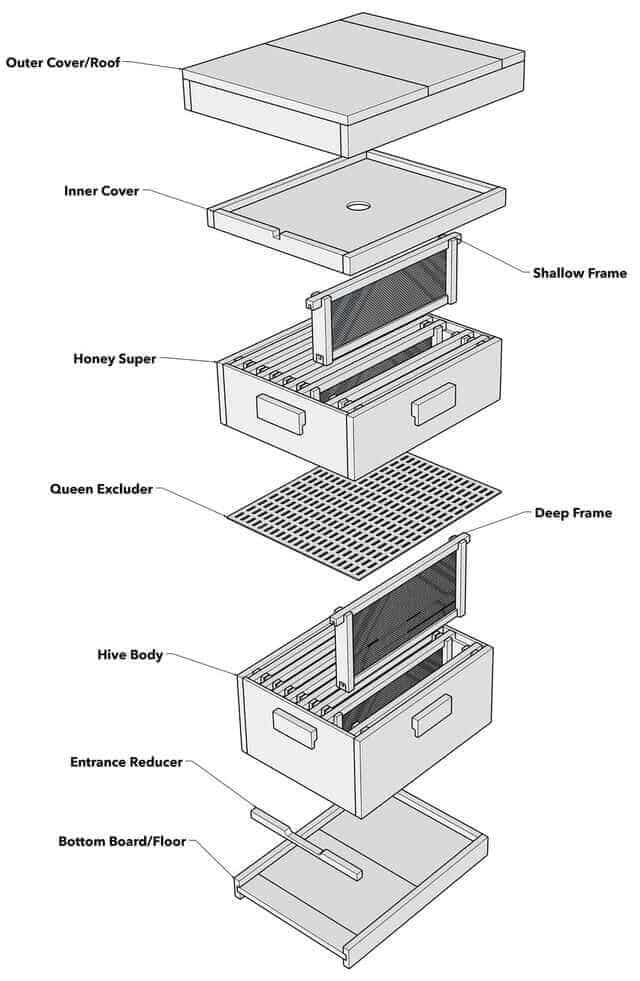
When beekeepers talk about the Parts of the Hives, they are usually referring to the physical components that make a Langstroth hive functional. A typical setup begins with a hive stand or other stable support, followed by a bottom board, entrance, one or more hive bodies, removable frames, an inner cover, and an outer cover. Additional boxes can be added as colony needs change.
A queen excluder may also be placed between the brood area and honey supers. It is an optional management tool rather than a required component of every Langstroth hive. The modular design is important because a beekeeper can increase or reduce hive space without replacing the entire hive.
| Hive Component | Primary Function | What a Beekeeper Evaluates |
|---|---|---|
| Hive stand | Raises and supports the hive | Stability, clearance, and accessibility |
| Bottom board | Forms the hive floor | Condition, debris, and entrance access |
| Hive body | Holds frames containing brood or food | Population, brood, food stores, and space |
| Frames | Support removable comb | Brood pattern, food stores, and comb condition |
| Foundation | Provides a guide for comb construction when used | Comb development and condition |
| Honey super | Adds storage space above the brood area | Nectar, honey, capping, and remaining space |
| Inner cover | Separates the hive boxes from the outer cover | Fit, propolis buildup, and moisture conditions |
| Outer cover | Protects the hive from weather | Weather resistance and physical condition |
The University of Missouri Extension describes the Langstroth hive as a system built around removable frames and identifies hive bodies, supers, covers, bottom boards, stands, and frames among its primary components. University of Missouri Extension: Honey Bees as Pollinators, Their Habitats and Products .
Which bees live in a honey bee colony?
- A normal queenright colony generally contains one reproductive queen.
- Worker bees are female and perform most of the colony's day-to-day labor.
- Drones are male honey bees whose primary biological role is reproduction.
- Worker responsibilities change according to age, colony conditions, and immediate needs.
- Drone populations commonly increase during reproductive periods and decline later in the season.
The queen's primary role is reproduction. She lays eggs and produces pheromones that contribute to social organization inside the colony. The queen should not be thought of as a human-style ruler directing individual workers. Honey bee colonies function through complex interactions among thousands of bees responding to pheromones, resources, environmental conditions, and colony needs.
Workers clean cells, feed developing brood, tend the queen, build comb, process food, regulate colony temperature, guard the entrance, and forage for nectar, pollen, water, and other needed resources. Drones do not perform the normal worker tasks of foraging and brood care. Their primary role is mating with receptive queens from other colonies.
What is the brood chamber in a beehive?
- Brood includes developing eggs, larvae, and pupae.
- The brood nest normally occupies comb near the colony's central living area.
- Pollen and honey are often stored around brood as nearby food reserves.
- A brood chamber can consist of one or more hive boxes.
- A deep box is a box size and is not automatically synonymous with the entire brood chamber.
In many Langstroth systems, beekeepers use one or more deep hive bodies for brood. However, medium boxes can also be used. For that reason, brood chamber is best understood as a functional description of the area occupied primarily by developing bees, not as the formal name of one specific box size.
Among the most important Parts of the Hives, the brood chamber is where much of the colony's reproductive activity takes place. Inside the brood nest, eggs and developing larvae are surrounded by resources used by the colony. Pollen supplies proteins and other nutrients, while honey and nectar provide carbohydrates. The exact distribution changes as the colony grows and moves through the season.
What are honey supers and what do they do?
- A super is a hive box commonly positioned above the brood area.
- Multiple supers can be added when a strong colony needs additional storage space.
- Bees may place incoming nectar in super comb before it is ripened into honey.
- Harvestable surplus should be distinguished from food the colony requires for itself.
- Supers can be made in different compatible box depths.
Honey supers give a productive colony additional comb space for nectar and honey. During a strong nectar flow, bees may fill available comb rapidly, so additional supers can be added when colony conditions justify more storage space.
Of all the Parts of the Hives, honey supers are especially important during periods of heavy nectar collection because they give the colony additional room for storage above the brood area.
Bees reduce the moisture content of nectar as it is processed into honey and commonly cap mature honey with wax. Capping is a useful field indicator, but beekeepers seeking a precise moisture measurement should use appropriate honey-testing equipment rather than assuming that every capped cell has an identical moisture level.
Honey should also be managed with the colony's own nutritional needs in mind. Not everything stored inside a hive is automatically surplus available for harvest.
What is the difference between frames, foundation, and comb?
- A frame is a removable structure designed to support comb.
- Foundation is a wax or plastic guide installed inside many frames.
- Foundationless frames can also be used with appropriate management.
- Comb is the beeswax structure produced by the bees themselves.
- Comb cells can contain brood, pollen, nectar, or honey.
These three terms describe different parts of the hive and should not be used interchangeably. The frame is beekeeping equipment. The foundation is a guide that may be installed inside a frame. The comb is the wax structure built and used by the bees.
Removable frames are one of the defining features of Langstroth equipment because individual combs can be removed, inspected, repositioned, or otherwise managed without requiring the beekeeper to destroy the entire nest. Understanding how frames, foundation, and comb interact makes the Parts of the Hives easier for a new beekeeper to identify during inspections.
How do the hive entrance, covers, and ventilation affect the colony?
- Foragers, drones, and other adult bees normally travel through the hive entrance.
- Guard workers help defend entrance areas from intruders.
- Entrance size can be changed with an entrance reducer.
- The outer cover helps protect hive equipment from precipitation and weather exposure.
- Ventilation and moisture-management needs depend on hive design, climate, season, and colony condition.
The entrance is more than a doorway. It is the primary traffic area for returning foragers and departing bees, and it is an important location for colony defense. Entrance reducers can change the amount of open space available and are commonly used when a beekeeper wants to reduce a colony's entrance.
Covers protect the top of the hive from weather. These protective components are among the Parts of the Hives that are easy to overlook but play an important role in keeping the physical hive protected from outside conditions.
Moisture management requires more context. Additional ventilation is one possible management strategy, but airflow should not automatically be increased in every hive, season, or climate. The goal is to manage conditions appropriately without treating one configuration as universally correct.
How does a honey bee develop from egg to adult?
- Honey bees pass through egg, larval, pupal, and adult stages.
- Honey bee eggs normally hatch approximately three days after being laid.
- Fertilized eggs can develop into female workers or queens.
- Unfertilized eggs normally develop into male drones.
- Queens, workers, and drones have different development schedules.
Honey bee development begins when an egg is laid in a cell. After approximately three days, the egg hatches and the bee enters the larval stage. Worker bees feed the developing larva, and the cell is later capped as development proceeds through the pupal stage.
Development time differs by caste. University of Georgia Cooperative Extension reports adult emergence at approximately day 16 for queens, day 21 for workers, and day 24 for drones. These timings are useful biological reference points when a beekeeper evaluates brood of different ages.
| Development Point | Queen | Worker | Drone |
|---|---|---|---|
| Egg hatches | About Day 3 | About Day 3 | About Day 3 |
| Adult emerges | About Day 16 | About Day 21 | About Day 24 |
Female caste is not determined simply by whether an egg is fertilized. Both queens and workers develop from fertilized eggs. Differences in how female larvae are reared, especially their nutrition, influence whether they develop into queens or workers.
What should a beekeeper look for when inspecting hive parts?
- Eggs or very young brood can indicate that a queen was recently laying.
- Brood appearance provides information about colony development and potential problems.
- Nectar, pollen, and honey stores help show the food resources available to the colony.
- Crowding and rapid population growth can occur before swarming behavior.
- Additional hive space should be based on colony conditions rather than a fixed calendar date.
A good inspection evaluates the bees and the equipment together. Frames can reveal brood stages, food distribution, available comb, population strength, and other changes that may affect management decisions. Learning to recognize the Parts of the Hives helps a beekeeper understand what each component is showing during an inspection.
Colony populations can increase rapidly during spring as brood rearing and floral resources expand. Penn State Extension describes the seasonal relationship among increasing brood production, worker population, food availability, and swarming. This is one reason a beekeeper should look at current colony conditions instead of relying only on the calendar.
- Observe the entrance. Look at flight activity and general conditions before opening the hive.
- Check food stores and population. Evaluate the amount and placement of honey, nectar, pollen, and adult bees.
- Examine the brood area. Look for eggs, larvae, capped brood, and the overall brood pattern.
- Evaluate queen status. Look for the queen when necessary, but also learn to recognize evidence of recent laying.
- Evaluate available space. Check drawn comb, occupied frames, and room for continued brood rearing or incoming nectar.
- Inspect equipment condition. Watch for damaged comb, deteriorating woodenware, or components needing maintenance.
- Record what you observed. Written records make it easier to compare colony changes during later inspections.
Why does understanding hive structure matter to beekeepers?
- Hive parts provide physical space for different colony activities.
- The colony's use of those parts changes throughout the season.
- Equipment should respond to colony needs rather than dictate them.
- Knowing where brood and food are located improves inspection decisions.
- Movable comb lets beekeepers evaluate colony condition without destroying the nest.
A Langstroth hive is useful because its components can be inspected, added, removed, and managed while preserving removable comb. That flexibility is central to modern beekeeping, but it does not mean every colony should have the same configuration at the same time.
Colony population, nectar flow, brood production, food stores, weather, pests, disease pressure, and management goals can all influence how hive equipment is used. A strong colony during a major nectar flow may need additional storage space, while a smaller colony may benefit from having less unused space to manage.
Understanding the Parts of the Hives makes these management decisions easier because the beekeeper can identify the purpose of each component and evaluate how the bees are using it.
The most useful way to think about a Langstroth hive is therefore as a modular management system built around the biology of the colony. The equipment provides access and organization, but the living colony determines what is happening inside it.
What are the most frequently asked questions about beehive parts?
What is the difference between a beehive and a bee colony?
A beehive is the physical structure or equipment where bees live. A colony is the queen, workers, drones, brood, and stored resources living inside it.
What is the brood chamber?
The brood chamber is the portion of the hive occupied primarily by developing bees and associated food stores. It may consist of one or more hive boxes.
Is a brood chamber always a deep box?
No. Deep boxes are commonly used for brood, but medium boxes and other compatible configurations can also form the brood area.
What is a honey super?
A honey super is a hive box generally added above the brood area to provide comb space for nectar and surplus honey storage.
What is the difference between a frame and foundation?
A frame is the removable structure that supports the comb. Foundation is an optional wax or plastic guide fitted inside many frames.
What is honeycomb?
Honeycomb is the beeswax structure built by worker bees. Its cells can hold developing brood, pollen, nectar, or honey.
Does every hive need a queen excluder?
No. A queen excluder is an optional management tool used by some beekeepers to limit queen access to selected boxes.
How long does a worker honey bee take to develop?
A worker honey bee normally takes about 21 days to develop from a newly laid egg to an emerging adult.
What are the three types of adult bees in a colony?
The three adult castes are the queen, female workers, and male drones. Each caste has distinct biological and reproductive functions.
When should another hive box be added?
Additional space should be added according to colony population, available comb, nectar intake, brood expansion, and management goals rather than a fixed calendar date.
Sources
The following university and Cooperative Extension references support the biology, terminology, development timing, hive-component descriptions, and seasonal colony management discussed in this guide.
- Honey Bees and Beekeeping — University of Georgia Cooperative Extension.
- An Introduction to Queen Honey Bee Development — Penn State Extension.
- Honey Bee Genetics Basics — Penn State Extension.
- Honey Bee Management Throughout the Seasons — Penn State Extension.
- Honey Bees as Pollinators, Their Habitats and Products — University of Missouri Extension.
- Beekeeping Tips for Beginners — University of Missouri Extension.
- Backyard Beekeeping — Utah State University Extension.
- Thriving Hives: The Apiary — Beekeeping Essentials — Utah State University Extension.
FAQs
What is the most important part of a beehive?
The brood chamber is often the most critical part because it supports egg laying, brood development, and the colony’s long-term continuity.
How many kinds of bees live in one hive?
A typical honeybee colony includes three castes: one queen, many worker bees, and seasonal drones.
Do worker bees make honey?
Yes. Worker bees collect nectar, process it, and store it in comb cells where it becomes honey.
What is the difference between a brood box and a honey super?
The brood box is used for raising young, while the honey super is used mainly for storing surplus honey above the brood nest.
Why do bees need ventilation in the hive?
Ventilation helps control moisture and heat, both of which affect brood health, honey storage, and colony survival.
What is comb used for inside a hive?
Comb is used to raise brood and store pollen, nectar, and honey in tightly organized wax cells.
Why are drones removed from the hive in some seasons?
Drones may be expelled when resources become scarce because they consume food but do not perform routine colony labor.
Can a hive survive without a queen?
A colony may survive briefly without a queen, but it usually declines unless it raises or receives a replacement queen.
Why is the entrance important to colony health?
The entrance manages movement, defense, and part of the hive’s airflow, making it important for both security and internal regulation.
Why are bees important beyond honey production?
Bees are important because they support pollination, which affects plant reproduction, biodiversity, gardens, and crop systems.