Welcome to Lappe's Bee Supply's blogs section. We are a trusted beekeeping company in the USA. We give relevant insights, seasonal guidance, and professional advice for beekeepers of all experience levels. From hive management and bee wellness to honey production and equipment guides, we have it all that you will require to thrive. Get updated, motivated, and connected with the beekeeping community through regular news from Lappe's Bee Supply.
The Critical Role of Water for Honey Bees
The Buzz About This Post
- Key Takeaways
- Table of Contents
- What is a water source for honey bees?
- Why is water for Honey Bees essential?
- How does water for honey bees to cool the hive?
- How does water support brood care and food preparation?
- How do honey bees find and collect water?
- What kinds of water sources do honey bees prefer?
- How can you make a safe water for honey bees?
- Which water sources are safest for honey bees?
- How should a bee water station be maintained?
- How can water for honey bees become contaminated?
- How do weather and seasonal conditions affect water for honey bees?
- What mistakes should be avoided when providing water?
- What should a beekeeper remember about honey bee water needs?
- Frequently Asked Questions
- Do honey bees drink water?
- Why do honey bees need water in the hive?
- How do honey bees cool a hive with water?
- When do honey bees collect the most water?
- Why are honey bees attracted to swimming pools?
- What is the best water source for honey bees?
- Can honey bees drown in a water station?
- Should sugar be added to a bee water station?
- How often should a bee water station be cleaned?
- Do honey bees need water during winter?
- Sources and Further Reading
- About Lappe's Bee Supply
- FAQs
The Critical Role of Water for Honey BeesAuthor: Lappe's Bee Supply Team Published: May 20, 2025 Last Updated: July 13, 2026 Reviewed by: Lappe's Bee Supply Beekeeping Team Editorial Note: This guide is written for beginning and experienced beekeepers, gardeners, and property owners. Biological claims are based on university extension resources, government publications, and peer-reviewed research when available. Practical recommendations are presented as general guidance and should be adjusted for local weather, water quality, and apiary conditions. |
Water for Honey Bees is for much more than drinking. Water for Honey Bees Colony is to help regulate hive temperature, support brood care, dilute concentrated food, and maintain the internal conditions needed for normal colony activity.
Water becomes especially important during hot weather, prolonged dry conditions, and periods of rapid brood expansion. A dependable water source near the apiary can reduce long flights, discourage bees from visiting neighboring pools or animal dishes, and give workers a safer place to land and drink.
Key Takeaways
|
What is a water source for honey bees?
A honey bee water source is any accessible location where worker bees can safely collect water for hydration, cooling, brood care, and food preparation. |
- Water is collected separately from nectar and pollen.
- Specialized foragers transport water back to the colony.
- A reliable source can serve one or several nearby colonies.
- Safe access is as important as water quality.
Honey bees may collect water from ponds, puddles, creeks, wet soil, livestock tanks, bird baths, irrigation leaks, fountains, swimming pools, and purpose-built bee water stations. The source does not have to be large. It must simply be accessible, dependable, and suitable for landing.
Water is not stored in capped comb in the same way that colonies store honey. Instead, workers collect it in response to current colony demand. That demand can change rapidly as outdoor temperatures, brood production, food conditions, and hive ventilation change.
Why is water for Honey Bees essential?
Water for Honey bees to remain hydrated, prepare food, care for developing brood, and regulate temperature and humidity within the colony. |
- Adult bees require water for normal body functions.
- Nurse bees use water while preparing food for brood.
- Workers use water to dilute concentrated or crystallized honey.
- Colonies use evaporation to remove excess heat.
- Water for Honey bees changes with colony size and brood activity.
A honey bee colony functions as a coordinated social unit. Water collected by one group of workers can be transferred to other bees and used wherever it is needed. During mild conditions, demand may be modest. During a period of high heat or intensive brood rearing, many more workers may become involved in water collection and distribution.
Water should therefore be treated as a basic apiary resource rather than an optional garden feature. A colony may survive without a beekeeper-provided waterer when natural water is available, but a dependable nearby source can reduce travel and help prevent conflicts with neighbors.
How does water for honey bees to cool the hive?
Honey bees spread water droplets inside the hive and fan their wings, allowing evaporation to remove heat and protect temperature-sensitive brood. |
- Water foragers carry liquid back to the colony.
- House bees distribute small droplets within the hive.
- Fanning workers increase air movement across wet surfaces.
- Evaporation absorbs heat and cools the surrounding area.
- Brood requires a comparatively stable thermal environment.
Honey bee larvae and pupae develop within a relatively narrow brood-nest temperature range. Research commonly places actively regulated brood temperatures near 33–36°C, or approximately 91–97°F. The exact temperature varies by colony conditions, brood location, measurement method, and environmental factors.
When a hive becomes too warm, worker bees increase ventilation and water use. Some workers position themselves near the entrance or within the hive and fan their wings. Others place droplets of water on comb or other surfaces. As moving air passes over the droplets, the water evaporates and removes heat.
This behavior is often described as evaporative cooling. It is one reason a colony's need for water can rise sharply during hot summer weather, especially when the hive contains a large area of developing brood.
How does water support brood care and food preparation?
Water helps nurse bees prepare moisture-rich brood food and dilute stored honey when concentrated food must be consumed or fed within the colony. |
- Young larvae receive food prepared by nurse bees.
- Brood food contains substantial moisture.
- Stored honey can become concentrated or crystallized.
- Water makes concentrated food easier for bees to consume.
- Rapid spring brood expansion may increase colony demand.
Honey bee larvae do not leave their cells to find food or water. Nurse bees supply everything the developing brood requires. Water supports the preparation and distribution of larval food and helps workers manage concentrated carbohydrate stores.
This does not mean bees simply mix equal amounts of honey and water and deliver that mixture to every larva. Brood feeding is a more complex biological process involving nurse-bee glandular secretions and food components that change with larval age. Water is nevertheless an important part of the colony's ability to prepare and distribute suitable food.
During early spring, a colony may be rearing brood before abundant nectar is available. Workers may need water to use stored food effectively, even when outdoor temperatures are still cool.
How do honey bees find and collect water?
Water-foraging honey bees use sensory cues, memory, and colony communication to locate dependable sources and recruit additional collectors when demand rises. |
- Foragers learn the location of dependable resources.
- Odor, visual contrast, moisture, and mineral content may influence attraction.
- Returning foragers can recruit nestmates to profitable locations.
- Water collection responds to changing colony demand.
- Bees may repeatedly visit the same source each day.
A worker usually collects water into the honey stomach, also called the crop, and transports it to the hive. After returning, the forager transfers the water to receiver bees or distributes it where the colony needs it.
Successful foragers can communicate resource location through dance behavior and other colony interactions. Recruitment becomes particularly valuable when cooling demand rises quickly. A source that begins with only a few visitors may attract many bees later in the day as temperatures increase.
Because bees learn and remember resource locations, moving a water station after they have established a routine may confuse them. Consistent placement generally makes a water source easier for bees to use.
What kinds of water sources do honey bees prefer?
Honey bees favor accessible, dependable water with safe landing surfaces, and they may choose mildly mineralized water over visually cleaner alternatives. |
- Shallow edges make drinking safer.
- Rough surfaces provide better footing than smooth walls.
- Warm, sunny locations may become active earlier in the day.
- Slightly mineralized water can attract foragers.
- Consistency often matters more than container size.
Bees do not always choose the water source that looks cleanest to a person. They may be attracted to water containing natural minerals, organic odors, damp soil, or traces of plant material. This helps explain why bees sometimes ignore a freshly filled bowl and gather around a muddy edge or livestock tank.
However, attraction does not prove that every dirty-looking source is safe. Water contaminated with pesticides, herbicides, petroleum products, cleaning chemicals, excessive salt, or harmful microorganisms should not be considered suitable.
Provide clean water without trying to make it sterile. A practical bee waterer can contain stones, twigs, or untreated wood while still being inspected and cleaned regularly.
How can you make a safe water for honey bees?
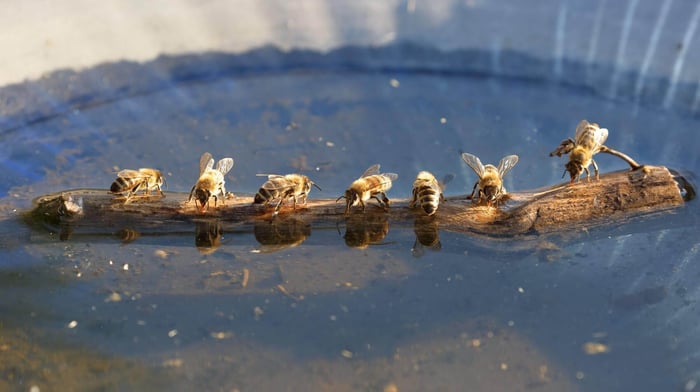
Use a shallow, stable container filled with clean water and enough stones, corks, or wood to give bees secure places to land and drink. |
Step 1: Choose a shallow container |
Select a bird bath, plant saucer, shallow pan, livestock float-valve tray, or another stable container. Wide containers with gradually sloped edges are generally safer than deep buckets with smooth, vertical walls. |
Step 2: Add stable landing materials |
Place clean pebbles, stones, floating corks, twigs, or pieces of untreated wood across the water. Landing materials should remain partly above the surface so bees can stand securely without entering open water. |
Step 3: Add clean water |
Fill the container without completely submerging every landing surface. Bees should be able to reach moisture from the edges of the stones or floating materials. |
Step 4: Choose the location carefully |
Place the water station where bees can locate it easily but where normal bee traffic will not interfere with doors, sidewalks, children's play areas, pet spaces, or outdoor dining. Morning sunlight can help warm the source and make it active earlier in the day. |
Step 5: Establish the source early |
Set out water before hot weather or before placing colonies in the apiary when possible. Bees that establish a routine at your water station may be less likely to adopt a neighbor's pool, fountain, or animal dish. |
Step 6: Keep the supply dependable |
Do not allow the station to remain dry for long periods. Bees may switch to another source when a waterer becomes unreliable, and they may continue visiting the replacement even after the original container is refilled. |
Bee Water Station Quick Reference
| Water Station Feature | Recommended Practice | Why It Matters |
|---|---|---|
| Container depth | Use shallow water or fill deep spaces with stones. | Reduces open-water drowning hazards. |
| Landing surfaces | Add pebbles, corks, twigs, or untreated wood. | Gives bees stable access to the water. |
| Placement | Choose a visible, consistent location. | Helps bees learn and revisit the source. |
| Water supply | Refill before the station becomes dry. | Discourages bees from changing locations. |
| Cleanliness | Remove algae, debris, and dead insects. | Reduces contamination and mosquito habitat. |
| Chemical exposure | Keep the source away from treated areas. | Limits pesticide and herbicide contamination. |
Which water sources are safest for honey bees?
Purpose-built shallow waterers and gradual pond edges are generally safer than pools, steep bird baths, rain barrels, or open buckets. |
| Water Source | Relative Safety | Primary Advantage | Primary Concern |
|---|---|---|---|
| Shallow bee water station | High when maintained | Easy to place near an apiary | Can dry out or develop algae |
| Bird bath with stones | High when shallow | Convenient and easy to observe | Needs frequent refilling and cleaning |
| Pond with gradual edges | Moderate to high | Large, dependable natural source | Steep or slippery edges may be unsafe |
| Drip irrigation or damp soil | Moderate | Provides shallow moisture | May be exposed to lawn or garden chemicals |
| Rain barrel | Low without safeguards | Stores a dependable volume of water | Open barrels present drowning and mosquito risks |
| Swimming pool | Low | Large and easy for bees to locate | Creates drowning risks and conflicts with people |
| Deep open bucket | Low | Simple to fill | Smooth walls and open water increase drowning risk |
Practical Beekeeper Note: The safest source is not necessarily the most expensive. A shallow container with suitable landing surfaces can work well when it is positioned thoughtfully and maintained consistently. |
How should a bee water station be maintained?
A bee water station should be inspected, refilled, and cleaned often enough to remain dependable and free of excessive algae, debris, and contamination. |
- Check the water level during hot and windy weather.
- Remove dead insects and accumulated debris.
- Scrub away heavy algae or biofilm.
- Prevent standing water from becoming mosquito habitat.
- Return the station to the same location after cleaning.
There is no single cleaning schedule appropriate for every container and climate. A small dish in direct sunlight may require attention every day, while a larger shaded source may remain usable longer. Inspect the source frequently and respond to actual conditions.
Empty and scrub the container when it develops heavy algae, unpleasant odors, visible contamination, or mosquito larvae. Rinse it thoroughly before refilling. Avoid leaving residues from household cleaners.
Automatic livestock valves or slow-drip systems can reduce the risk of an empty waterer, but they still require inspection. Overflow can create mud, attract pests, or wash agricultural chemicals into the drinking area.
How can water for honey bees become contaminated?
Water for Honey bees can become contaminated through pesticide drift, treated runoff, dirty containers, animal waste, petroleum products, and concentrated cleaning chemicals. |
- Do not place waterers where pesticide spray can drift onto them.
- Avoid runoff from treated lawns, fields, and ornamental plants.
- Do not use containers that previously held hazardous chemicals.
- Prevent animals from heavily fouling small water stations.
- Follow every pesticide label and pollinator-protection direction.
Even a well-designed water station can become unsafe when it is placed in the wrong location. Water near recently treated vegetation, mixing areas, fuel storage, or equipment-washing sites may collect residues.
Important: “Organic” does not automatically mean harmless to bees. Any pest-control product should be used according to its label, and direct contamination of water for honey bees should be prevented. |
When garden treatment is unavoidable, cover or temporarily remove nearby water for Honey bees and restore them only after the application area is safe according to the label.
How do weather and seasonal conditions affect water for honey bees?
Water for Honey Bees usually increases with hot weather, drought, active brood rearing, concentrated food stores, and limited natural water availability. |
Spring |
Colonies often expand brood production as temperatures rise and pollen becomes available. Cool spring weather can still create a need for water because nurse bees must prepare food while foragers may have only short windows in which they can fly. |
Summer |
Summer commonly brings the greatest visible water-foraging activity. High temperatures increase the need for evaporative cooling, while drought can eliminate puddles and other temporary sources. Waterers may require frequent refilling during prolonged heat. |
Fall |
Water collection generally declines as brood rearing and outdoor temperatures decrease, although colonies may still collect water on warm days. Fall dearth conditions can also change where bees search for resources. |
Winter |
Honey bees usually remain clustered during cold weather and do not use an outdoor water station in the same way they do during summer. Moisture is still present within the hive through food consumption, respiration, and condensation. Winter moisture management is a separate issue from providing an open outdoor waterer. |
Drought and Unusual Heat |
Extended drought can reduce natural water availability and force bees to travel farther. Providing several small, safe sources may be more practical than relying on one container that can dry out unexpectedly. Monitor water use rather than assuming one setup will meet demand throughout the season. |
What mistakes should be avoided when providing water?
Common mistakes include using deep containers, omitting landing surfaces, allowing the source to dry out, and placing water near chemical contamination. |
1. Using a deep container without landing materials |
Open buckets, barrels, and smooth-sided tubs may trap or drown bees. |
2. Waiting until bees adopt a neighbor's pool |
Once bees learn a dependable location, redirecting them can be difficult. |
3. Moving the waterer repeatedly |
Frequent relocation interferes with the bees' learned flight pattern. |
4. Allowing the station to become dry |
An unreliable source encourages foragers to search elsewhere. |
5. Adding sugar or honey to routine drinking water |
Sweetened water may attract large numbers of bees and other insects, encourage robbing, and create fermentation or disease concerns. |
6. Using containers with chemical residues |
Containers previously used for pesticides, fuel, cleaners, or agricultural chemicals should not be repurposed as bee waterers. |
7. Ignoring mosquitoes |
Standing water should be managed so it does not become a mosquito breeding site. |
8. Placing the waterer in a high-traffic area |
Heavy bee activity near doors, patios, play areas, or animal spaces can create unnecessary conflicts. |
What should a beekeeper remember about honey bee water needs?
Water is a working colony resource, and the best bee water source is safe, close, clean, accessible, dependable, and established before demand peaks. |
Honey bees rely on water for hydration, brood care, food preparation, and hive cooling. The colony's demand is dynamic: it may remain low during mild weather and rise quickly during heat, drought, or intensive brood production.
A beekeeper does not need an elaborate water system to help. A shallow container, secure landing surfaces, thoughtful placement, and consistent maintenance can provide a practical source. The most important step is reliability. Bees learn where resources are located, so a water station that remains available is more useful than one that repeatedly dries out or moves.
By supplying water before bees establish less desirable habits, beekeepers and gardeners can support normal colony behavior while reducing visits to pools, pet dishes, and neighboring properties.
Frequently Asked Questions
Do honey bees drink water? |
Yes. Adult honey bees drink water, and specialized water-foraging workers also carry water back to the colony for cooling, brood care, and food preparation. |
Why do honey bees need water in the hive? |
Honey bees use water to cool the colony, support brood care, dilute concentrated food, maintain hydration, and regulate conditions inside the hive. |
How do honey bees cool a hive with water? |
Workers place water droplets inside the hive and fan their wings to increase airflow. As the water evaporates, it removes heat from the colony. |
When do honey bees collect the most water? |
Water collection usually increases during hot weather, dry conditions, and periods of active brood rearing when the colony needs additional cooling and moisture. |
Why are honey bees attracted to swimming pools? |
Swimming pools can become dependable, easy-to-locate water sources. Bees may continue returning after they learn the location, especially when no better source is available. |
What is the best water source for honey bees? |
A shallow, consistently filled container with clean water and stable landing materials is a practical and comparatively safe water source for honey bees. |
Can honey bees drown in a water station? |
Yes. Bees may drown in deep or steep-sided containers, especially when no stones, corks, twigs, or other stable landing surfaces are available. |
Should sugar be added to a bee water station? |
No. A routine outdoor water station should provide water rather than sugar syrup because syrup can encourage crowding, robbing, fermentation, and unwanted insects. |
How often should a bee water station be cleaned? |
Inspect it frequently and clean it whenever algae, debris, dead insects, odors, or contamination appear. Refill it often enough to keep the source dependable. |
Do honey bees need water during winter? |
Winter water-foraging activity is limited because bees usually remain clustered during cold weather, but the colony still depends on moisture obtained from food and hive conditions. |
Sources and Further Reading
FAQs
Do honey bees really need water?
Yes. Honey bees use water for drinking, hive cooling, humidity control, and preparing brood food.
Do honey bees store water in the hive?
Honey bees do not store water in comb the way they store honey or pollen. They usually collect water when the colony needs it.
What is the safest way to give honey bees water?
Use a shallow dish or pan with stones, gravel, corks, or sticks that rise above the waterline so bees can stand while drinking.
Should I add sugar to water for bees?
No. A bee water source should be plain water, not sugar syrup, because feeding and watering serve different purposes.
Why are bees using my swimming pool?
Bees use pools because they are large, reliable, warm, and easy to locate. A nearby shallow bee waterer may help redirect them.
How often should I refill a bee waterer?
Refill it before it dries out. In hot weather, small waterers may need to be checked daily.
Can bees drown in a bird bath?
Yes. Bees can drown in deep or slippery bird baths unless stones, floats, or shallow landing edges are provided.
Where should I place water for honey bees?
Place water near bee activity but away from hive entrances, heavy foot traffic, pesticide drift, and areas where it will be dumped or disturbed.
Do honey bees prefer dirty water?
Bees may choose mineralized or scented water over fresh-looking water. That does not mean contaminated water is safe.
Is water more important during hot weather?
Yes. Hot weather can increase the colony’s need for water because bees use it for evaporative cooling inside the hive.