Welcome to Lappe's Bee Supply's blogs section. We are a trusted beekeeping company in the USA. We give relevant insights, seasonal guidance, and professional advice for beekeepers of all experience levels. From hive management and bee wellness to honey production and equipment guides, we have it all that you will require to thrive. Get updated, motivated, and connected with the beekeeping community through regular news from Lappe's Bee Supply.
Hive Beetles: Nature’s Uninvited Guests
The Buzz About This Post
- Key Takeaways
- Table of Contents
- What Are Hive Beetles?
- Physical Characteristics
- Life Cycle and Behavior
- The Impact on Honey Bee Colonies
- Management Strategies for Beetles
- The Role of Beetles in the Ecosystem
- Small Beetle Management Checklist
- Frequently Asked Questions
- What attracts small beetles to a beehive?
- Are small beetles dangerous to humans?
- Can a strong colony control small beetles?
- What does small beetle damage look like?
- Where do small beetle larvae pupate?
- Do small beetles kill bee colonies?
- Do beetle traps eliminate small beetles?
- Should I use chemicals first for small beetles?
- Sources
- Editorial Standards
- FAQs
Small Hive Beetles: Identification, Life Cycle, Damage, Prevention, and Control
Small beetles are one of the most frustrating pests a beekeeper can find inside a honey bee colony. A few adult beetles may not destroy a strong colony by themselves, but a growing infestation can damage comb, contaminate honey, stress bees, and create serious problems for weak or undersized colonies.
The most important beetle for beekeepers is the small hive beetle, scientifically known as Aethina tumida. It belongs to the beetle family Nitidulidae, a group often associated with fermenting fruit, plant material, and decaying organic matter. Inside a honey bee colony, however, this scavenging behavior becomes destructive because beetle larvae feed on pollen, honey, brood, and comb.
Key Takeaways
- Small beetles are invasive scavenger beetles that reproduce inside honey bee colonies.
- Adult beetles are usually dark brown to black, oval-shaped, and about 5 to 7 mm long.
- Larvae cause the greatest damage by feeding through comb, honey, pollen, and brood.
- Strong colonies can suppress beetles more effectively than weak or queenless colonies.
- Warm, humid conditions increase beetle activity and reproduction risk.
- Prevention depends on regular inspections, strong colonies, sanitation, and correct hive space.
- Beetle traps work best when used as part of an integrated pest management plan.
Table of Contents
What Are Hive Beetles?
- The beetle’s scientific name is Aethina tumida.
- Beetles belong to the scavenger beetle family Nitidulidae.
- The pest is native to sub-Saharan Africa.
- Beetles were first detected in the United States in the 1990s.
- Adult beetles invade colonies, while larvae cause most of the visible hive damage.
Beetles are small insects that may be found in or around honey bee colonies. The species most concerning to beekeepers is the small hive beetle, Aethina tumida. In its native range, it is usually less destructive because African honey bees have stronger behavioral defenses against the pest. In European-derived honey bee colonies, including most managed colonies in the United States, small hive beetles can become a serious problem when colonies are weak, crowded with unused space, queenless, stressed, or poorly monitored.
Lappe’s field note: Beetles are easiest to spot when the inner cover is lifted quickly during a warm-weather inspection. Adults often run from light and try to hide in corners, frame rests, or cracks.
Physical Characteristics
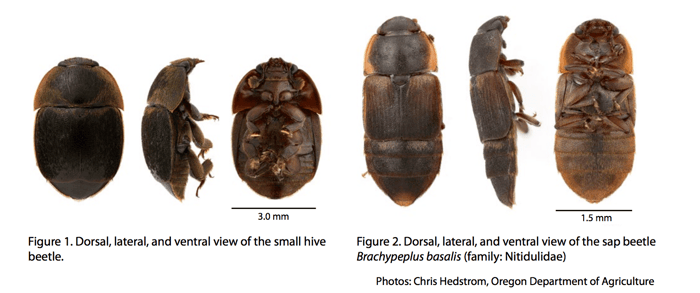
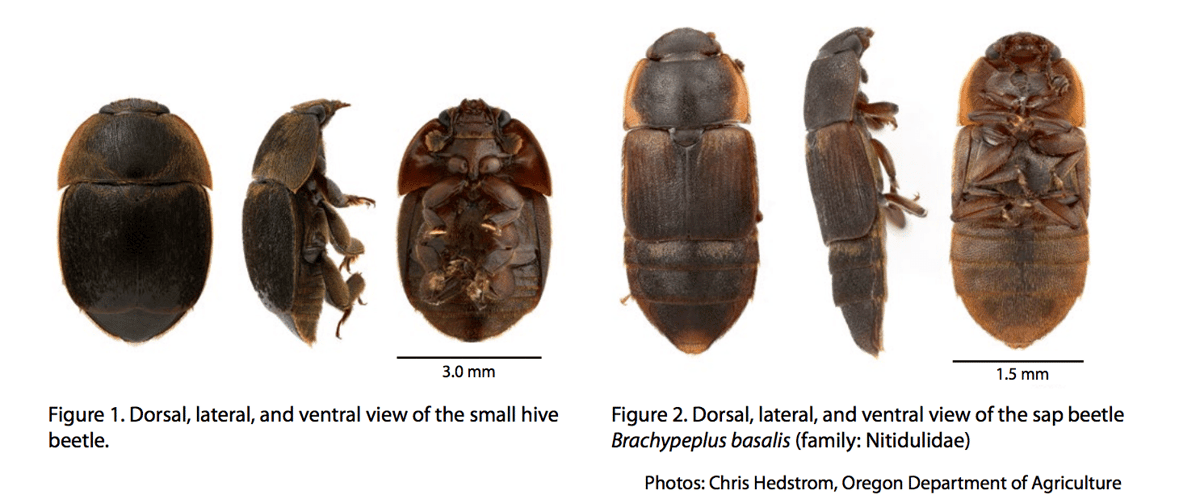
- Adult beetles are smaller than worker honey bees.
- The body is oval, flattened, and shiny.
- Adults are usually dark brown to black.
- Short wing covers may leave the end of the abdomen partly visible.
- Adults move quickly through cracks, corners, and frame rests.
Beetles are not hard to recognize once a beekeeper knows what to look for. Adult beetles are compact, dark, and fast-moving. Their flattened shape allows them to slip into places where honey bees have difficulty reaching them. During inspections, beetles may be seen running across the inner cover, hiding beneath frame ears, or escaping toward the darker edges of the hive body.
Accurate identification matters because not every small dark beetle near an apiary is a beetle. Beekeepers should look for the combination of size, oval shape, shiny dark body, and quick movement inside the colony. Larvae should also be distinguished from wax moth larvae. Beetle larvae usually have rows of small spines and three pairs of legs near the head, while wax moth larvae are more caterpillar-like and often leave webbing.
| Feature | Small Hive Beetle | Wax Moth Larva |
|---|---|---|
| Main damage stage | Larva | Larva |
| Common signs | Slimed comb, fermented honey, beetle larvae | Webbing, tunnels, frass, damaged comb |
| Larva appearance | Firm body, small spines, three pairs of legs near head | Softer caterpillar-like body, more obvious webbing |
| Primary risk | Honey contamination and colony stress | Comb destruction, especially in weak colonies or stored equipment |
Life Cycle and Behavior
- Female beetles lay eggs in protected cracks, crevices, and comb areas.
- Eggs hatch faster in warm, humid conditions.
- Larvae feed on pollen, honey, brood, and comb residues.
- Mature larvae leave the hive and pupate in nearby soil.
- Adults emerge from the soil and can reinvade colonies.
The beetle life cycle includes four stages: egg, larva, pupa, and adult. Female beetles lay eggs in protected areas where worker bees have difficulty removing them. After hatching, larvae feed inside the hive and create the greatest damage. They tunnel through comb, consume hive resources, and contaminate honey with waste and associated fermentation.
When larvae mature, they usually crawl out of the colony and burrow into surrounding soil to pupate. Soil moisture, temperature, and texture can influence pupation success. Once adult beetles emerge, they can fly to nearby colonies and begin the cycle again. This is why hive beetle management must consider both the inside of the hive and the environment immediately around the colony.
The Impact on Honey Bee Colonies
- Larvae feed through comb, pollen, brood, and honey.
- Honey can ferment and become unsellable.
- Severe infestations may create slimed comb.
- Worker bees may spend more time chasing beetles than caring for brood.
- Weak colonies are more likely to be overwhelmed.
Beetles are most damaging when larvae become established. Larval feeding can ruin honey supers, destroy comb, and create a slimy mess that smells fermented. Honey contaminated by beetle larvae should not be sold for human consumption. In severe cases, the colony may abandon the hive, especially when the bee population is too small to defend the available comb area.
Adult beetles also create stress. Worker bees may chase, confine, or guard beetles instead of focusing fully on brood care, nectar processing, and colony maintenance. Strong colonies can often corral beetles into cracks and propolis prisons, but stressed colonies may lose control of the pest population quickly.
Important beekeeper warning: A few adult beetles do not always mean a colony is failing. Beetle larvae, slimed comb, fermented honey, or a weak bee population are more serious warning signs.
Management Strategies for Beetles
- Strong colonies are the first defense against small beetles.
- Excess empty space gives beetles more places to hide and reproduce.
- Regular inspections help catch beetle problems before larvae spread.
- Traps can reduce adult beetle pressure inside the hive.
- Chemical controls should only be used according to label directions.
Small beetle control works best when beekeepers use several methods together. This approach is called integrated pest management, or IPM. Instead of relying on one product or treatment, IPM combines prevention, monitoring, sanitation, mechanical trapping, cultural management, and careful use of labeled treatments when needed.
Regular Inspections
Inspect colonies more often during warm, humid periods when beetle pressure tends to rise. Look under the inner cover, along frame rests, in bottom board debris, and around pollen-rich frames. Early detection helps prevent adult beetles from producing damaging larvae.
Maintaining Strong Colonies
Strong colonies defend themselves better than weak ones. A healthy queen, adequate food, balanced hive space, and good population size all help bees control beetles. Weak colonies, queenless colonies, and small splits may need reduced space or extra attention until their population grows.
Using Beetle Traps
Commercially available small beetle traps can help reduce adult beetle numbers inside the hive. Traps are most useful when placed where beetles naturally run to hide, such as between frames or near the edges of the hive.
Cultural Practices
Good hive hygiene matters. Remove deadouts promptly, avoid leaving exposed comb or honey near the apiary, and clean up broken burr comb. Do not leave wet supers sitting unprotected where beetles can reproduce.
Soil and Apiary Awareness
Because mature larvae leave the hive to pupate in soil, the area around the hive can affect beetle pressure. Beekeepers in areas with heavy beetle pressure may need to pay closer attention to hive stands, soil moisture, shade, and sanitation around the apiary.
Chemical Controls
Chemical controls should be considered a last-resort tool, not the foundation of management. Any pesticide or in-hive treatment must be legal for the intended use and applied exactly according to label directions to protect bees, honey, comb, and the beekeeper.
The Role of Beetles in the Ecosystem
- Small beetles belong to a scavenger beetle family.
- Scavenger beetles help break down organic material.
- Their natural role changes when they reproduce inside managed hives.
- Inside colonies, their feeding damages valuable comb, brood, pollen, and honey.
In natural ecosystems, scavenger beetles can help recycle nutrients by feeding on decaying material, fermenting substances, or other organic resources. That ecological role does not make them beneficial inside a managed honey bee colony. In a beehive, the same feeding behavior becomes harmful because beetle larvae consume resources that bees need and contaminate honey that beekeepers intend to harvest.
For beekeepers, the practical goal is not to eliminate every beetle from the landscape. The goal is to prevent beetles from reproducing inside colonies and causing economic or colony-health damage.
Small Beetle Management Checklist
| Management Step | Why It Matters | When To Do It |
|---|---|---|
| Keep colonies strong | Strong bee populations patrol comb and confine adult beetles more effectively. | All season |
| Reduce excess hive space | Unused space gives beetles places to hide away from worker bees. | During colony setup and inspections |
| Inspect for adult beetles | Early detection helps prevent larvae from becoming established. | Every 2 to 3 weeks in warm weather |
| Use beetle traps | Traps reduce adult beetle pressure when used correctly. | During beetle season or when beetles are seen |
| Remove slimed comb | Damaged comb can spread odor, fermentation, and contamination. | Immediately when found |
| Clean up deadouts quickly | Dead colonies and unprotected comb can become beetle breeding sites. | As soon as discovered |
| Follow treatment labels | Improper chemical use can harm bees or contaminate hive products. | Only when treatment is necessary |
Lappe’s practical tip: If a colony is too small to cover its frames, reduce the hive space until the bees can patrol the comb. Correct sizing is one of the simplest beetle-prevention steps for beginner beekeepers.
Frequently Asked Questions
What attracts small beetles to a beehive?
Small beetles are attracted to hive odors, pollen, honey, brood, and fermentation odors. Weak colonies and exposed comb can increase beetle risk.
Are small beetles dangerous to humans?
Small beetles are not dangerous to humans. The concern is their ability to damage comb, contaminate honey, and weaken honey bee colonies.
Can a strong colony control small beetles?
A strong colony can often suppress adult beetles by chasing, confining, and limiting their access to comb. Strong colonies may still need monitoring and traps.
What does small beetle damage look like?
Damage may include slimy comb, fermented honey, crawling larvae, damaged brood areas, and honey that leaks or bubbles from cells.
Where do small beetle larvae pupate?
Mature larvae usually leave the hive and pupate in nearby soil. Soil conditions can influence how successfully larvae become adults.
Do small beetles kill bee colonies?
Small hive beetles can contribute to colony failure when infestations are severe. Weak colonies are at the greatest risk of being overwhelmed.
Do beetle traps eliminate small beetles?
Beetle traps can reduce adult beetle numbers, but they rarely solve the problem alone. Traps work best with strong colonies and good sanitation.
Should I use chemicals first for small beetles?
Chemical controls should not be the first step. Start with strong colonies, correct hive space, inspections, sanitation, and traps before considering labeled treatments.
Sources
- Small Hive Beetle, Aethina tumida Murray — University of Florida IFAS Extension
- Small Hive Beetles — University of Florida Honey Bee Research and Extension Laboratory
- Small Hive Beetles — USDA Agricultural Research Service
- The Small Hive Beetle: A Pest of Honey Bee Colonies — NC State Extension
- Small Hive Beetle — North Carolina Department of Agriculture
- The Hive and the Honey Bee — Dadant & Sons
- Honey Bee Pests, Predators, and Diseases — Morse and Nowogrodzki
Editorial Standards
This guide was prepared to support practical beekeeping decisions while keeping claims clear, sourceable, and easy to verify. Management recommendations should be checked against local regulations, product labels, and regional extension guidance before treatment decisions are made.
FAQs
What attracts small hive beetles to a beehive?
Small hive beetles are attracted to hive odors, pollen, honey, brood, and fermentation odors. Weak colonies and exposed comb can increase beetle risk.
Are small hive beetles dangerous to humans?
Small hive beetles are not dangerous to humans. The concern is their ability to damage comb, contaminate honey, and weaken honey bee colonies.
Can a strong colony control small hive beetles?
A strong colony can often suppress adult beetles by chasing, confining, and limiting their access to comb. Strong colonies may still need monitoring and traps.
What does small hive beetle damage look like?
Damage may include slimy comb, fermented honey, crawling larvae, damaged brood areas, and honey that leaks or bubbles from cells.
Where do small hive beetle larvae pupate?
Mature larvae usually leave the hive and pupate in nearby soil. Soil conditions can influence how successfully larvae become adults.
Do small hive beetles kill bee colonies?
Small hive beetles can contribute to colony failure when infestations are severe. Weak colonies are at the greatest risk of being overwhelmed.
Do beetle traps eliminate small hive beetles?
Beetle traps can reduce adult beetle numbers, but they rarely solve the problem alone. Traps work best with strong colonies and good sanitation.
Should I use chemicals first for small hive beetles?
Chemical controls should not be the first step. Start with strong colonies, correct hive space, inspections, sanitation, and traps before considering labeled treatments.