Welcome to Lappe's Bee Supply's blogs section. We are a trusted beekeeping company in the USA. We give relevant insights, seasonal guidance, and professional advice for beekeepers of all experience levels. From hive management and bee wellness to honey production and equipment guides, we have it all that you will require to thrive. Get updated, motivated, and connected with the beekeeping community through regular news from Lappe's Bee Supply.
Best Honey Bee Feeders by Season: Spring, Summer, Fall & Winter
```html
Best Honey Bee Feeders by Season: What to Use in Spring, Summer, Fall, and Winter
Published: September 21, 2026
Author: Lappe’s Bee Supply
Editorial standards: This guide reflects established beekeeping practices, reputable extension and industry guidance, and practical feeder troubleshooting experience. Because colony needs and weather vary by region, local extension recommendations should take priority when conditions differ.
Choosing a honey bee feeder is not simply a matter of finding the largest container or the easiest feeder to refill. The right choice depends on season, temperature, colony strength, available food stores, natural forage, and how easily the bees can reach the feed. A feeder that works well for a strong colony during warm fall weather may be ineffective for a small colony during a cold spring spell.
This guide explains the most common honey bee feeders, when each type is most useful, when extra caution is needed, and why feeding methods often change as the beekeeping season progresses.
Key Takeaways
- The best bee feeder depends on season, colony strength, temperature, forage availability, and accessibility.
- Feed located near the cluster is generally easier for bees to reach during cool conditions.
- Large-capacity feeders are most useful when colonies can consume syrup before it remains unused for too long.
- Leaking or exposed syrup can attract other bees and increase robbing pressure, particularly during a nectar dearth.
- Frame feeders keep syrup inside the hive but need an effective ladder, float, screen, or similar drowning-prevention system.
- Liquid syrup becomes less dependable during sustained cold weather when clustered bees have limited mobility.
- Supplemental feeding should respond to actual colony needs rather than the calendar alone.
Definitions (quick reference)
A bee feeder supplies supplemental food to a honey bee colony when available stores or natural forage do not adequately meet the colony’s needs.
- Bee feeder: A device or hive component used to provide sugar syrup or another supplemental food to a colony.
- Cluster: A compact group of honey bees that forms as bees regulate colony temperature, especially during cool or cold weather.
- Robbing: Behavior in which bees enter another colony or exposed food source to take honey or supplemental feed.
- Nectar dearth: A period when natural nectar sources are limited or unavailable.
- Sugar syrup: Sugar dissolved in water and provided as supplemental carbohydrate feed. Syrup concentration and timing should follow the management goal and appropriate regional guidance.
Understanding these terms makes feeder selection easier because most feeding decisions come back to three practical questions: Does the colony need additional food, can the bees reach it, and can they use it before conditions change?
What is the best honey bee feeder for each season?
The best feeder changes with the season because bee mobility, colony population, temperature, forage availability, and the amount of supplemental feed required all change.
There is no single type of honey bee feeder that is automatically best from spring through winter. Early in the season, a smaller colony may benefit from syrup that is positioned reasonably close to the bees. As weather warms and colony populations increase, larger-capacity feeders become more practical because strong colonies can usually access and process greater amounts of syrup.
Fall feeding presents another situation. A colony that enters fall with inadequate stores may need substantial supplemental carbohydrates before sustained cold weather arrives. As temperatures fall, however, the distance between the cluster and the food becomes increasingly important.
The most useful approach is to match the feeder to the colony rather than simply matching it to the month. Check food stores, population, weather, natural forage, and consumption before deciding how much syrup to provide.
Practical Lappe’s note: Two recurring feeder problems encountered in customer troubleshooting are syrup remaining unused long enough to deteriorate and leaking syrup attracting unwanted bee activity. Providing an amount appropriate for the colony and checking the feeder regularly can prevent many feeding problems.
What is the best honey bee feeder for winter?
During sustained cold weather, fondant, candy boards, or dry sugar placed where clustered bees can reach them are generally more dependable than liquid syrup.
Winter feeding is different from spring or fall feeding because the goal is generally emergency support rather than colony buildup. Honey bees form a cluster during cold weather and may have limited ability to travel through the hive to reach distant food.
A feeder can contain plenty of syrup and still provide little practical value if the colony cannot reach it. This is one reason liquid feeding becomes less dependable as prolonged cold develops.
Solid or dry carbohydrate feed placed above the cluster reduces the distance bees need to travel. Winter supplemental feeding does not replace proper fall preparation, and colonies with adequate, accessible honey stores may not require emergency feed.
Winter feeding methods (quick list)
- Fondant: A soft or semi-solid sugar feed positioned where clustered bees can reach it.
- Candy boards: Hardened sugar feed placed above the colony to provide a longer-lasting emergency carbohydrate source.
- Dry sugar (“mountain camp” method): Granulated sugar placed above the cluster using an appropriate hive setup.
Beekeepers looking for seasonal feeding products can browse Lappe’s Honey Bee Feed & Feeders category, including supplemental feed and winter feeding options.
What is a top tank (hive-top) feeder, and when should you use it?
A hive-top tank feeder is a higher-capacity syrup feeder positioned above the colony and is most practical when a strong colony can consume substantial feed.
Among the larger-capacity honey bee feeders, hive-top feeders are useful when a colony requires more syrup than a small jar or frame feeder can conveniently provide. Their larger capacity can reduce refill frequency, making them especially practical during periods of significant supplemental feeding.
Capacity alone does not make a feeder appropriate. Syrup remains above the brood area, so colony size, weather, feeder design, and expected consumption should all be considered. A small colony may consume a large volume slowly, leaving syrup unused longer than intended.
Hive-top feeders become particularly useful when temperatures are mild enough for bees to move readily through the hive and when the colony population is large enough to use the available feed. During cold periods, smaller volumes or feeders positioned closer to the colony may be more appropriate.
Browse available bee feeders and feeding equipment to compare hive-top, in-hive, entrance, and other feeder styles.
What are top bucket, jar, or barrel feeders, and when do they work best?
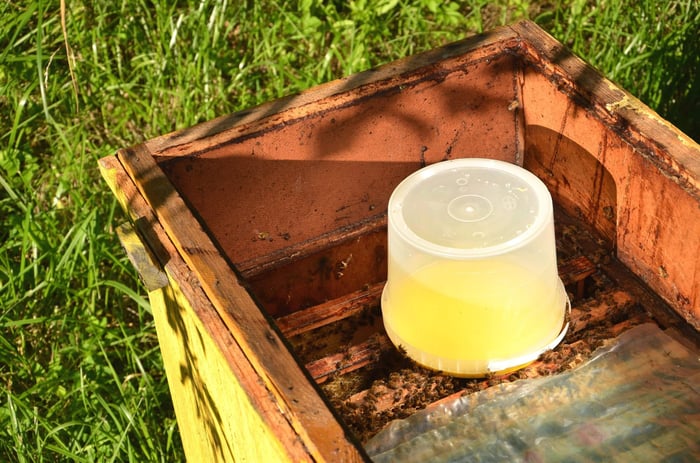
Top bucket, jar, and similar feeders position syrup above the colony and work best when temperatures allow bees to move upward and reach liquid feed reliably.
Bucket and jar feeders are popular because they are straightforward to use, easy to inspect, and available in different capacities. An inverted container typically releases syrup through small openings while bees access the feed from below.
These feeders can be particularly useful during spring buildup or other periods when bees are active enough to move upward but a beekeeper does not need the capacity of a large hive-top tank.
Proper sealing is essential. A container that drips syrup into or down the outside of a hive can attract other colonies and contribute to robbing pressure. Temperature changes, lid fit, hole size, and feeder position can all affect performance.
Practical tip: If syrup begins running down the front or side of the hive, correct or remove the feeder and clean the spill. Do not leave exposed syrup available around the hive entrance.
What is an in-hive frame feeder, and when should you use it?
A frame feeder holds syrup inside the hive, limiting access by outside bees while keeping supplemental feed close to the colony.
Frame feeders occupy space inside the hive that would otherwise contain one or more frames. Their protected location can reduce syrup exposure to outside bees compared with an entrance feeder, making them useful when robbing pressure is a concern.
They are also adaptable to different colony sizes because the beekeeper can control how much syrup is added. A smaller colony does not need a feeder filled to its maximum capacity simply because the container can hold that amount.
The most important safety consideration is drowning prevention. Bees need a secure way to enter the feeding area, reach the syrup, and climb back out. Depending on the design, this may involve ladders, floats, caps, screens, or textured surfaces.
Practical Lappe’s note: When customers report excessive drowning in frame feeders, a common troubleshooting point is checking whether the ladder or float is missing, displaced, warped, or otherwise failing to provide a dependable climb-out surface.
What is a front entrance feeder, and when should you avoid using it?
A front entrance feeder is convenient to inspect and refill, but syrup positioned at the hive entrance can increase robbing concerns during a nectar dearth.
Entrance feeders are simple and visible. A beekeeper can usually see the syrup level and refill the container without opening the hive, which makes them convenient for routine feeding.
Their location is also their main limitation. Syrup sits at the same area bees use to enter and defend the colony. Leaks, spills, or the odor of exposed feed may attract bees from other colonies, especially when natural nectar sources are scarce.
Entrance feeders also become less dependable during cold weather because the cluster may remain deeper inside the hive and may not travel to the entrance for supplemental syrup.
When using an entrance feeder, keep spills to a minimum, make sure the feeder seals correctly, and consider whether the colony is strong enough to defend its entrance.
What is open feeding, and when is it appropriate for beekeepers?
Open feeding provides a shared outdoor food source for many bees, but it gives the beekeeper much less control over which colonies receive the feed.
Open feeding means placing supplemental feed in a shared location where bees from multiple colonies can collect it. This approach may be convenient in some large-apiary situations because many bees can access the same source without individual feeders being installed in every hive.
The tradeoff is control. The beekeeper cannot determine exactly which colony receives the feed or how much each colony collects. Strong colonies may gather more than weaker colonies, even when the weaker colony is the one that actually needs supplemental food.
Shared feeding locations can also concentrate large numbers of bees in one area. For backyard operations or situations where one specific colony needs help, an individual protected feeder usually provides more control.
Open feeding should therefore be treated as a specialized management method rather than the automatic choice for a small apiary.
How do you choose the right bee feeder based on colony strength and weather?
Choose a feeder by matching feed location and capacity to colony strength, bee mobility, weather conditions, forage availability, and expected syrup consumption.
Start with the colony rather than the feeder. A small or newly established colony has different feeding needs from a large established colony preparing stores for winter. Similarly, bees experiencing mild daytime temperatures can move through the hive differently from bees clustered through a cold spell.
- Check whether supplemental feeding is actually needed.
- Evaluate colony population and strength.
- Review daytime and overnight temperatures.
- Consider whether natural nectar is abundant, limited, or absent.
- Choose a feeder location bees can reliably reach.
- Match feed volume to expected consumption rather than container capacity.
- Check the feeder for leaks after installation.
- Use appropriate drowning protection where required.
- Monitor consumption and adjust the feeding method as conditions change.
These steps help prevent a common mistake: choosing equipment based only on convenience. The easiest feeder for the beekeeper is not always the feeder the bees can use most effectively under current conditions.
Which honey bee feeder types are best by season?
Cooler weather favors accessible feed near the colony, while warm conditions allow strong colonies to use larger-capacity feeders more effectively.
The table below provides a practical starting point for comparing honey bee feeders by season and colony condition. It should not be treated as a fixed calendar because spring, summer, fall, and winter conditions vary substantially by region and from year to year.
| Season or condition | Common practical options | Use extra caution with | Main consideration |
|---|---|---|---|
| Early spring / cool | Top jar or bucket; frame feeder | Large syrup volumes distant from a small cluster | Bee mobility may remain limited |
| Late spring / mild | Hive-top feeder; bucket or jar; frame feeder | Unnecessary feeding during abundant natural forage | Colony growth and nectar availability |
| Summer / nectar dearth | Protected in-hive feeding when needed | Entrance or exposed feeders | Robbing pressure |
| Early fall / mild | Hive-top feeder; bucket; frame feeder | Leaking feeders | Building needed stores efficiently |
| Late fall / cold nights | Accessible liquid feeding while bees still take syrup | Distant or exposed liquid feeders | Declining bee movement |
| Winter / sustained cold | Fondant; candy board; dry sugar when needed | Most liquid-syrup systems | Feed accessibility from the cluster |
Regional note: Calendar dates alone should not determine feeding. Temperature, colony stores, natural forage, colony strength, and regional beekeeping guidance provide a better basis for deciding when and how to feed.
Frequently Asked Questions
What is the best feeder for spring build-up?
A top jar or bucket feeder and an in-hive frame feeder are common spring choices because they can keep syrup reasonably close to the colony. Colony strength and temperature should determine the final choice.
Can a top feeder cause brood to get chilled?
A top feeder does not automatically chill brood. However, small colonies may have more difficulty managing additional upper hive space during cold conditions.
Are frame feeders good for small colonies?
Yes. Frame feeders can work well for small colonies because feed remains inside the hive and close to the bees, but proper drowning prevention is important.
Why do bees drown in feeders?
Bees can drown when they contact an open syrup surface without a secure float, ladder, screen, or textured surface that provides a way to climb out.
When should you stop feeding syrup?
Reduce or stop supplemental feeding when the colony no longer needs it, bees stop taking the syrup, or natural forage and colony stores adequately meet the management goal.
Are entrance feeders good in cold weather?
Entrance feeders become less dependable in cold weather because clustered bees may not travel to the hive entrance to reach the syrup.
What causes robbing when feeding bees?
Exposed syrup, leaks, spills, weak colony defenses, and nectar dearth conditions can increase the likelihood of robbing around a hive.
Is open feeding safe for backyard beekeepers?
Open feeding provides less control over which colonies receive syrup. Individual protected feeders are generally easier to manage when only a few colonies require supplemental feed.
Do top feeders ferment syrup faster?
Syrup in any feeder can deteriorate when it remains unused for too long, especially in warm conditions. Match the amount provided to the colony’s expected consumption.
What feeder works in the widest range of conditions?
No feeder is best in every situation. Frame feeders are versatile, while hive-top and bucket feeders can be more efficient when strong colonies require larger volumes of syrup.
Related beekeeping starter kits and supplies
Sources
The following references provide additional information on honey bee biology, nutrition, supplemental feeding, and colony-management practices.
- Caron, Dewey M., and Lawrence John Connor. Honey Bee Biology and Beekeeping. Wicwas Press. View reference
- Honey Bee Health Coalition. Best Management Practices for Hive Health: A Guide for Beekeepers. View resource
- Honey Bee Health Coalition. Honey Bee Nutrition and Supplemental Feeding Guide. Honey Bee Health Coalition
- University of Arizona Cooperative Extension. Feeding Your Bees. View PDF
- National Bee Unit. Feeding Sugar to Bees: Best Practice Guideline. View guideline
- Penn State Extension. Beekeeping Resources. View resources
- United States Department of Agriculture. Honey Bees. View USDA resource
- Food and Agriculture Organization of the United Nations. Beekeeping and Sustainable Livelihoods. View FAO resource
The bottom line
The best honey bee feeders are the ones colonies can reach, use, and defend under current conditions. Instead of relying on one feeder for every season, evaluate colony strength, food stores, temperature, natural forage, robbing pressure, and expected consumption. Keeping those factors in mind makes it easier to choose between hive-top feeders, bucket or jar feeders, frame feeders, entrance feeders, and solid winter feeding methods.
```
FAQs
What is the best feeder for spring build-up?
A top jar or bucket feeder and an in-hive frame feeder are common spring choices because they can keep syrup reasonably close to the colony. Colony strength and temperature should determine the final choice.
Can a top feeder cause brood to get chilled?
A top feeder does not automatically chill brood. However, small colonies may have more difficulty managing additional upper hive space during cold conditions.
Are frame feeders good for small colonies?
Yes. Frame feeders can work well for small colonies because feed remains inside the hive and close to the bees, but proper drowning prevention is important.
Why do bees drown in feeders?
Bees can drown when they contact an open syrup surface without a secure float, ladder, screen, or textured surface that provides a way to climb out.
When should you stop feeding syrup?
Reduce or stop supplemental feeding when the colony no longer needs it, bees stop taking the syrup, or natural forage and colony stores adequately meet the management goal.
Are entrance feeders good in cold weather?
Entrance feeders become less dependable in cold weather because clustered bees may not travel to the hive entrance to reach the syrup.
What causes robbing when feeding bees?
Exposed syrup, leaks, spills, weak colony defenses, and nectar dearth conditions can increase the likelihood of robbing around a hive.
Is open feeding safe for backyard beekeepers?
Open feeding provides less control over which colonies receive syrup. Individual protected feeders are generally easier to manage when only a few colonies require supplemental feed.
Do top feeders ferment syrup faster?
Syrup in any feeder can deteriorate when it remains unused for too long, especially in warm conditions. Match the amount provided to the colony’s expected consumption.
What feeder works in the widest range of conditions?
No feeder is best in every situation. Frame feeders are versatile, while hive-top and bucket feeders can be more efficient when strong colonies require larger volumes of syrup.