Welcome to Lappe's Bee Supply's blogs section. We are a trusted beekeeping company in the USA. We give relevant insights, seasonal guidance, and professional advice for beekeepers of all experience levels. From hive management and bee wellness to honey production and equipment guides, we have it all that you will require to thrive. Get updated, motivated, and connected with the beekeeping community through regular news from Lappe's Bee Supply.
Bee Bearding: The Art and Science Behind a Unique Beekeeping Phenomenon
The Buzz About This Post
- Key Takeaways
- Table of Contents
- What Is Bee Bearding?
- Why Do Honey Bees Beard?
- Does Bee Bearding Mean a Colony Is About to Swarm?
- What Should a Beekeeper Do When Bees Are Bearding?
- When Is Bee Bearding a Warning Sign?
- Can Bees Form a “Bee Beard” on a Person?
- Why Does Bee Bearding Matter to Honey Bee Biology?
- Frequently Asked Questions
- What does it mean when bees are bearding?
- Is bee bearding normal?
- Does bearding mean my bees are going to swarm?
- Why do bees beard at night?
- Should I add another box when my bees are bearding?
- Should I open the hive while bees are bearding?
- Do bees beard because the hive has poor ventilation?
- Can Varroa treatments cause bees to beard?
- What is the difference between bearding and a swarm?
- Will bearding bees go back inside the hive?
- Sources
- FAQs
Bee Bearding: Why Honey Bees Cluster Outside the Hive
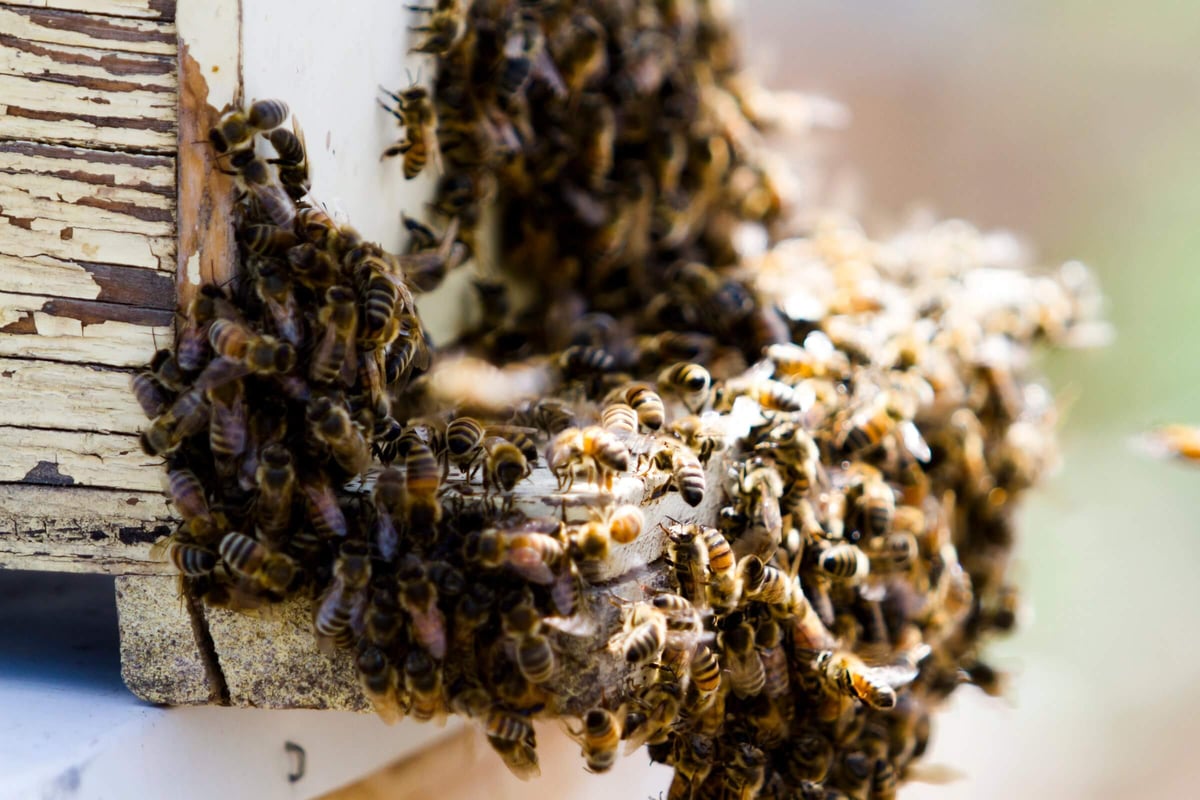
Seeing thousands of honey bees hanging from the front of a hive can look alarming, especially to a new beekeeper. In many cases, however, the colony is displaying a normal behavior known as bee bearding. Bearding commonly appears during warm conditions as workers gather outside the occupied hive while the colony manages heat, airflow, and population density inside the nest.
Bee bearding is visually dramatic, but the size of the cluster does not automatically indicate an emergency. Understanding why bees beard, how bearding differs from swarming, and when exterior clustering deserves closer inspection can help a beekeeper respond to the colony rather than simply reacting to what looks unusual.
What Is Bee Bearding?
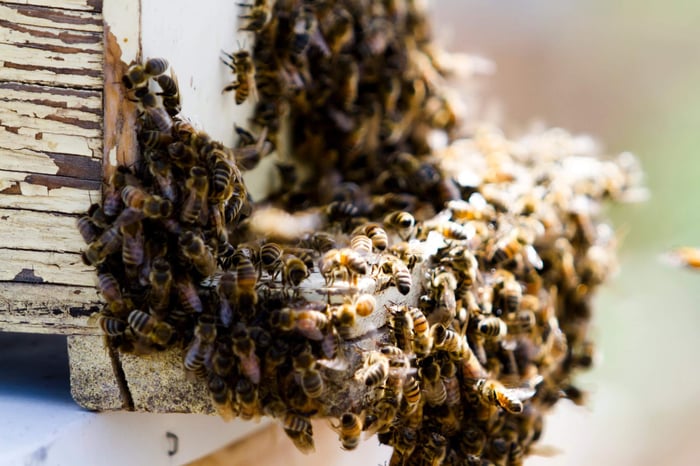
Bee bearding is when adult honey bees cluster outside the hive, usually in warm weather, to reduce crowding and help the colony manage nest heat.
- Bearding usually appears as a dense curtain or cluster of bees near the hive entrance.
- Hundreds or even thousands of adult worker bees may participate in a large beard.
- The cluster can spread across the landing board, hive front, or underside of the bottom board.
- Bearding is commonly observed during warm weather and may become more noticeable later in the day.
- Bearding bees often return to the nest as colony and environmental conditions change.
Beekeepers call the behavior bearding because a hanging mass of bees around the entrance resembles a beard. The appearance can be intimidating, but the behavior itself is an established component of honey bee colony thermoregulation. Worker bees can move outside the nest while other workers fan air, distribute water, and perform other behaviors that help regulate the colony environment. [1] [2]
Modern research describes bearding as a form of thermoregulatory evacuation in which workers leave the nest and aggregate around the entrance. The exterior cluster is only the visible part of a much larger colony response. Inside the hive, other workers may be moving air through the cavity, spreading water for evaporative cooling, or changing their position relative to the brood.
Why Do Honey Bees Beard?
Honey bees beard mainly during heat stress, when moving workers outside can reduce internal crowding and support airflow and cooling.
- Honey bee colonies actively regulate the environment surrounding developing brood.
- Warm conditions increase the colony's need for cooling and ventilation behaviors.
- Moving workers outside reduces the number of adult bees occupying the nest cavity.
- Honey bees also fan air and collect water that can be used for evaporative cooling.
- Recent research found that larger colonies can produce larger and longer-lasting beards.
Honey bees do not depend on a single cooling technique. Colony temperature regulation is the combined result of many individual worker behaviors. Workers may fan their wings to move air, forage for water, spread water through the nest, reposition themselves, or leave the nest and join an exterior beard. [2] [3]
Temperature is especially important around developing brood. Peer-reviewed research describes honey bee brood as being maintained within a relatively narrow temperature range, generally around the mid-30s Celsius. A major benefit of colony-level thermoregulation is that thousands of workers can alter their behavior in response to changing nest conditions. [3] [4]
A 2025 research study examining natural honey bee beards found that colonies bearded during hot weather, while the largest beards tended to occur in the evening and at night. Researchers also found that larger colonies produced larger beards and bearded for longer periods. These observations are useful because they show why a beekeeper should not assume that the most dramatic beard will always occur at the hottest moment of the afternoon. [2]
Does Bee Bearding Mean a Colony Is About to Swarm?
Bearding alone does not mean a colony will swarm; swarming involves colony reproduction, queen departure, and separate preparation signals.
- Bearding and swarming are different honey bee behaviors.
- Heat-related bearding can occur without an impending swarm.
- A primary swarm normally includes the established queen and a portion of the worker population.
- Swarm assessment should consider conditions inside the colony rather than the exterior beard alone.
- A mass of bees attached to an occupied hive is not automatically a departing swarm.
Bearding is often mistaken for swarm preparation because both behaviors can place large numbers of bees where a beekeeper can easily see them. That visual similarity does not make the behaviors equivalent. Michigan State University Extension specifically explains that normal bearding during hot weather is not, by itself, an indication that a colony will swarm. [1]
Swarming is a reproductive event for the colony. A queen and thousands of workers leave the original nest, after which they may gather temporarily in a cluster on a branch, fence, structure, or another nearby surface while scout bees continue searching for a new nest site. A beard, in contrast, remains associated with an occupied hive. [6]
| Observation | Normal Bearding | Swarming or Swarm Preparation |
|---|---|---|
| Bees remain attached to the occupied hive | Common | Can occur before departure, but is not diagnostic |
| Hot or humid weather | Common association | Not required |
| Bees later move back inside | Common | Not the defining pattern of a swarm that has departed |
| Queen leaves the existing colony | No | Yes, during a primary swarm |
| Temporary cluster away from the hive | No | Common after swarm departure |
| Exterior beard alone proves swarming | No | No |
If swarm prevention is the concern, inspect the colony at an appropriate time and use internal evidence rather than beard size alone. Colony population, brood-nest congestion, queen-cell development, available comb space, nectar conditions, queen status, and season can provide more useful context.
What Should a Beekeeper Do When Bees Are Bearding?
When bees are bearding, first check heat, entrance airflow, water access, colony space, and swarm signs before changing hive equipment.
- Normal hot-weather bearding often requires observation rather than immediate intervention.
- Keep hive entrances free from unintended obstruction during very warm conditions.
- Make an appropriate clean water source accessible to bees during hot weather.
- Evaluate colony space based on actual hive conditions and seasonal needs.
- Check Varroa treatment labels because some products have temperature-related restrictions.
- Do not diagnose an impending swarm from exterior bearding alone.
The best first response to a beard is usually to observe the entire situation. Consider the temperature, humidity, time of day, colony strength, entrance activity, available water, and whether nearby colonies are showing similar behavior. A populous colony displaying a substantial beard on a hot evening may simply be using a normal thermoregulatory strategy.
Michigan State University Extension recommends maintaining appropriate entrance airflow during hot conditions and making water available to bees. The same guidance reminds beekeepers that treatment labels matter during high temperatures because some Varroa-control products have application restrictions or temperature limits. [1]
Extra hive space should also be added for normal management reasons rather than as an automatic response to a beard. If a colony needs additional room for brood expansion or incoming nectar, providing appropriate space can be useful. If the colony already has adequate room, adding boxes solely because bees are sitting outside may not address the actual reason for the behavior.
Quick Bearding Check
- Observe the weather, humidity, and time of day.
- Confirm the entrance is not unintentionally blocked.
- Make sure the colony has reasonable access to clean water.
- Compare the behavior with other colonies in the same apiary.
- Review recent hive treatments and all product-label temperature requirements.
- During the next appropriate inspection, evaluate colony space and separate swarm indicators.
When Is Bee Bearding a Warning Sign?
Bearding deserves closer inspection when it persists in mild weather, follows a treatment, restricts normal hive activity, or appears with separate swarm indicators.
- Context matters more than beard size alone.
- Exterior clustering during unexpectedly mild conditions deserves additional observation.
- Bearding that begins after a hive treatment should prompt a review of the product label and colony response.
- Blocked or unusually restricted entrances can interfere with normal bee traffic and ventilation.
- Internal swarm indicators should be evaluated independently from the exterior beard.
Bearding should not automatically be categorized as either healthy or unhealthy. It is a behavior that needs context. Current research strongly supports heat-related thermoregulation as an important function, but scientists continue investigating the precise cues individual workers use when joining or leaving a beard. [2]
Exterior clustering can also occur in other situations. Research discussions have noted bearding in connection with volatile hive treatments, which is another reason a sudden behavioral change immediately following treatment should be evaluated against the product label and application instructions. [2]
A beekeeper should look more carefully when bearding appears unrelated to warm conditions, when entrance activity changes noticeably, when bees behave abnormally after treatment, or when the colony shows other signs that merit inspection. The goal is not to stop bearding simply because it is visible; the goal is to determine whether the colony is displaying expected behavior under the current conditions.
Can Bees Form a “Bee Beard” on a Person?
A staged “bee beard” on a person is different from natural hive bearding and should not be attempted without expert controls and safety planning.
- Natural bearding occurs on or immediately around an occupied honey bee nest.
- A human “bee beard” is an intentionally created demonstration rather than ordinary hive thermoregulation.
- The two behaviors should not be presented as the same biological event.
- Deliberately covering a person with bees introduces sting risks for the participant and bystanders.
- Observing natural hive bearding does not require handling the exterior cluster.
The phrase “bee beard” is also used for demonstrations in which a mass of honey bees is intentionally gathered on a person. The BeeMD distinguishes this practice from natural bearding around a hive entrance. Human bee-beard demonstrations can use a caged queen or queen-related attraction to encourage bees to cluster in a particular location. [5]
That staged activity should not define normal bee bearding in an educational guide. Natural bearding is a colony behavior occurring around the nest. A staged human bee beard is a controlled demonstration involving additional human intervention and additional safety considerations.
Why Does Bee Bearding Matter to Honey Bee Biology?
Bee bearding shows how thousands of honey bees alter individual behavior together to help regulate the shared environment of their colony.
- Honey bee thermoregulation results from collective worker behavior.
- Workers can warm brood, move air, collect water, and leave the nest during heat.
- Temperature around developing brood is regulated more tightly than many other areas of the hive.
- Individual worker decisions can produce a colony-level environmental response.
- Bearding is one visible component of a larger thermoregulatory system.
A honey bee colony is often studied as a biological system in which many individual workers contribute to functions that benefit the colony as a whole. No single worker needs to control every part of nest temperature regulation. Instead, thousands of local behavioral responses can produce a stable colony environment. [3]
During cold conditions, adult workers can cluster and generate heat using their flight muscles. During excessive heat, workers have a different toolkit: fanning, water collection, evaporative cooling, movement within the hive, and nest evacuation through bearding. The combination allows a colony to respond dynamically to conditions that would be difficult for an individual bee to manage. [2] [3]
Recent research adds another important piece to that picture. In observed colonies, the largest natural beards commonly appeared during evening and nighttime hours rather than precisely when outdoor temperatures peaked. Researchers also found that beard size increased with colony size, while colonies could still beard even when brood was absent. Those findings show that natural bearding is more nuanced than a simple “outside temperature reaches a certain number, so the bees leave” explanation. [2]
For beekeepers, this matters because good management starts with interpreting behavior accurately. Seeing bees outside the hive does not automatically mean they lack space, are preparing to swarm, or are experiencing colony failure. A beekeeper who understands thermoregulation can evaluate the exterior beard alongside weather, colony strength, entrance activity, water availability, seasonal conditions, and observations from inside the hive.
Frequently Asked Questions
What does it mean when bees are bearding?
Bee bearding means adult honey bees are clustered on the exterior of their occupied hive. It is commonly associated with warm conditions and colony thermoregulation.
Is bee bearding normal?
Yes. Bearding can be normal behavior in strong honey bee colonies during hot or humid weather.
Does bearding mean my bees are going to swarm?
No. Bearding alone is not evidence that a honey bee colony is preparing to swarm. Swarm assessment requires additional colony observations.
Why do bees beard at night?
Beards can become especially noticeable during warm evenings. Recent research documented some of the largest natural beards during evening and nighttime hours.
Should I add another box when my bees are bearding?
Not automatically. Add space according to colony needs, available comb, incoming nectar, and normal hive-management criteria rather than exterior bearding alone.
Should I open the hive while bees are bearding?
An immediate inspection is not always necessary when bearding corresponds with hot weather and otherwise normal colony activity. Inspect when weather and colony conditions make an inspection appropriate.
Do bees beard because the hive has poor ventilation?
Bearding can support cooling and ventilation, but exterior bearding does not automatically prove that a hive has a ventilation defect.
Can Varroa treatments cause bees to beard?
Some volatile hive treatments may be associated with exterior clustering. Always follow the specific product label, including temperature limits and application instructions.
What is the difference between bearding and a swarm?
Bearding occurs around an occupied hive, while a swarm involves a queen and workers leaving the parent colony as part of colony reproduction.
Will bearding bees go back inside the hive?
Often they do. Normal heat-related beards commonly shrink or disappear as environmental and colony conditions change.
Sources
- Tips for Honey Bees and Beekeepers in Hot Weather. Michigan State University Extension. Read the Michigan State University Extension resource .
- Rowe, E. B., Prathibha, P., Marting, P. R., et al. Honey Bee Beards: Internal and External Factors Driving Mass Thermoregulatory Evacuation. Insectes Sociaux. Read the peer-reviewed research .
- Coping With the Cold and Fighting the Heat: Thermal Homeostasis of a Superorganism, the Honeybee Colony. Read the research through PubMed Central .
- Hot Spots in the Bee Hive. Naturwissenschaften. View the PubMed record .
- Bearding. The BeeMD. Read the BeeMD reference .
- Wasps and Bees. University of Minnesota Extension. Read the University of Minnesota Extension resource .
FAQs
What does it mean when bees are bearding?
Bee bearding means adult honey bees are clustered on the exterior of their occupied hive. It is commonly associated with warm conditions and colony thermoregulation.
Is bee bearding normal?
Yes. Bearding can be normal behavior in strong honey bee colonies during hot or humid weather.
Does bearding mean my bees are going to swarm?
No. Bearding alone is not evidence that a honey bee colony is preparing to swarm. Swarm assessment requires additional colony observations.
Why do bees beard at night?
Beards can become especially noticeable during warm evenings. Recent research documented some of the largest natural beards during evening and nighttime hours.
Should I add another box when my bees are bearding?
Not automatically. Add space according to colony needs, available comb, incoming nectar, and normal hive-management criteria rather than exterior bearding alone.
Should I open the hive while bees are bearding?
An immediate inspection is not always necessary when bearding corresponds with hot weather and otherwise normal colony activity. Inspect when weather and colony conditions make an inspection appropriate.
Do bees beard because the hive has poor ventilation?
Bearding can support cooling and ventilation, but exterior bearding does not automatically prove that a hive has a ventilation defect.
Can Varroa treatments cause bees to beard?
Some volatile hive treatments may be associated with exterior clustering. Always follow the specific product label, including temperature limits and application instructions.
What is the difference between bearding and a swarm?
Bearding occurs around an occupied hive, while a swarm involves a queen and workers leaving the parent colony as part of colony reproduction.
Will bearding bees go back inside the hive?
Often they do. Normal heat-related beards commonly shrink or disappear as environmental and colony conditions change.