

Product Overview
Winter Bee Hive Wrap & Winterizing Kit – 8 & 10 Frame
One coordinated setup for winter wind protection, moisture management, feeding clearance, and supplemental feed
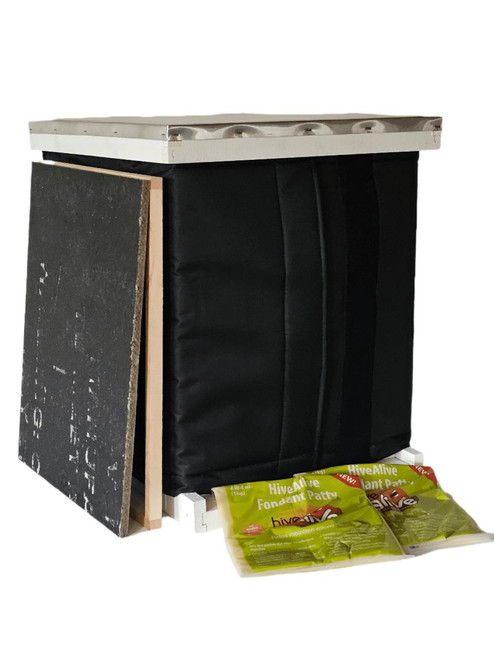
The Winter Bee Hive Wrap & Winterizing Kit – 8 & 10 Frame brings together four winter-management components for a compatible Langstroth hive: an exterior insulation wrap, a moisture board, a shim, and two 2.2 lb HiveAlive fondant patties. Instead of treating insulation as the entire winter plan, this kit addresses wind exposure and heat loss, moisture above the colony, feeding clearance, and access to supplemental carbohydrate feed.
At Lappe's Bee Supply, we use this style of winterizing setup in cold Midwestern conditions, including exposed bee yards where winter wind is an important consideration. The most important ordering detail is that wrap height and frame size are two separate choices: choose the wrap according to the boxes remaining on the hive for winter, then choose the moisture board and shim according to whether you use 8-frame or 10-frame equipment.
At a Glance
- Product: Winter Bee Hive Wrap & Winterizing Kit – 8 & 10 Frame
- SKU: WNTS-2346
- Hive format: Compatible Langstroth configurations
- 20½-inch wrap: Approximately 76-1/8" L × 20-1/2" H × 1/4" thick; for two deep boxes
- 23½-inch wrap: Approximately 75-1/4" L × 23-1/2" H × 1/4" thick; for two deep boxes plus one medium
- Moisture board: 1/2" thick; select 8-frame or 10-frame
- Feeding Shim: Assembled unfinished pine; 3/4" high; select 8-frame or 10-frame
- Fondant: Two 2.2 lb HiveAlive fondant patties
- Included: One insulation wrap, one moisture board, one shim, and two 2.2 lb HiveALive fondant patties
Choose the Correct Configuration Before Ordering
This kit requires two independent selections. Do not choose the wrap height based on whether your hive is 8-frame or 10-frame. First determine the box configuration that will remain on the colony for winter. Then match the moisture board and shim to your frame format.
| What You Are Choosing | Choose This Option | When to Choose It |
|---|---|---|
| Wrap height | 20½ inches | Two deep boxes remain for winter |
| Wrap height | 23½ inches | Two deep boxes plus one medium remain for winter |
| Moisture board & shim | 8-frame | Your hive uses compatible 8-frame equipment |
| Moisture board & shim | 10-frame | Your hive uses compatible 10-frame equipment |
Compatibility and Fit
This kit is designed for compatible 8-frame and 10-frame Langstroth equipment, but frame count alone does not guarantee fit. Before ordering, measure the exterior dimensions of your assembled winter hive and compare them with the specifications below.
Handles, cleats, feeders, homemade woodenware, attached hardware, or other exterior projections can affect wrap fit and reduce the amount of closure overlap available. Alternative hive styles, unusual box dimensions, or winter stacks outside the listed configurations should not be assumed to fit.
What Is Included?
- One winter hive insulation wrap in the selected height
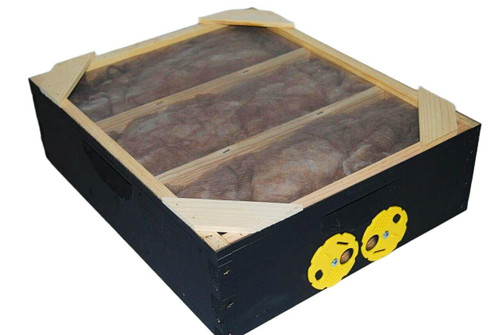
- One moisture board in the selected 8-frame or 10-frame size
- One shim in the selected 8-frame or 10-frame size
- Two 2.2 lb HiveAlive fondant patties
The beekeeper supplies the compatible hive and normal hive components. Entrance reducers, mouse guards, other winter entrance equipment, and any additional supplemental feed needed later are separate from this kit.
Component Specifications
Each kit includes four components sized for the selected winter configuration. Review the specifications below when choosing your setup.
Winter Hive Insulation Wrap
Choose the wrap according to the boxes that will remain on the hive for winter.
20½-Inch Wrap – Two Deep Boxes
- Overall dimensions: approximately 76-1/8" L × 20-1/2" H × 1/4" thick
- Intended configuration: two deep hive bodies
- Intended 8-frame hive dimensions: 20" L × 14" W × 20-1/2" H
- Intended 10-frame hive dimensions: 20" L × 16-1/4" W × 20-1/2" H
- Reopenable Velcro closure
- No straps
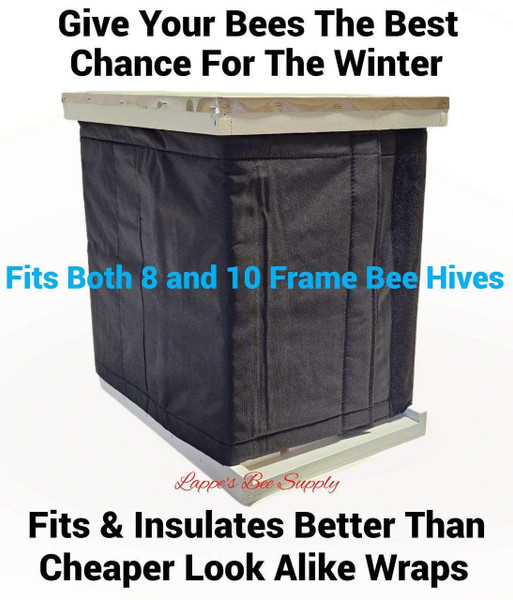
- Wraps around the exterior of the hive bodies for winter wind protection and insulation
23½-Inch Wrap – Two Deep Boxes + One Medium
- Overall dimensions: approximately 75-1/4" L × 23-1/2" H × 1/4" thick
- Intended configuration: two deep hive bodies plus one medium
- Intended 8-frame hive dimensions: 20" L × 14" W × 23-1/2" H
- Intended 10-frame hive dimensions: 20" L × 16-1/4" W × 23-1/2" H
- Reopenable Velcro closure
- Attached straps included
The overall wrap dimensions describe the physical wrap itself. The intended hive dimensions describe the exterior hive size the wrap is designed to fit. Do not compare your hive dimensions directly with the wrap's overall laid-flat length.
Before ordering, measure the outside length, width, and total height of your assembled winter hive stack. Exterior handles, cleats, feeders, homemade woodenware, or other projecting hardware can increase the space required and reduce the amount of Velcro overlap available for securely closing the wrap.
Winter Bee Hive Moisture Board
Choose the moisture board according to your hive's frame format.
8-Frame
- Dimensions: 20" L × 14" W × 1/2" thick
10-Frame
- Dimensions: 20" L × 16" W × 1/2" thick
The moisture board is installed above the compatible shim with the dark side facing upward, away from the bees. The inner cover is removed when using this configuration, and the outer cover is replaced above the moisture board.
Feeding Shim
The included wooden feeding shim provides clearance above the brood frames for the fondant patties.
- Material: pine
- Construction: assembled and unfinished
- Height: 3/4" shallow shim
8-Frame
- Outside dimensions: 20" L × 14" W
10-Frame
- Outside dimensions: 20" L × 16-3/16" W
The 3/4-inch height provides room for the included fondant without adding unnecessary empty space above the colony.
Fondant Patties
- Quantity included: Two 2.2 lb HiveAlive fondant patties
- Supplemental carbohydrate feed for winter use
- Designed to be positioned above the brood frames within the feeding-shim space
- Keep the wrapper on the fondant during use
- Cut an approximately 3" (8 cm) opening in the wrapper and position that opening directly over the brood frames
The fondant supplements the colony's existing winter stores; it does not replace the need for adequate stored food going into winter.
How to Install the Winterizing Kit
After the colony and hive are prepared for winter, assemble the kit in this order:
- Place the fondant above the brood frames. Keep the wrapper on each patty, cut an approximately 3" (8 cm) opening in the wrapper, and position the opening over the brood frames.
- Install the feeding shim. Place the 3/4" shim above the hive body to provide clearance for the fondant.
- Add the moisture board. Remove the inner cover and place the moisture board above the shim with the dark side facing upward, away from the bees.
- Replace the outer cover above the moisture board.
- Install the winter wrap around the hive bodies. Keep the entrance and necessary ventilation unobstructed and make sure the wrap is securely closed around the hive.
For the 23½" wrap, use the included straps to help secure the wrap around the hive. After installation, check that the wrap is secure and that entrances and necessary ventilation remain clear.
How the Winterizing Kit Works as a System
Exterior insulation and wind protection
The winter hive wrap surrounds the hive bodies to provide a physical barrier against direct winter wind and reduce heat loss through the hive walls. The wrap does not generate heat and is not intended to create artificially warm, summer-like conditions inside the hive.
Moisture management above the colony
The moisture board supports winter moisture management above the colony. Managing moisture remains an important part of the overall winter setup rather than something insulation replaces.
Clearance for supplemental feeding
The shim provides additional space above the colony for feeding. This allows the included fondant to be positioned above the cluster where bees can move upward toward it when conditions and colony needs call for supplemental feed.
Two 2.2 lb HiveAlive fondant patties
Two 2.2 lb HiveAlive fondant patties provide supplemental winter carbohydrate feed. They do not replace the need to prepare the colony with adequate winter stores, and additional feed may be needed later depending on colony conditions.
Lappe's Bee Supply Apiary Note: Food Present Is Not Always Food Accessible
In our experience with cold Midwestern winters, a colony can still have honey elsewhere in the hive while the winter cluster has difficulty reaching those stores during prolonged cold. That is why we consider food accessibility as well as total stores. Supplemental fondant positioned above the cluster can provide another accessible food source when it is needed.
Our rule of thumb is simple: Get the bees ready for winter first. Then get the hive ready for winter. Winterizing equipment can help manage environmental stresses, but it cannot correct an unhealthy colony, excessive Varroa pressure, inadequate food stores, or other unresolved colony-management problems.
When Should You Install the Winter Setup?
Winter hive wraps are generally installed after sustained cold becomes established but before severe winter weather makes hive work difficult. Complete colony preparation first, then install the selected winter equipment before prolonged severe cold and strong winter winds arrive.
During winter, many checks can be made from outside the hive. Monitor the wrap to make sure it remains secure, keep entrances clear, watch the condition of the cover and other exterior equipment, and continue evaluating supplemental food needs without unnecessarily taking the hive apart.
For more seasonal guidance, see when to add insulation wraps to a beehive.
Is the Complete Winterizing Kit Right for Your Hive?
This kit may be a good choice when you have a supported 8-frame or 10-frame Langstroth winter configuration and want insulation, moisture management, feeding clearance, and supplemental fondant organized into one setup. It is particularly relevant to cold, windy conditions and exposed apiary locations.
Individual components may make more sense if you already own an effective wrap, moisture-management equipment, feeding shim, or another part of your winter system. The goal is to fill real winter-management needs rather than duplicate equipment you already have.
Explore the Winter Bee Hive Insulation Wrap if you only need the exterior wrap, or see the Winter Bee Hive Moisture Board for the moisture-management component by itself.
Important Winter Expectations
A winterizing kit helps manage the colony's winter environment, but it does not guarantee colony survival or replace proper colony preparation.
- The wrap provides insulation and wind protection; it does not generate heat.
- The kit does not replace adequate and accessible food stores, appropriate Varroa management, or other necessary winter preparation.
- Winter results still depend on factors such as colony condition, weather, hive location, moisture management, installation, and normal biological variability.
- Not every climate, apiary, hive style, or beekeeper needs the complete kit, and unsupported hive configurations should not be forced to fit the available components.
Reusable Winter Equipment: Inspect Function, Not Just Appearance
Reusable winterizing components do not have a fixed number of winters after which they must automatically be discarded. Repeated wind, moisture, wet/dry cycles, handling, installation, and storage can gradually increase wear, so condition and function are more useful replacement guides than age alone.
Cosmetic creasing, staining, discoloration, or ordinary weathering does not automatically mean a component is worn out. Repair or replacement becomes more appropriate when damage compromises fit, strength, secure attachment, structural integrity, or the component's intended winter function.
For the wrap, minor localized damage may be repairable when the surrounding material remains sound and the wrap can still be secured reliably. Lappe's generally replaces structurally damaged moisture boards rather than patching them. Minor shim repairs may be worthwhile when the shim can be restored to solid, square, proper-fitting condition.
Winter Beekeeping Resources
Compare additional winter bee hive wraps and insulation, or browse winter beekeeping supplies for other equipment that may be part of your colony's winter plan.
Frequently Asked Questions
Which wrap height do I need?
Choose the 20½-inch-high wrap when your winter hive configuration is two deep boxes. Choose the 23½-inch-high wrap when your winter configuration is two deep boxes plus one medium.
Do I choose the wrap based on whether I have an 8-frame or 10-frame hive?
No. Wrap height is selected according to the boxes remaining on the hive for winter. The 8-frame or 10-frame selection applies to the moisture board and shim.
What comes with the Winter Bee Hive Wrap & Winterizing Kit?
The kit includes one winter hive insulation wrap in the selected height, one moisture board in the selected 8-frame or 10-frame size, one matching shim, and two 2.2 lb HiveAlive fondant patties.
Will this winterizing kit work with my hive?
The kit is intended for compatible Langstroth configurations using the supported 8-frame or 10-frame equipment and winter box arrangements. Alternative hive styles, unusual dimensions, or unsupported box configurations should not be assumed to fit.
Where does the fondant go?
The fondant is positioned above the colony where the winter cluster can move upward toward it, with the shim providing feeding clearance. Supplemental feed should be used according to the colony's food needs.
Will wrapping my hive guarantee that the colony survives winter?
No. Winterizing equipment does not guarantee colony survival. Colony health, Varroa management, adequate and accessible food, moisture management, weather, hive location, and correct installation remain important.
Do I need the complete kit if I already own some winterizing equipment?
Not necessarily. If you already have suitable insulation, moisture-management equipment, feeding clearance, or another effective part of your winter setup, buying only the individual components you still need may be more appropriate.
Can I reuse the winterizing components?
Reusable components may continue to be used while their fit, structure, secure attachment, and intended function remain sound. Replace or repair components when damage compromises those functions rather than relying on a fixed number of winters.