Welcome to Lappe's Bee Supply's blogs section. We are a trusted beekeeping company in the USA. We give relevant insights, seasonal guidance, and professional advice for beekeepers of all experience levels. From hive management and bee wellness to honey production and equipment guides, we have it all that you will require to thrive. Get updated, motivated, and connected with the beekeeping community through regular news from Lappe's Bee Supply.
What is Beeswax and How is it Made???
The Buzz About This Post
What Is Beeswax? How It’s Made, Uses, and Environmental Impact
Published: September 16, 2026
By: Lappe’s Bee Supply • Reviewed for factual clarity, practical accuracy, source quality, and readability.
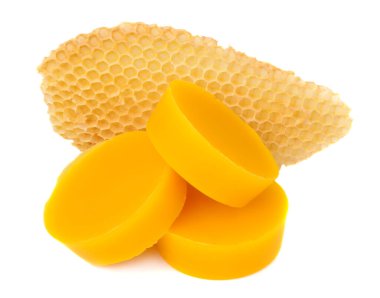
Beeswax is one of the most recognizable materials produced by a honeybee colony. Inside the hive, it forms the comb that organizes food storage and brood rearing. Outside the hive, rendered wax has been used for generations in candles, balms, polishes, coatings, artwork, and other products.
Understanding beeswax requires looking at both the biology of the honeybee and the physical properties of the wax itself. Worker bees produce tiny wax scales, manipulate the material, and build it into an organized comb structure. Once harvested and rendered, the same natural material can be cleaned and used in many practical applications.
On This Page
Key Takeaways
- Beeswax is a natural wax secreted by worker honeybees and used to construct honeycomb.
- Honeycomb provides cells for storing honey and pollen and for rearing developing bees.
- Beeswax is a complex mixture containing esters, hydrocarbons, fatty acids, alcohols, and many minor constituents.
- Worker bees produce small wax scales and manipulate them while constructing comb.
- Beeswax commonly melts at approximately 62–65°C, although natural variation affects the exact range.
- Common uses include candles, cosmetics, wax coatings, polishes, pharmaceutical formulations, and art.
- Beeswax is biologically produced, while conventional paraffin wax is petroleum-derived.
Quick Definition
Beeswax is a natural wax secreted by worker honeybees and used as the primary construction material for honeycomb.
What is beeswax?
Beeswax is a natural wax secreted by worker honeybees and used to build honeycomb for storing honey, pollen, and developing brood.
- Worker honeybees produce the wax used to construct comb.
- Freshly secreted wax begins as small scales.
- Comb provides storage space for honey and pollen.
- Comb cells also provide the structure in which brood develops.
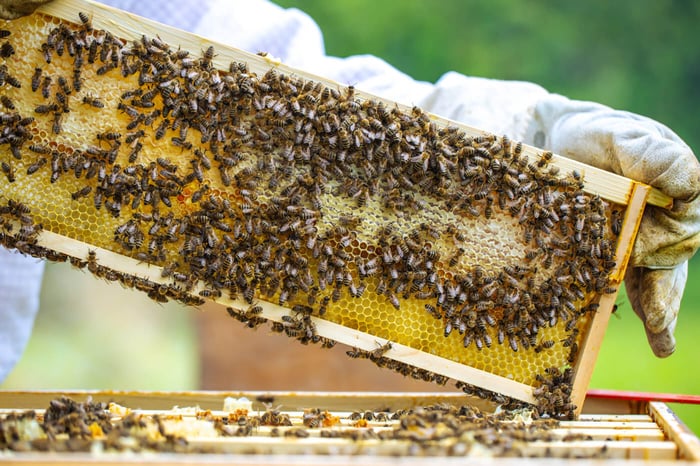
In practical terms, beeswax is the building material of the honeybee colony. Honeybees depend on comb for much of the organization inside the hive. Honey is stored in comb cells, pollen can be packed into cells, and eggs are laid in cells where larvae and pupae develop.
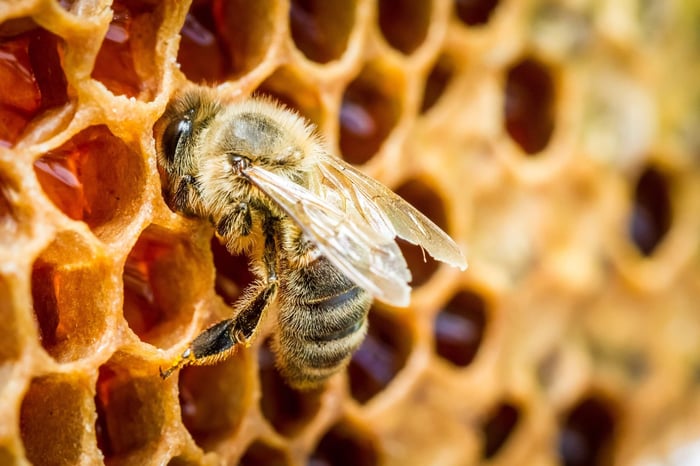
Fresh wax is generally pale, but comb can become darker as it ages and remains in use. Pollen, propolis, cocoon material, and other hive substances can gradually become incorporated into older comb. This is why freshly drawn comb may look almost white while older brood comb can appear brown or very dark.
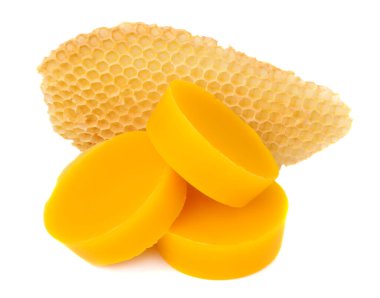
Once beeswax is removed from the hive and rendered, it can be filtered and formed into blocks, pellets, sheets, or other forms depending on its intended use. Its combination of firmness at normal room temperatures and workability when warmed helps explain its long history as a useful natural material.
What is beeswax made of?
Beeswax is a complex natural mixture dominated by esters, with hydrocarbons, fatty acids, alcohols, and other minor compounds also present.
- Beeswax is not one single chemical compound.
- Esters represent a major portion of natural beeswax.
- Hydrocarbons and free fatty acids are also important components.
- Minor constituents contribute to the wax’s natural variability.
Scientific analyses describe beeswax as a complex mixture containing hundreds of chemical constituents. Research reviews identify wax esters, hydrocarbons, free fatty acids, fatty alcohols, and related compounds among its major chemical groups. The exact proportions can vary with bee species, geographical origin, age of the wax, and other factors.
This variability helps explain why beeswax does not behave exactly like a purified synthetic wax. Different batches may show modest differences in color, aroma, hardness, and melting behavior while still being genuine beeswax.
| Component Group | What It Means |
|---|---|
| Wax esters | Represent a major structural fraction of natural beeswax. |
| Hydrocarbons | Contribute to the physical and water-resistant characteristics of the wax. |
| Free fatty acids | Form another important chemical fraction of natural beeswax. |
| Fatty alcohols | Occur in smaller amounts as part of the overall mixture. |
| Minor constituents | May contribute to natural differences in aroma, color, texture, and handling. |
How do honeybees make beeswax?
Worker honeybees secrete tiny wax scales from abdominal glands, then manipulate and shape the softened wax while constructing honeycomb cells.
- Specialized glands on worker bees produce wax.
- The wax first appears as small scales.
- Workers manipulate the scales with their legs and mouthparts.
- The material is incorporated into developing honeycomb.
Beeswax production takes place inside the worker honeybee. Specialized wax glands are located on the underside of the abdomen. Wax is secreted and appears as small scales, which workers remove and manipulate while constructing comb.
Building comb requires colony resources and energy. Wax production is closely connected with colony activity, food availability, temperature, and the physiological condition of the bees. This is why comb building is often most noticeable when a colony is growing and resources are available.
- Energy is available: Worker bees use colony food resources to support wax production and comb building.
- Wax is secreted: Specialized abdominal glands produce tiny wax scales.
- Wax is manipulated: Workers handle and condition the scales.
- Cells are formed: The softened material is incorporated into developing comb.
- Comb expands: Repeated construction creates the connected cells used throughout the colony.
The finished comb becomes much more than a storage area. It is the physical framework around which much of colony life is organized.
Why is honeycomb hexagonal?
Honeycomb forms repeating hexagonal cells because hexagons tile efficiently without leaving gaps and create a compact repeating structure.
- Regular hexagons can fit together without gaps.
- Hexagonal tiling creates a compact repeating pattern.
- Mathematics shows hexagonal partitions minimize boundary length for equal-area regions.
- Actual honeycomb is three-dimensional and more complex than a flat diagram.
The familiar hexagonal pattern of honeycomb is an example of highly efficient geometry. A regular hexagonal tiling can divide a surface into equal areas without leaving unused gaps. The mathematical Honeycomb Conjecture demonstrates that a regular hexagonal tiling minimizes the total perimeter needed to divide a plane into equal-area regions.
That geometric result helps explain why hexagons are described as material-efficient. Less boundary length is needed than with many alternative equal-area patterns. However, real honeycomb should not be reduced to a simple two-dimensional drawing. Honeybee comb consists of opposing layers of three-dimensional cells, and researchers continue to study the details of its geometry and construction.
What are common uses of beeswax?
Beeswax is used in candles, cosmetics, food coatings, polishes, pharmaceuticals, and art because it stays stable, moldable, protective, and workable.
- Beeswax is a traditional material for candle making.
- Balms and cosmetics use beeswax to add structure and body.
- Wax coatings can provide a protective surface.
- Beeswax is used in some pharmaceutical formulations.
- Artists use beeswax in encaustic painting and other wax-based techniques.
Beeswax remains useful because its physical characteristics work well in many different applications. It softens when warmed and becomes firm again as it cools. It can add structure to mixtures, create a waxed surface, and help thicken formulations without behaving like a rigid material at every temperature.
In cosmetics and balms, beeswax can help create body and consistency. In candles, it serves as the primary combustible wax. In polishes and finishes, it can contribute sheen and a protective wax layer. Pharmaceutical literature also describes beeswax as a stiffening agent, viscosity modifier, emulsion stabilizer, and lipid-based formulation material.
| Common Use | Why Beeswax Is Used |
|---|---|
| Candles | Provides a firm natural candle wax that becomes workable when heated. |
| Balms and cosmetics | Adds structure, firmness, and viscosity to many formulations. |
| Food-related coatings and wraps | Creates a flexible wax coating when used in an appropriate formulation. |
| Wood and furniture finishes | Can provide sheen and a protective waxed surface. |
| Pharmaceutical formulations | Can function as a stiffening, stabilizing, or lipid-based excipient. |
| Encaustic art | Provides a durable wax medium that can be heated and manipulated. |
How does beeswax compare to paraffin wax?
Beeswax is produced by honeybees, while conventional paraffin wax is petroleum-derived; performance and environmental effects depend on the intended use.
- Beeswax is produced biologically by honeybees.
- Conventional paraffin wax is derived from petroleum refining.
- Natural beeswax varies somewhat in composition.
- Paraffin is available in grades with different melting and handling characteristics.
- The best wax depends on the product and its intended performance.
Beeswax and paraffin can both be used in candles and other wax-based products, but their origins are fundamentally different. Beeswax is made by living honeybee colonies. Conventional paraffin is obtained from petroleum-derived feedstocks and refined into wax grades with different physical characteristics.
It is tempting to describe one material as universally better than the other, but that comparison is too simple. Price, melting behavior, hardness, fragrance, processing requirements, additives, transportation, formulation, and final use can all affect the practical and environmental result.
| Feature | Beeswax | Paraffin Wax |
|---|---|---|
| Source | Produced by honeybees | Primarily petroleum-derived |
| Composition | Complex natural mixture | Refined mixture of hydrocarbons |
| Typical melting behavior | Commonly about 62–65°C | Varies by grade and formulation |
| Natural variability | Yes | Generally more controlled through refining |
| Feedstock | Biologically produced | Fossil-derived |
Beeswax melting point: Natural beeswax commonly melts at approximately 62–65°C, or about 144–149°F. The exact measured range can vary because beeswax is a complex natural mixture rather than a single purified compound.
When melting beeswax, gentle heating is preferable. The Food and Agriculture Organization advises avoiding direct flame and heating only enough to melt the wax. Excessive temperatures can discolor or damage beeswax.
Is beeswax environmentally sustainable?
Beeswax is biologically renewable, but overall sustainability depends on colony health, responsible sourcing, processing, transportation, formulation, and final use.
- Honeybee colonies can produce additional wax over time.
- Beeswax is biologically produced rather than refined from petroleum.
- Responsible colony management matters when evaluating its sustainability.
- Rendering, cleaning, transportation, and packaging also require resources.
- The environmental impact of a finished product depends on more than the wax alone.
Beeswax is often described as a renewable natural material because honeybee colonies can continue producing wax. Its biological origin distinguishes it from conventional petroleum-derived paraffin. Beeswax can also break down under suitable environmental conditions, although biodegradation depends on temperature, microorganisms, exposure, and the other ingredients in a finished product.
Natural origin alone does not make any material impact-free. Beekeeping practices, colony health, wax collection, rendering, filtration, transportation, packaging, and final product formulation can all influence environmental performance.
For that reason, the most defensible description is that beeswax is a renewable biological material with potential environmental advantages. A claim that it is always more sustainable than every alternative would require a lifecycle comparison of equivalent finished products.
Frequently Asked Questions
What is beeswax?
Beeswax is a natural wax secreted by worker honeybees and used to construct honeycomb for storing honey, pollen, and developing brood.
What is beeswax made of?
Beeswax is a complex natural mixture dominated by esters and also contains hydrocarbons, fatty acids, alcohols, and other minor compounds.
How do honeybees make beeswax?
Worker honeybees secrete small wax scales from specialized glands on the abdomen, then manipulate and shape the wax while building honeycomb.
Why is honeycomb hexagonal?
Hexagonal cells fit together without gaps and form an efficient repeating structure. The mathematics of hexagonal tiling shows that it minimizes boundary length for equal-area regions.
What are common uses of beeswax?
Common beeswax uses include candles, cosmetics, lip balms, food-related coatings, polishes, wood finishes, pharmaceutical formulations, and encaustic art.
How does beeswax compare to paraffin wax?
Beeswax is produced biologically by honeybees, while conventional paraffin wax is petroleum-derived. Their performance, price, and environmental effects depend on grade, formulation, processing, and use.
At what temperature does beeswax melt?
Beeswax commonly melts at approximately 62–65°C, or about 144–149°F, although the measured range can vary slightly.
Is beeswax biodegradable?
Beeswax is a natural biological material that can biodegrade under suitable environmental conditions, although the rate depends on conditions and the finished product.
Is beeswax vegan?
Beeswax is produced by honeybees and is therefore an animal-derived material. Most definitions of vegan products exclude beeswax.
Sources
The following references provide additional scientific and technical information about beeswax composition, physical properties, processing, applications, and honeycomb geometry.
- Food and Agriculture Organization of the United Nations — Value-Added Products from Beekeeping: Beeswax
- Food and Agriculture Organization of the United Nations — Bees and Their Role in Forest Livelihoods
- Huanbutta et al. — Beeswax in Pharmaceutical Sciences: Chemical Composition, Applications, and Formulation Roles
- Fratini et al. — Beeswax: A Minireview of Its Antimicrobial Activity and Its Application in Medicine
- Asian Pacific Journal of Tropical Medicine — Beeswax Composition and Physical Properties
- Discrete & Computational Geometry — The Honeycomb Conjecture
FAQs
What Is Beeswax?
Beeswax is a natural wax secreted by the glands of worker honeybees, primarily those between the ages of 4 and 12 days old.
What is beeswax made of?
Beeswax is composed primarily of esters, with smaller amounts of hydrocarbons, fatty acids, and long-chain alcohols.
How do honeybees make beeswax?
Worker bees consume honey for energy, secrete wax scales from abdominal glands, chew and soften the scales, and mold them into honeycomb.
At what temperature does beeswax melt?
Beeswax typically melts around 62–64°C (143–147°F), though exact values can vary slightly by composition and processing.
Is beeswax biodegradable?
Yes. Beeswax is a natural biodegradable material under typical environmental conditions.
Is beeswax vegan?
No. Beeswax is produced by honeybees and is considered an animal-derived product.