Welcome to Lappe's Bee Supply's blogs section. We are a trusted beekeeping company in the USA. We give relevant insights, seasonal guidance, and professional advice for beekeepers of all experience levels. From hive management and bee wellness to honey production and equipment guides, we have it all that you will require to thrive. Get updated, motivated, and connected with the beekeeping community through regular news from Lappe's Bee Supply.
Understanding Varroa Mite Infestation in Honey Bees: Detailed Identification and Detection Methods
The Buzz About This Post
- What Should Beekeepers Know About Varroa Mites?
- What Does This Varroa Mite Guide Cover?
- What Are Varroa Mites and Why Are They Dangerous to Honey Bees?
- What Are the Signs of Varroa Infestation in Honey Bees?
- How Can Beekeepers Detect Varroa Accurately?
- How Do You Perform an Alcohol Wash for Varroa?
- How Does a Sugar Shake Test Detect Varroa?
- Can Visual Inspection and Drone Brood Inspection Detect Varroa?
- How Is an Infestation Level Calculated?
- How Should Beekeepers Manage a Varroa Infestation?
- What Are the Most Common Questions About Varroa?
- Can you see Varroa mites on honey bees?
- What does a Varroa mite look like?
- Do deformed wings mean a colony has Varroa?
- What is the best way to check a hive for infestation?
- How many bees are used for a mite test?
- Does an alcohol wash kill the bees?
- Does a powdered sugar roll kill the bees?
- What does a 3% infestation mean?
- Is seeing one mite enough to treat a hive?
- Should mite levels be checked after treatment?
- Where Can Beekeepers Find Reliable Varroa Information?
- FAQs
Understanding Varroa Mite Infestation in Honey Bees: Detailed Identification and Detection Methods
Written by Lappe's Bee Supply
Published: August 29, 2025
Last Updated: August 26, 2026
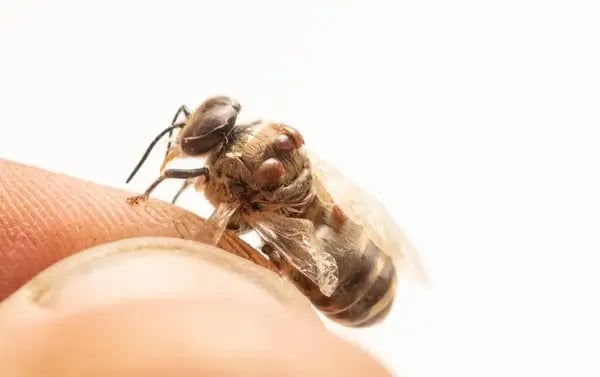
Varroa is one of the most serious parasite threats facing managed honey bee colonies. Learning how to recognize signs of infestation is important, but visual symptoms alone cannot tell a beekeeper how severe the problem is. Reliable management depends on routinely sampling adult bees, calculating infestation levels, and responding before parasite and virus pressure becomes overwhelming.
|
What Does This Varroa Mite Guide Cover?This guide covers identification, colony symptoms, alcohol washes, sugar rolls, brood inspection, mite calculations, and management decisions.
|
What Are Varroa Mites and Why Are They Dangerous to Honey Bees?
|
- The scientific name of the parasite is Varroa destructor.
- Female mites enter brood cells before the cells are capped.
- The parasite reproduces while the developing honey bee is sealed inside the brood cell.
- It also parasitizes adult honey bees.
- The mites can transmit viruses, including deformed wing virus.
Beekeeping is a rewarding pursuit, but maintaining healthy colonies requires ongoing attention to parasites and disease. Among the most important threats is Varroa destructor. These small parasites can remain unnoticed during casual hive inspections while still building to damaging levels within a colony.
The parasite was once commonly described as feeding primarily on the bee's hemolymph, which functions somewhat like blood. Research conducted by scientists with the USDA Agricultural Research Service and the University of Maryland changed that understanding. The research demonstrated that it primarily consumes honey bee fat body tissue.
The honey bee fat body performs important functions involving nutrient storage, immune response, pesticide detoxification, and overwintering health. Damage to this tissue can therefore affect much more than the individual feeding site.
This parasite is especially dangerous because it also acts as a vector for honey bee viruses. A colony may therefore be dealing with both direct parasitic injury and increasing virus pressure at the same time.
What Are the Signs of Varroa Infestation in Honey Bees?
|
Recognizing Signs of Varroa Mite Infestation
Recognizing possible signs of infestation can help beekeepers identify colonies that require immediate attention. However, symptoms should be considered warning signs rather than a replacement for a mite count. Colonies can carry damaging parasite populations before obvious visual symptoms appear.
1. Deformed Bees
Bees with shriveled, crumpled, or poorly developed wings are among the most recognizable warning signs associated with severe parasite and virus pressure. Deformed wing virus is strongly associated with heavy infestations because the mites can transmit the virus while feeding.
Affected bees may crawl instead of fly and may have shortened abdomens or other developmental abnormalities. Although these symptoms should prompt immediate investigation, not every abnormal bee proves that mites are the sole cause.
2. Brood Issues
Healthy brood normally has a reasonably consistent pattern when a productive queen is laying well and developing brood remains healthy. Colonies experiencing severe parasite-associated disease may develop spotty or irregular brood patterns.
Beekeepers may notice unhealthy larvae or pupae, damaged or chewed brood cappings, prematurely opened cells, or brood that fails to develop normally. These conditions can also occur for reasons unrelated to infestation, so they should lead to further testing rather than an automatic diagnosis.
3. Visible Mites on Bees
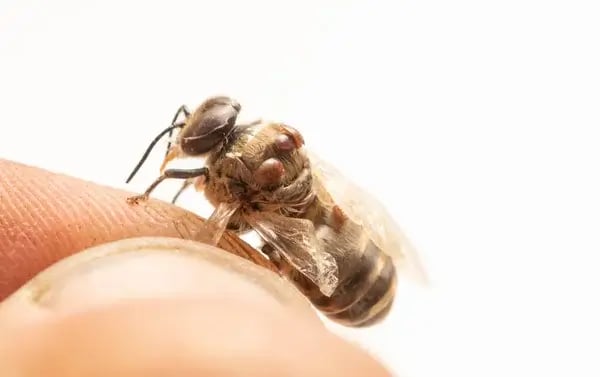
Adult female Varroa mites are reddish-brown, flattened, and oval. Their bodies are wider than they are long. A mite may occasionally be visible on an adult bee, although many parasites occupy locations that are difficult for a beekeeper to see during a normal hive inspection.
Mites can also be observed in capped brood. Opening infested brood cells may reveal adult females and developing offspring around the bee pupa.
|
4. Other Pertinent Symptoms
A colony suffering from high parasite and virus pressure may experience a declining adult bee population, increased numbers of unhealthy or crawling bees, and removal of damaged brood or compromised adults by worker bees.
These signs become especially concerning when several appear together. However, the most useful next step is still to perform a standardized test rather than trying to estimate mite pressure by appearance alone.
How Can Beekeepers Detect Varroa Accurately?
|
Effective Detection Methods
Effective management begins with measurement. Beekeepers should use a consistent monitoring method so results can be compared between colonies and over time.
The two primary methods for estimating mite levels on adult bees are an alcohol wash and powdered sugar roll. The University of Minnesota Bee Lab states that the alcohol wash is more reliable than the powdered sugar roll because fewer outside variables affect the result.
| Detection Method | Provides a Count? | Sample Bees Killed? | Best Use | Main Limitation |
|---|---|---|---|---|
| Alcohol Wash | Yes | Yes | Quantitative routine monitoring | Sacrifices the sampled adult bees |
| Powdered Sugar Roll | Yes | Generally no | Nonlethal adult-bee monitoring | Technique, humidity, and sugar condition can affect results |
| Visual Inspection | Not a reliable infestation rate | No | Recognizing obvious mites or symptoms | Can substantially underestimate infestation |
| Drone Brood Inspection | Not an adult-bee infestation rate | Brood cells are opened | Finding mites reproducing in brood | Does not replace standardized adult-bee sampling |
How Do You Perform an Alcohol Wash for Varroa?
|
1. Alcohol Wash
An alcohol wash is one of the most useful methods for estimating parasite levels in a honey bee colony. Penn State Extension describes the alcohol wash as its preferred method of monitoring infestation.
A typical test uses approximately one-half cup of adult bees, which is commonly estimated as roughly 300 bees. Bees are often collected from a brood-area frame containing open brood because nurse-age bees are useful for standardized sampling.
Alcohol Wash Checklist
|
Alcohol washing kills the sampled bees, which is an important consideration for beekeepers. The queen must never be included in the sample.
Although losing several hundred worker bees may initially seem concerning, a strong colony contains many thousands of adult bees. Obtaining an accurate picture of parasite pressure can provide information needed to protect the colony as a whole.
How Does a Sugar Shake Test Detect Varroa?
|
2. Sugar Shake Test
The sugar shake test, also commonly called a powdered sugar roll, provides a nonlethal alternative for estimating infestation levels on adult bees.
Approximately one-half cup of adult bees can be placed in a screened sampling container with powdered sugar. The bees are coated thoroughly so that mites become dislodged from their bodies. The parasites and sugar are then shaken through the screen for counting.
After the test, the adult bees can generally be returned to their colony. This is one of the major reasons some beekeepers prefer the powdered sugar method.
However, careful technique matters. The University of Minnesota Bee Lab notes that humidity, nectar flow, clumped or stale powdered sugar, and variations in how the bees are shaken can affect results. The alcohol wash therefore tends to provide more reliable monitoring because fewer variables affect mite recovery.
|
Can Visual Inspection and Drone Brood Inspection Detect Varroa?
|
3. Visual Inspection
Routine visual examination remains valuable because beekeepers should pay attention to the condition of adult bees, brood, and the overall colony.
Look for adult mites, deformed bees, unusual brood patterns, unhealthy pupae, damaged cappings, and other signs that suggest the colony may be under stress.
The limitation is that only a tiny percentage of the bees in a colony are examined closely during a normal inspection. A beekeeper can therefore fail to see parasites even when the colony has a significant infestation.
4. Drone Brood Inspection
Varroa reproduces in capped brood, and drone brood is especially useful for seeing mites because the larger cells and pale developing pupae can make reddish-brown adult parasites easier to recognize.
Carefully opening capped drone cells can reveal mites within the brood. This is useful for confirming the presence of infestation and teaching beekeepers what the parasite looks like.
Drone brood inspection should not be treated as a replacement for an alcohol wash or powdered sugar roll when the objective is determining the adult-bee infestation rate.
How Is an Infestation Level Calculated?
|
Counting mites becomes much more useful when the beekeeper also knows approximately how many bees were sampled. Results are commonly expressed as the number of mites per 100 adult bees.
The basic calculation is:
| Mite infestation (%) = mites counted ÷ adult bees sampled × 100 |
For example, if an alcohol wash recovers 9 mites from approximately 300 adult bees:
| 9 ÷ 300 × 100 = 3% |
That result can also be stated as approximately 3 mites per 100 adult bees.
| Mites Found in a 300-Bee Sample | Approximate Mites per 100 Bees |
|---|---|
| 1 | 0.3% |
| 3 | 1.0% |
| 6 | 2.0% |
| 9 | 3.0% |
| 12 | 4.0% |
| 15 | 5.0% |
Penn State Extension currently describes 2% or less as acceptable within its alcohol-wash monitoring guidance and advises action when more than six mites are found in an approximately 300-bee sample.
That figure should not be interpreted as a universal treatment threshold for every colony in every location. Appropriate action levels can vary with season, region, colony condition, management goals, and current recommendations. Beekeepers should consult current regional extension or integrated pest management guidance when making treatment decisions.
How Should Beekeepers Manage a Varroa Infestation?
|
Considerations for Management
Early Detection is Crucial
Control is much easier when parasite populations are identified before a colony reaches an advanced stage of decline. Waiting for deformed bees or visible mites can allow significant parasite and virus pressure to develop before action is taken.
Routine sampling gives a beekeeper the opportunity to recognize increasing infestation levels while the colony still appears relatively normal.
Regular Monitoring
Monitoring should be incorporated into the seasonal management routine rather than performed only when something appears wrong. Penn State Extension recommends regular sampling and emphasizes keeping written records so mite populations can be tracked over time.
Recording the colony, date, sample size, mite count, treatment, and follow-up result creates a much clearer picture of what is happening within the apiary.
Follow Treatment Guidelines
When parasite populations reach a level requiring control, select a management option appropriate for current colony conditions and follow the product label exactly.
Treatment choice may depend on factors such as brood presence, colony strength, temperature, honey-super status, treatment timing, active ingredient, resistance considerations, and label restrictions.
The Honey Bee Health Coalition's current Tools for Varroa Management Guide provides updated information on biology, monitoring, control methods, and integrated pest management.
Consider Natural Treatments
Formic acid and oxalic acid are active ingredients used for control. They are sometimes described as naturally occurring or organic-acid treatments, but that terminology should not be interpreted to mean that they can be used without precautions.
Any treatment should be selected according to current legal use requirements and its product label. Application method, temperature limitations, brood conditions, honey-super restrictions, personal protective equipment, dosage, and timing may differ between products.
|
Conclusion
Detecting and managing Varroa is an essential part of maintaining healthy honey bee colonies. Learning to recognize deformed bees, unhealthy brood, visible parasites, and declining colony populations can alert a beekeeper to possible trouble, but visual observations should not replace quantitative monitoring.
An alcohol wash or properly performed powdered sugar roll provides much more useful information because it allows the beekeeper to calculate an approximate infestation rate. Monitoring regularly, keeping records, choosing appropriate control methods, following treatment labels, and testing again afterward create a more complete management program.
The goal is not simply to notice mites. The goal is to know how parasite pressure is changing and respond early enough to protect the colony.
What Are the Most Common Questions About Varroa?
|
Can you see Varroa mites on honey bees?Yes. Adult female Varroa mites can sometimes be seen on adult bees, brood, or comb, but failing to see them does not mean the infestation is low. What does a Varroa mite look like?An adult female Varroa mite is a small, flattened, reddish-brown parasite with an oval body that is wider than it is long. Do deformed wings mean a colony has Varroa?Deformed wings can indicate deformed wing virus associated with parasite pressure, but the symptom alone does not measure the colony's infestation level. What is the best way to check a hive for infestation?Standardized adult-bee sampling, particularly an alcohol wash, provides more useful quantitative information than visual inspection alone. How many bees are used for a mite test?Many alcohol-wash and powdered-sugar-roll protocols use approximately one-half cup, or roughly 300 adult bees. Does an alcohol wash kill the bees?Yes. An alcohol wash kills the sampled adult bees, so beekeepers must make certain that the queen is not included in the sample. Does a powdered sugar roll kill the bees?A properly performed powdered sugar roll is intended as a nonlethal sampling method, allowing the adult bees to be returned to their colony. What does a 3% infestation mean?A 3% result means approximately three mites were recovered for every 100 sampled adult bees, or about nine mites from a 300-bee sample. Is seeing one mite enough to treat a hive?Seeing a mite confirms that infestation is present, but treatment decisions should generally be based on standardized sampling, colony conditions, and current regional guidance. Should mite levels be checked after treatment?Yes. Follow-up monitoring helps determine whether parasite levels actually declined and whether additional management may be necessary. |
Where Can Beekeepers Find Reliable Varroa Information?
|
Sources and Further Reading
- Varroa destructor feeds primarily on honey bee fat body tissue and not hemolymph — Proceedings of the National Academy of Sciences / USDA Agricultural Research Service.
- ARS Microscopy Research Helps Unravel the Workings of a Major Honey Bee Pest — USDA Agricultural Research Service.
- Alcohol Wash for Varroa Mite Monitoring — Penn State Extension.
- How to Do an Alcohol Wash — Penn State Extension.
- Varroa Mite Testing and Management — University of Minnesota Bee Lab.
- Tools for Varroa Management — Honey Bee Health Coalition.
- Ninth Edition of the Tools for Varroa Management Guide — Honey Bee Health Coalition, 2026.
|
FAQs
Can you see Varroa mites on honey bees?
Yes. Adult female Varroa mites can sometimes be seen on adult bees, brood, or comb, but failing to see mites does not mean the infestation is low.
What does a Varroa mite look like?
An adult female Varroa mite is a small, flattened, reddish-brown parasite with an oval body that is wider than it is long.
Do deformed wings mean a colony has Varroa mites?
Deformed wings can indicate deformed wing virus associated with Varroa pressure, but the symptom alone does not measure the colony's infestation level.
What is the best way to check a hive for Varroa mites?
Standardized adult-bee sampling, particularly an alcohol wash, provides more useful quantitative information than visual inspection alone.
How many bees are used for a Varroa mite test?
Many alcohol-wash and powdered-sugar-roll protocols use approximately one-half cup, or roughly 300 adult bees.
Does an alcohol wash kill the bees?
Yes. An alcohol wash kills the sampled adult bees, so beekeepers must make certain that the queen is not included in the sample.
Does a powdered sugar roll kill the bees?
A properly performed powdered sugar roll is intended as a nonlethal sampling method, allowing the adult bees to be returned to their colony.
What does a 3% Varroa infestation mean?
A 3% result means approximately three mites were recovered for every 100 sampled adult bees, or about nine mites from a 300-bee sample.
Is seeing one Varroa mite enough to treat a hive?
Seeing a mite confirms that Varroa is present, but treatment decisions should generally be based on standardized sampling, colony conditions, and current regional guidance.
Should Varroa levels be checked after treatment?
Yes. Follow-up monitoring helps determine whether mite levels actually declined and whether additional management may be necessary.
Related Articles