Welcome to Lappe's Bee Supply's blogs section. We are a trusted beekeeping company in the USA. We give relevant insights, seasonal guidance, and professional advice for beekeepers of all experience levels. From hive management and bee wellness to honey production and equipment guides, we have it all that you will require to thrive. Get updated, motivated, and connected with the beekeeping community through regular news from Lappe's Bee Supply.
Understanding Honeybee Swarming: Nature's Way of Reproduction and Survival
The Buzz About This Post
- What Is Honey Bee Swarming?
- Why Do Honey Bees Swarm?
- When Do Honey Bees Usually Swarm?
- What Signs Show a Honey Bee Colony May Swarm?
- How Does the Honey Bee Swarming Process Work?
- How Is Swarming Different From Supersedure, Emergency Queen Rearing, and Absconding?
- How Can Beekeepers Reduce Swarm Risk?
- How Does Swarming Affect the Parent Colony and Surrounding Environment?
- What Should You Remember About Honey Bee Swarming?
- What Are the Most Frequently Asked Questions About Honey Bee Swarming?
- What Sources Support This Honey Bee Swarming Guide?
- FAQs
Why Do Honey Bees Swarm? Causes, Signs, Timing, and Swarm Prevention
Honeybees swarming is the natural way a colony reproduces. The established queen and many worker bees leave to form a new colony while the original hive raises a replacement queen.
Seeing thousands of honey bees pour from a hive can look alarming, especially to a new beekeeper. Yet a swarm is not automatically a sign that a colony is unhealthy or that something has gone wrong. Strong, rapidly growing colonies are often the colonies most capable of producing reproductive swarms.
Understanding why bees swarm, what warning signs appear beforehand, and how a beekeeper can respond makes swarm season much easier to manage. The key is to read the colony as a whole rather than relying on a single clue such as population size or the presence of a queen cup.

Key Takeaways
- Honeybee swarming is a normal form of reproduction at the colony level.
- A primary swarm normally includes the established queen and a large number of worker bees.
- Rapid population growth and congestion inside the brood nest can increase swarm pressure.
- Abundant nectar and pollen commonly coincide with swarm season because strong forage supports rapid colony growth.
- Queen cells require context because colonies also rear queens for supersedure and emergency replacement.
- Adding a super may relieve storage congestion, but additional space alone cannot guarantee swarm prevention.
- Swarm management is generally more effective before a colony has fully committed to the swarming process.
What Is Honey Bee Swarming?
Honey bee swarming is colony-level reproduction: the established queen and many workers leave to establish another colony while the parent hive raises a replacement queen.
- A swarm represents reproduction of the honey bee colony rather than reproduction of an individual bee.
- The established queen normally leaves with the primary swarm.
- The original hive retains brood, workers, food stores, and developing queen cells.
- The parent colony must establish a replacement queen after the swarm leaves.
A honey bee colony functions as more than a collection of individual insects. It operates as a highly coordinated social unit. Swarming is one of the clearest examples of that organization because the colony effectively divides itself into two groups capable of continuing independently.
Penn State Extension describes swarming as reproduction at the colony level and explains that it is normal behavior in productive colonies.[2] The departing bees leave with a queen and begin searching for another nest, while the parent colony remains in the original hive.
This is why a swarm should not automatically be interpreted as colony failure. In many cases, the colony has become sufficiently populous and well supplied to invest resources in reproduction.
Back to top ↑Why Do Honey Bees Swarm?
Honey bees swarm when colony growth, brood-nest congestion, queen-related signals, seasonal conditions, and strong forage combine to favor colony reproduction.
- Congestion is more meaningful than population size alone.
- Limited open cells can reduce the amount of space available for the queen to lay eggs.
- Reduced distribution of queen pheromones through a crowded colony is associated with swarm preparation.
- Strong nectar and pollen availability can support the population growth that precedes swarming.
- Queen age, colony genetics, weather, and local nectar flows can influence swarm tendency.
There is rarely one single trigger that explains every swarm. A beekeeper may see a large colony and assume that the number of bees alone caused the problem, but usable space inside the colony matters just as much.
A hive may have an empty box above the brood chamber and still experience congestion where the queen is attempting to lay. Incoming nectar can occupy cells in or around the brood nest, reducing available laying space even when the hive does not appear completely full.
University of Florida IFAS Extension identifies colony congestion, queen pheromone distribution, resource availability, queen-related factors, and seasonal conditions among the influences associated with swarm preparation.[1]
When Do Honey Bees Usually Swarm?
Swarming usually peaks during spring and early summer as colonies expand rapidly and nectar and pollen become abundant enough to support colony division.
- Rapid spring brood rearing commonly precedes reproductive swarming.
- Major nectar flows can coincide with intense colony expansion.
- Local bloom periods are often more useful than a single nationwide swarm date.
- Swarming can occur outside the main spring period when colony and forage conditions support it.
Honey bee colonies change dramatically with the seasons. As temperatures warm and flowering plants begin producing pollen and nectar, queens increase egg laying and worker populations rise. Penn State Extension describes this rapid spring increase in brood and adult bees as part of the seasonal progression that can lead to swarming.[3]
Because climate and bloom dates vary, a beekeeper in Iowa may experience a different swarm window than a beekeeper in Georgia, Pennsylvania, or Texas. A fixed calendar date is therefore less useful than watching colony growth and the local nectar flow.
Begin paying particularly close attention before and during the period when colonies are building rapidly. Inspections during this window should focus on brood-space availability, queen-cell development, colony population, nectar placement, and queen status.
Back to top ↑What Signs Show a Honey Bee Colony May Swarm?
Developing queen cells, brood-nest congestion, restricted laying space, a heavy adult population, and spring growth can signal increasing swarm risk.
- Empty queen cups alone do not prove that a colony is preparing to swarm.
- Queen cells containing eggs or larvae are more significant than unused cups.
- Multiple developed queen cells in a strong, crowded colony deserve close attention.
- Reduced laying space can accompany swarm preparation.
- Once swarm preparation is advanced, management options become more limited.
Queen cells are one of the most recognizable warning signs, but they are also one of the easiest signs to misinterpret. Honey bee colonies routinely construct small queen cups, and an empty cup does not necessarily indicate an imminent swarm.
A beekeeper should inspect the cup for an egg or developing larva and then look at the rest of the colony. Is the brood nest crowded? Is incoming nectar filling cells that could be used for eggs? Are numerous queen cells developing? Does the colony still contain fresh eggs? Is the queen present?
Penn State notes that queen rearing can begin before a swarm issues and identifies charged queen cups or queen cells as an important management signal.[2] The important lesson is to interpret queen cells as part of a pattern rather than as an isolated diagnosis.
Back to top ↑How Does the Honey Bee Swarming Process Work?
A primary swarm leaves with the established queen, clusters temporarily, sends scouts to evaluate nest sites, and relocates after reaching a collective decision.
- The established queen normally departs with the primary swarm.
- The swarm commonly forms a temporary cluster after leaving the hive.
- Scout bees investigate possible nesting locations.
- Scouts advertise promising nest sites with waggle dances.
- Recruitment and inhibitory signals help the swarm reach a collective decision.
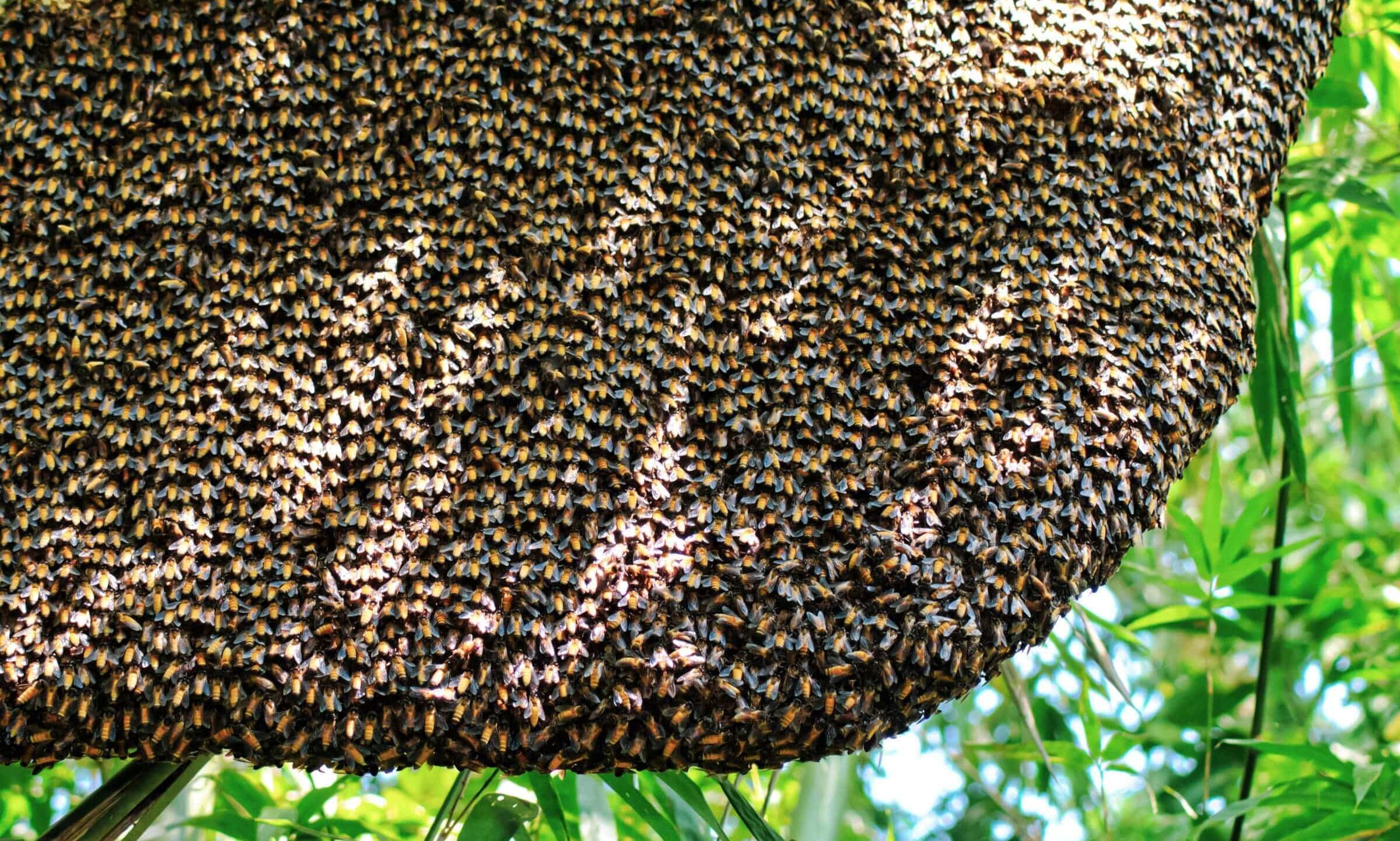
The swarm that appears on a tree limb is usually not establishing its permanent home on that branch. It is often a temporary staging point. While most bees remain clustered around the queen, a smaller number of scout bees search the surrounding area for suitable nesting cavities.
Research by Thomas Seeley and P. Kirk Visscher showed that honey bee scouts communicate information about potential nest sites using waggle dances and that the intensity of recruitment helps encode site quality.[4]
Other primary research has shown that scouts also use inhibitory stop signals during the decision process. These signals help competing groups of scouts reduce support for alternative locations and can improve the swarm's ability to reach consensus.[5]
Once enough support develops for a selected site, the swarm becomes organized for departure and moves to the new cavity, where workers begin building comb, storing food, and establishing brood production.
Back to top ↑How Is Swarming Different From Supersedure, Emergency Queen Rearing, and Absconding?
Swarming divides a colony; supersedure replaces a queen, emergency queen rearing replaces a suddenly lost queen, and absconding abandons the nest.
These behaviors are often confused because more than one can involve queen cells or major changes in colony behavior. Distinguishing them makes inspection decisions much more accurate.
| Colony Behavior | Primary Purpose | What Happens? | Queen Cells? |
|---|---|---|---|
| Swarming | Colony reproduction | The colony divides into a departing swarm and a parent colony. | Commonly present during preparation. |
| Supersedure | Replace an existing queen | The colony generally stays together while replacing its queen. | Yes. |
| Emergency Queen Rearing | Replace a lost or failed queen | Workers raise a queen from suitable young female brood. | Yes. |
| Absconding | Abandon an unsuitable nest | Essentially the colony leaves the existing nest rather than dividing reproductively. | Not the defining feature. |
For the beekeeper, the major lesson is simple: the presence of queen cells does not automatically mean a colony is going to swarm. Queen status, colony population, brood pattern, cell development, congestion, season, and recent management should all be considered before deciding what action to take.
Back to top ↑How Can Beekeepers Reduce Swarm Risk?
Beekeepers reduce swarm risk by managing congestion early, preserving laying space, adding usable room, making appropriate splits, and monitoring queen cells.
- Swarm management is generally most effective before the colony is fully committed to swarming.
- Usable comb in the brood area can matter more than simply adding empty hive volume.
- Splitting a sufficiently strong colony can reduce congestion and create another managed colony.
- Queen cells should be interpreted before they are destroyed or moved.
- No single swarm-control technique guarantees that a colony will remain in the hive.
The best swarm-management program begins with inspection rather than reaction. Beekeepers should understand how much room the queen has to lay, how much of the brood area is occupied by incoming nectar, and whether the colony has begun actively rearing queens.
- Check usable laying space. Look for open cells in and around the brood nest rather than judging space only by the number of boxes.
- Inspect queen cups and queen cells. Determine whether cups are empty or contain eggs, larvae, royal jelly, or developing queens.
- Evaluate brood-nest congestion. Look for crowding from bees, brood, pollen, and incoming nectar.
- Add appropriate space when needed. Additional drawn comb can be especially useful because bees can occupy it immediately.
- Consider a controlled split. When colony strength, weather, drones, and season support it, dividing a strong colony can reduce swarm pressure.
- Reinspect during swarm season. Colony conditions can change quickly during strong spring buildup and nectar flows.
UF/IFAS includes relieving congestion, providing adequate comb, creating nucs or splits, queen management, and regular monitoring among the tools used to reduce swarming in managed colonies.[1]
How Does Swarming Affect the Parent Colony and Surrounding Environment?
Swarming creates another colony but reduces the parent hive's workforce, while wider ecological effects depend on habitat, forage, and local pollinator communities.
- A primary swarm removes a substantial number of adult workers from the parent colony.
- The parent hive must establish a replacement queen after the swarm leaves.
- A break in normal egg laying occurs while the new queen develops and begins laying.
- A reduced foraging workforce can affect honey-production potential.
- The ecological effects of additional honey bee colonies are context-dependent rather than universally positive.
From a beekeeper's perspective, an unmanaged swarm can be costly even though it is biologically normal. Many adult workers leave at a time when a strong colony could otherwise be gathering nectar. The parent colony then needs time for a replacement queen to mature, mate successfully, and begin laying.
Honey bees are extremely important agricultural pollinators, but the ecological effect of increasing honey bee density is more complex than saying that every additional colony automatically improves an ecosystem. Outcomes can vary according to floral resources, habitat, pollinator density, disease pressure, and the surrounding wild-pollinator community.
For managed apiaries, the most useful focus is maintaining healthy colonies while practicing responsible stocking, disease management, and forage stewardship.
Back to top ↑What Should You Remember About Honey Bee Swarming?
Honey bee swarming is normal colony reproduction, but understanding its timing and warning signs gives beekeepers far more control over colony management.
- Swarming is natural behavior and does not automatically indicate poor beekeeping.
- Strong spring growth can create conditions favorable to swarming.
- Brood-space availability is more useful than simply asking whether another box is empty.
- Queen cells should always be interpreted in the context of the whole colony.
- Early swarm management provides more options than waiting until preparations are advanced.
Honey bee swarming is one of the most impressive examples of social coordination in an apiary. Thousands of bees prepare for division, leave the parent colony, cluster together, evaluate possible homes, and ultimately move as an organized group.
For a beekeeper, successful swarm management does not mean eliminating the bees' reproductive instinct. It means recognizing when colony biology and apiary goals are beginning to conflict and acting early enough to maintain more control.
Watch the brood nest, queen cells, population, nectar flow, queen condition, and available comb together. That approach provides a much more useful picture than relying on any single warning sign.
When swarm-season observations become part of normal inspections, finding a colony preparing to reproduce becomes a management decision rather than a surprise cluster hanging from a nearby tree.
Back to top ↑What Are the Most Frequently Asked Questions About Honey Bee Swarming?
These answers cover swarm timing, queens, queen cells, prevention, temporary clustering, colony splits, and the difference between swarming and absconding.
Why do honey bees swarm?
Honey bees swarm primarily to reproduce at the colony level. Rapid population growth, congestion, forage conditions, queen-related signals, and seasonal timing can contribute to swarm preparation.
Does a swarm mean something is wrong with the hive?
No. Strong and productive colonies can swarm because reproductive swarming is normal honey bee behavior, although management conditions can influence the likelihood of swarming.
Does seeing queen cells mean the colony will swarm?
Not always. Queen cells may be associated with swarming, supersedure, or emergency queen replacement, so the rest of the colony must also be evaluated.
Does the old queen leave with the swarm?
The established queen normally leaves with the primary swarm. The parent colony remains behind and completes the process of establishing a replacement queen.
What time of year do honey bees swarm most often?
Swarming is most common during spring and early summer when colony populations and forage availability are increasing, although exact timing depends on region and weather.
Will adding another super stop a colony from swarming?
Not necessarily. Additional storage space can help relieve congestion, but swarm pressure may continue when the brood nest remains crowded or the queen has insufficient laying space.
Can a beekeeper prevent every swarm?
No swarm-control method guarantees complete prevention. Regular inspections, adequate usable space, colony splits, and queen management can reduce swarm risk.
What is the difference between swarming and absconding?
Swarming divides one colony into a departing swarm and a surviving parent colony. Absconding occurs when essentially the entire colony abandons its existing nest.
Are clustered honey bee swarms permanent?
Usually not. A swarm commonly forms a temporary cluster while scout bees search for and evaluate a suitable permanent nesting location.
Why can swarming reduce honey production?
A primary swarm removes many adult workers, and the parent colony experiences a brood interruption while a replacement queen develops, mates, and begins laying.
What Sources Support This Honey Bee Swarming Guide?
This guide relies on university extension materials and primary honey bee research covering colony reproduction, swarm management, and nest-site decisions.
- Swarm Control for Managed Beehives. University of Florida IFAS Extension, Honey Bee Research and Extension Laboratory. Read the UF/IFAS resource .
- Colony Division: An Easy Method to Split a Colony. Penn State Extension. Read the Penn State Extension resource .
- Honey Bee Management Throughout the Seasons. Penn State Extension. Read the Penn State Extension resource .
- Sensory Coding of Nest-Site Value in Honeybee Swarms. Seeley, T. D. & Visscher, P. K. Journal of Experimental Biology, 2008. View the research record at PubMed .
- Stop Signals Provide Cross Inhibition in Collective Decision-Making by Honeybee Swarms. Seeley, T. D., Visscher, P. K., Schlegel, T., Hogan, P. M., Franks, N. R. & Marshall, J. A. R. Science, 2012. View the research record at PubMed .
- Group Decision Making in Nest-Site Selection Among Social Insects. Visscher, P. K. Annual Review of Entomology, 2007. View the research record at PubMed .
FAQs
Why do honey bees swarm?
Honey bees swarm primarily to reproduce at the colony level. Rapid population growth, congestion, forage conditions, queen-related signals, and seasonal timing can contribute to swarm preparation.
Does a swarm mean something is wrong with the hive?
No. Strong and productive colonies can swarm because reproductive swarming is normal honey bee behavior, although management conditions can influence the likelihood of swarming.
Does seeing queen cells mean the colony will swarm?
Not always. Queen cells may be associated with swarming, supersedure, or emergency queen replacement, so the rest of the colony must also be evaluated.
Does the old queen leave with the swarm?
The established queen normally leaves with the primary swarm. The parent colony remains behind and completes the process of establishing a replacement queen.
What time of year do honey bees swarm most often?
Swarming is most common during spring and early summer when colony populations and forage availability are increasing, although exact timing depends on region and weather.
Will adding another super stop a colony from swarming?
Not necessarily. Additional storage space can help relieve congestion, but swarm pressure may continue when the brood nest remains crowded or the queen has insufficient laying space.
Can a beekeeper prevent every swarm?
No swarm-control method guarantees complete prevention. Regular inspections, adequate usable space, colony splits, and queen management can reduce swarm risk.
What is the difference between swarming and absconding?
Swarming divides one colony into a departing swarm and a surviving parent colony. Absconding occurs when essentially the entire colony abandons its existing nest.
Are clustered honey bee swarms permanent?
Usually not. A swarm commonly forms a temporary cluster while scout bees search for and evaluate a suitable permanent nesting location.
Why can swarming reduce honey production?
A primary swarm removes many adult workers, and the parent colony experiences a brood interruption while a replacement queen develops, mates, and begins laying.