Welcome to Lappe's Bee Supply's blogs section. We are a trusted beekeeping company in the USA. We give relevant insights, seasonal guidance, and professional advice for beekeepers of all experience levels. From hive management and bee wellness to honey production and equipment guides, we have it all that you will require to thrive. Get updated, motivated, and connected with the beekeeping community through regular news from Lappe's Bee Supply.
Guide to Honey Bee Removal: Safety, Benefits, and Effective Strategies
The Buzz About This Post
- Key Takeaways
- Table of Contents
- What Is Honey Bee Removal, and Why Does It Matter?
- How Can You Tell a Honey Bee Swarm From an Established Colony?
- When Should You Call a Honey Bee Removal Professional?
- What Happens During Professional Honey Bee Removal?
- What Should You Do Before and After Honey Bee Removal?
- How Can You Prevent Honey Bees From Nesting in a Structure?
- Why Should Honey Bee Colonies Be Relocated When Practical?
- Frequently Asked Questions About Honey Bee Removal: What Should You Know?
- What is the difference between a honey bee swarm and a hive in a wall?
- Should I seal the hole honey bees are using to enter my wall?
- Can a beekeeper remove honey bees from a house?
- Are honey bee swarms dangerous?
- Does honeycomb need to be removed from a wall?
- Can peppermint oil keep honey bees out of a house?
- Should I remove flowers from my yard to keep honey bees away?
- When is professional honey bee removal recommended?
- Can every honey bee colony be relocated alive?
- How can I stop another swarm from moving into the same location?
- What Sources Support This Honey Bee Removal Guide?
- FAQs
Key Takeaways
- A honey bee swarm and an established structural colony are different situations and should not be handled the same way.
- Honey bees may establish colonies in wall voids, roofs, ceilings, chimneys, sheds, and other protected cavities.
- Do not seal the entrance of an active colony inside a structure before the colony has been removed.
- Established colony removal may require removal of accessible bees, wax comb, honey, brood, and other nest material.
- Professional assistance is especially important when structural access, ladders, demolition, allergies, children, or pets increase risk.
- Relocation may be appropriate when practical, but human safety, structural conditions, colony condition, and local requirements come first.
- Preventive repairs are most effective when suitable nesting openings are closed before a swarm occupies the cavity.
What Is Honey Bee Removal, and Why Does It Matter?
- Honey bee removal can involve either swarm collection or removal of an established nest.
- Established colonies may contain bees, wax comb, honey, pollen, brood, and other nest material.
- Structural removal may require access through siding, ceilings, roofing, masonry, soffits, or interior walls.
- Removing adult bees alone can leave comb and stored food behind inside the cavity.
- Exclusion repairs should generally follow removal rather than trap an active colony inside a structure.
Honey bees are cavity-nesting social insects. In nature, a colony may occupy a hollow tree or another protected cavity. Buildings can provide similar spaces, including gaps behind siding, wall voids, attic cavities, roof spaces, chimneys, and areas around soffits or fascia.
Once a colony begins constructing comb, removing only the visible bees may not solve the entire problem. Wax, honey, pollen, brood, dead bees, and other nest material can remain behind. NC State Extension notes that structural honey bee removal may require addressing both the colony and material remaining inside the structure.
A cut-out is a type of removal in which an occupied cavity is opened so the colony and accessible comb can be physically removed. Other situations may involve simple swarm collection or specialized removal methods determined by the location of the nest and accessibility of the structure.
For more information about structural colonies, see NC State Extension's guidance on removing honey bees from structures .
↑ Back to topHow Can You Tell a Honey Bee Swarm From an Established Colony?
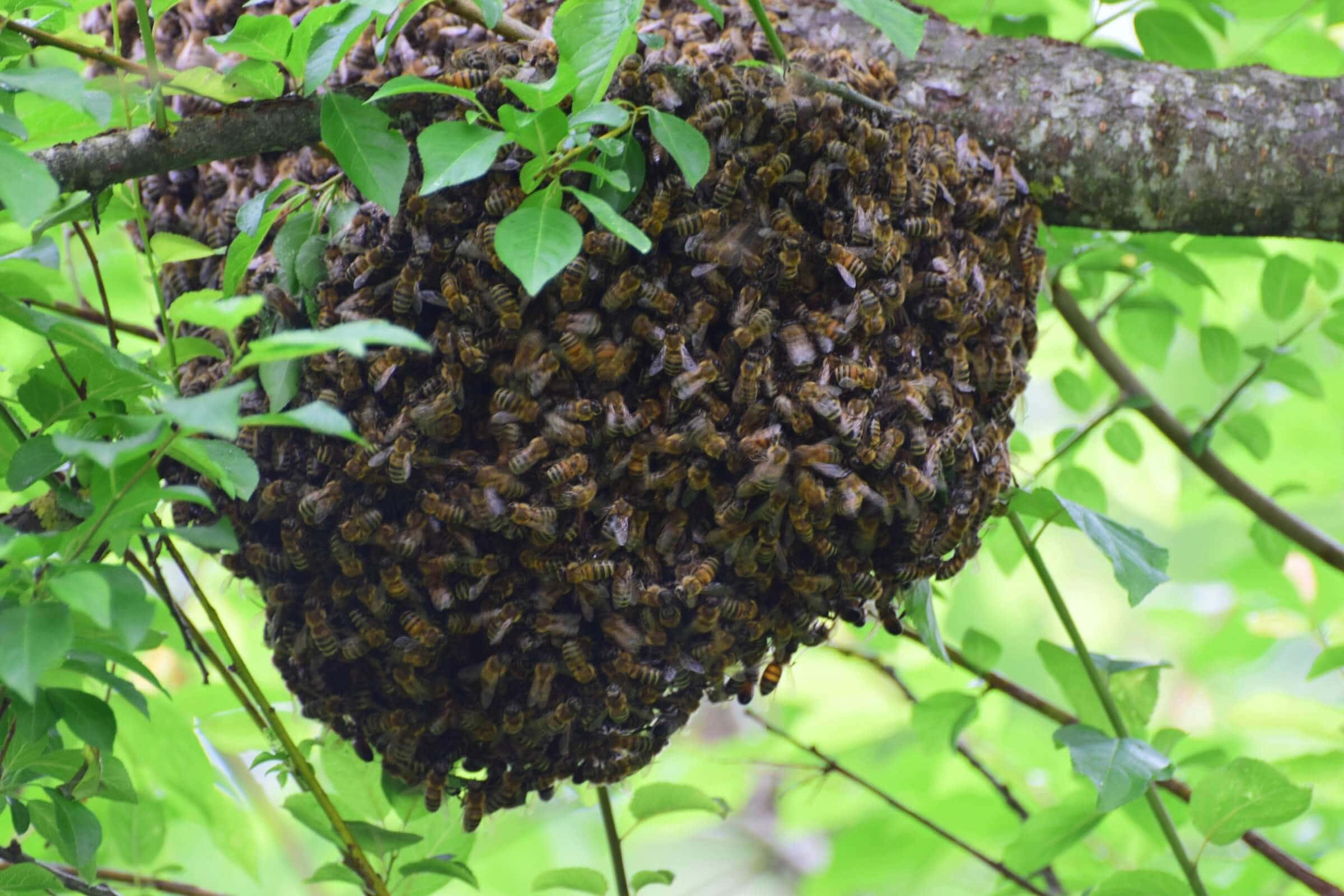
- A swarm is part of the natural reproductive process of a honey bee colony.
- Swarms may temporarily cluster on tree branches, fences, buildings, shrubs, or other exposed surfaces.
- Scout bees search for a suitable nesting cavity while the swarm remains clustered.
- Established colonies generally show repeated bee traffic through the same opening.
- Comb inside a cavity is strong evidence that bees have begun establishing a permanent nest.
Swarming commonly occurs when part of an existing honey bee colony leaves with a queen to establish a new nest. The bees may gather into a conspicuous cluster while scout bees search for a suitable cavity. Swarming is particularly common during spring and early summer, although timing varies with weather, colony condition, forage availability, and location.
An exposed cluster hanging from a branch is therefore not automatically the same thing as a colony living inside a wall. Once bees move into a protected cavity and begin building comb, the situation becomes more complex and may require structural removal.
| Observation | Temporary Swarm | Established Colony |
|---|---|---|
| Typical location | Exposed cluster on a branch, fence, shrub, building, or similar surface | Bees repeatedly entering a wall, roof, ceiling, chimney, shed, or other cavity |
| Comb visible | Usually no established comb at the temporary clustering site | Comb may be present inside the occupied cavity |
| Traffic pattern | Temporary and may change as scouts search for a home | Regular flight traffic through one or more established entrances |
| Typical response | Contact a beekeeper or experienced swarm collector | Contact a professional experienced with structural honey bee removal |
| Structural work | Usually unnecessary | May require opening and repairing part of the structure |
University of Minnesota Extension provides additional information about honey bee swarming and identification. Penn State Extension also offers guidance for evaluating bees and wasps nesting near homes.
When Should You Call a Honey Bee Removal Professional?
- Structural colonies can be difficult to locate and access completely.
- Disturbing an established nest can trigger defensive behavior.
- People with insect-venom allergies face greater consequences from stings.
- Ladders, roofs, demolition, electrical systems, and confined spaces create hazards beyond the bees themselves.
- Local laws may regulate pesticide work, structural work, or other removal practices.
Honey bees are generally valued pollinators, but an established colony can defend its nest when threatened. A removal that involves opening walls, climbing onto a roof, entering an attic, working around electrical components, or handling large amounts of bees and comb can require expertise beyond ordinary beekeeping.
Professional assistance becomes particularly important when the colony is inside a building, located high above the ground, difficult to reach, or positioned where children, pets, customers, employees, or other people regularly pass nearby.
Utah State University Extension provides additional guidance about honey bees in structures and recommends considering qualified hive or swarm extraction when colonies create a health or structural concern: Honey Bee Structural Pest Identification Guide.
What Happens During Professional Honey Bee Removal?
- Confirming that the insects are honey bees.
- Determining whether the situation involves a swarm or an established colony.
- Locating the occupied cavity rather than assuming the visible entrance marks the entire nest.
- Creating safe structural access when necessary.
- Removing bees and accessible comb or stored material.
- Repairing and excluding entry points after the colony has been removed.
The visible entrance does not always reveal the exact dimensions or position of the colony. Bees may enter through a small exterior opening and travel farther inside a wall, roof, or ceiling before reaching the comb.
For an established colony, a professional may need to create access to the nest, collect or remove the bees, locate the queen when practical, remove accessible comb and honey, and evaluate the cavity for remaining material.
This matters because abandoned nest material can create problems of its own. Honey may leak or ferment, wax may soften in hot weather, and remaining organic material can attract other insects or pests. The exact repair process depends on the building and location of the colony.
What Should You Do Before and After Honey Bee Removal?
- Keep children, pets, and unnecessary foot traffic away from the colony.
- Do not strike, spray, shake, or deliberately agitate the bees.
- Do not plug an occupied structural entrance.
- Observe the entry location from a safe distance.
- Note whether activity is concentrated around one opening or several openings.
Observation is often more useful than disturbance. If bees are repeatedly entering the same part of a building, note the location so a removal professional can evaluate it. Avoid standing directly in the flight path and do not attempt to determine colony size by probing into the opening.
A temporary exposed swarm may be best left undisturbed while a beekeeper or swarm collector is contacted. Swarms are often less defensive than bees protecting an established nest, but clustered bees can still sting if provoked.
Homeowner Response Checklist
- Identify the insect as accurately as possible.
- Determine whether the bees are clustered outside or repeatedly entering a structure.
- Keep people and pets away from the area.
- Do not block an active entrance.
- Contact a beekeeper, experienced bee-removal professional, or appropriately licensed pest professional.
- Ask whether structural access and repairs are included in the removal service.
- Address accessible nest material when an established colony is removed.
- Seal suitable entry points after removal is complete.
- Monitor the location for returning or renewed bee activity.
After an established colony has been removed, the cavity should be evaluated for accessible comb and stored material. Openings that could allow another swarm to enter should then be repaired without blocking ventilation that the building legitimately requires.
Continue observing the former entrance and nearby gaps. A small number of returning foragers may sometimes appear immediately after removal, but persistent or increasing traffic should be reported to the removal professional.
How Can You Prevent Honey Bees From Nesting in a Structure?
- Focus on eliminating access to nesting cavities rather than eliminating flowers from the landscape.
- Repair gaps in siding, soffits, fascia, roofing, trim, and utility penetrations.
- Maintain intact screening where ventilation openings must remain open.
- Inspect sheds, garages, outbuildings, and unused structures for suitable cavities.
- Seal openings before occupancy rather than trapping an active colony inside.
Structural exclusion is more dependable than trying to repel honey bees with household scents. Maintaining screens, repairing damaged construction, and closing unnecessary access points before bees move in directly reduces the availability of suitable nesting cavities.
Common areas worth inspecting include soffits, fascia boards, roof transitions, openings around pipes or cables, damaged siding, unused vents, gaps around chimneys, and poorly sealed outbuildings.
Peppermint oil and similar household substances should not be relied upon as the primary way to prevent structural honey bee nesting. Physical exclusion and routine building maintenance provide a clearer and more dependable prevention strategy.
A property can therefore be both bee-friendly and bee-resistant: flowering plants can provide pollinator forage while the building itself remains properly screened, repaired, and protected from unwanted colony entry.
Why Should Honey Bee Colonies Be Relocated When Practical?
- Honey bees provide valuable pollination services to many agricultural crops.
- An accessible swarm may sometimes be collected and managed by a beekeeper.
- Structural relocation is considerably more complicated than collecting an exposed swarm.
- Not every colony or nesting situation can be relocated successfully.
- Human safety and applicable legal requirements take priority over relocation.
Honey bees are important managed pollinators in agriculture. The U.S. Department of Agriculture describes honey bees and other pollinators as important to the production of fruits, nuts, vegetables, and many other crops.
That makes relocation worth considering when conditions permit. An exposed swarm may sometimes be collected relatively easily by an experienced beekeeper. An established colony inside a wall or roof can require much more labor because the bees, comb, honey, and structural cavity all have to be considered.
Relocation should not be presented as a guaranteed outcome. Unsafe access, structural limitations, pesticide exposure, disease, poor colony condition, legal restrictions, or other circumstances may limit the available options.
Responsible honey bee removal balances pollinator conservation with the safety of people and animals and the protection of the structure.
Learn more about pollinator importance from the U.S. Department of Agriculture's pollinator resources .
Frequently Asked Questions About Honey Bee Removal: What Should You Know?
What is the difference between a honey bee swarm and a hive in a wall?
A swarm is usually a temporary exposed cluster searching for a nesting site. Bees repeatedly entering a wall or other cavity may indicate an established colony.
Should I seal the hole honey bees are using to enter my wall?
No. Do not seal an active colony inside a structure. Remove the colony first and complete exclusion repairs afterward.
Can a beekeeper remove honey bees from a house?
Some beekeepers perform swarm collection or structural bee removal, while others do not. Structural removals may also require a contractor or appropriately licensed pest professional.
Are honey bee swarms dangerous?
Swarms are generally less defensive than established colonies because they are not protecting a permanent nest, but the bees can still sting if disturbed.
Does honeycomb need to be removed from a wall?
Accessible comb and stored material should generally be addressed during an established structural removal because abandoned nest material can create additional problems.
Can peppermint oil keep honey bees out of a house?
Peppermint oil should not be relied upon as a primary structural prevention method. Physical exclusion and building maintenance provide a clearer strategy.
Should I remove flowers from my yard to keep honey bees away?
No. Flowering plants are food sources, not structural nesting cavities, and removing flowers does not correct openings that allow bees to enter a building.
When is professional honey bee removal recommended?
Professional help is recommended when bees occupy a building, access is difficult, people or pets are at risk, or complete nest removal may require structural work.
Can every honey bee colony be relocated alive?
No. Relocation may be possible in many situations, but safety, access, colony condition, contamination, and local requirements can limit the available options.
How can I stop another swarm from moving into the same location?
After the existing colony and accessible nest material are removed, repair the cavity and seal suitable entry points while maintaining any required ventilation.
What Sources Support This Honey Bee Removal Guide?
- Honey Bee Removal From Residential & Commercial Sites — NC State Extension.
- Five-Step Decision Support: Nesting Bees and Wasps Near Homes — Penn State Extension.
- Wasps and Bees — University of Minnesota Extension.
- Honey Bee Structural Pest Identification Guide — Utah State University Extension.
- Pollinators — U.S. Department of Agriculture.
- Honey Bees on the Move: From Pollination to Honey Production and Back — USDA Economic Research Service.
- What You Can Do to Protect Honey Bees and Other Pollinators — U.S. Environmental Protection Agency.
- Recognizing and Responding to Anaphylaxis — Centers for Disease Control and Prevention.
- Got a Swarm? Everything's Going to BEE Alright! — University of Georgia Extension.
```
FAQs
What is the difference between a honey bee swarm and a hive in a wall?
A swarm is usually a temporary exposed cluster searching for a nesting site. Bees repeatedly entering a wall or other cavity may indicate an established colony.
Should I seal the hole honey bees are using to enter my wall?
No. Do not seal an active colony inside a structure. Remove the colony first and complete exclusion repairs afterward.
Can a beekeeper remove honey bees from a house?
Some beekeepers perform swarm collection or structural bee removal, while others do not. Structural removals may also require a contractor or appropriately licensed pest professional.
Are honey bee swarms dangerous?
Swarms are generally less defensive than established colonies because they are not protecting a permanent nest, but the bees can still sting if disturbed.
Does honeycomb need to be removed from a wall?
Accessible comb and stored material should generally be addressed during an established structural removal because abandoned nest material can create additional problems.
Can peppermint oil keep honey bees out of a house?
Peppermint oil should not be relied upon as a primary structural prevention method. Physical exclusion and building maintenance provide a clearer strategy.
Should I remove flowers from my yard to keep honey bees away?
No. Flowering plants are food sources, not structural nesting cavities, and removing flowers does not correct openings that allow bees to enter a building.
When is professional honey bee removal recommended?
Professional help is recommended when bees occupy a building, access is difficult, people or pets are at risk, or complete nest removal may require structural work.
Can every honey bee colony be relocated alive?
No. Relocation may be possible in many situations, but safety, access, colony condition, contamination, and local requirements can limit the available options.
How can I stop another swarm from moving into the same location?
After the existing colony and accessible nest material are removed, repair the cavity and seal suitable entry points while maintaining any required ventilation.