
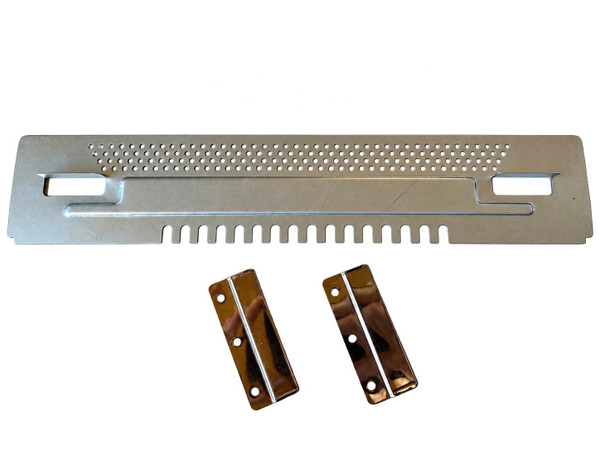


Product Overview
10 Frame Metal Bee Hive Entrance Reducer & Mouse Guard – Cut to Fit
Adapt the entrance guard to the bottom board instead of assuming every 10-frame entrance is identical.
The 10 Frame Metal Bee Hive Entrance Reducer & Mouse Guard – Cut to Fit is a metal entrance guard for 10-frame hive equipment that combines mouse exclusion with entrance reduction. Its cut-to-fit construction allows the guard to be adjusted to the actual bottom-board entrance rather than relying on a universal 10-frame entrance dimension.
Because bottom-board entrances can vary, measure and test-fit the guard before fastening it permanently. Trimming may be necessary depending on your bottom-board configuration. Mounting screws or nails are not included.
At a Glance
- SKU: WNTS-2376
- Equipment format: 10-frame hive equipment
- Construction: Metal
- Overall dimensions: 15 5/16" L × 2 9/16" W
- Individual bee opening: 1/4" L × 7/16" W
- Bee-access section length: 7 1/2"
- Fit: Cut to fit the actual bottom-board entrance
- Primary functions: Mouse exclusion and entrance reduction
- Installation: Measure, test-fit, trim if necessary, then fasten with screws or nails
- Mounting hardware: Screws or nails must be supplied separately
Why the Cut-to-Fit Design Matters
A 10-frame designation identifies the intended hive equipment format, but it does not mean every 10-frame bottom-board entrance has exactly the same configuration. Lappe's has found that this variation becomes especially apparent when fitting guards across different 10-frame hives.
The cut-to-fit design lets you adapt the guard to the individual entrance. Standard 10-frame bottom boards may require little adjustment, while rail-style bottom boards are more likely to require trimming at the ends. This flexibility makes measuring the actual entrance more important than assuming the guard will be a universal drop-in fit.
Is This Mouse Guard Right for Your Hive?
Choose this model if you use 10-frame equipment and are comfortable measuring your actual bottom-board entrance and trimming the guard if needed. The guard measures 15 5/16" long before trimming, but bottom-board entrance configurations vary, so use your hive's actual entrance—not a presumed standard measurement—to guide the final fit.
This is not the correct configuration for 8-frame equipment or 4- and 5-frame nuc equipment. If you specifically want a guaranteed no-trim installation, keep in mind that this model is intentionally designed to be cut to fit and may require adjustment.
What You Receive
The product includes one metal entrance reducer and mouse guard for 10-frame hive equipment.
What You Need to Supply
- Suitable screws or nails for fastening
- Tin snips if trimming is required
- Measuring tape or ruler for checking the entrance before cutting
How to Fit and Install the Guard
- Measure the entrance. Check the actual available opening on your 10-frame bottom board.
- Test-fit before cutting. Position the guard and determine whether trimming is necessary.
- Trim conservatively. If adjustment is needed, use tin snips to remove a small amount from the ends. Test-fit after each cut rather than making one large final cut.
- Test-fit again. Repeat small adjustments until the guard fits the intended entrance correctly.
- Fasten the guard. Once the fit is established, secure it with customer-supplied screws or nails.
- Check the finished installation. Confirm that the guard remains securely positioned, problematic gaps are not present, and the available bee passages are clear.
Fall and Winter Use
Lappe's finds this guard particularly useful when preparing colonies for fall and winter, before mice begin looking for sheltered locations as temperatures fall. When correctly fitted and unobstructed, the openings allow worker-bee movement while the metal guard provides a physical barrier against mice at the protected entrance.
The entrance-reduction function can also be useful when a colony benefits from having less entrance area to defend, including during periods of robbing pressure. Entrance reduction is one colony-management measure, however, and should not be treated as a guarantee that robbing will stop.
Keep a Reduced Entrance Clear
A reduced entrance makes the condition of the remaining passages more important. Lappe's periodically checks reduced entrances during fall and winter because dead bees and loose debris occupying an opening can become more consequential when fewer passages are available.
During use, check for dead bees, loose debris, buildup that materially restricts the openings, loosening or shifting, unintended gaps, and bending that affects fit. Before seasonal reuse, clear accumulated debris and restrictive propolis or wax, inspect the fastening points, and confirm that the guard can still be positioned securely.
Judge the Guard by Fit and Function
Staining, weathering, propolis, wax, dirt, and other signs of normal hive use do not by themselves mean a mouse guard needs to be replaced. Lappe's judges a used guard primarily by whether it can still fit securely, maintain the intended mouse barrier, and leave usable passages for bees.
A minor bend also does not automatically require replacement if it can be corrected and proper fit and function can be restored. Replace the guard when significant damage prevents secure positioning, creates problematic gaps that cannot be corrected, interferes with the openings, or prevents appropriate bee passages from being restored.
Lappe's rule of thumb: Fit the guard to the hive, then judge it by function rather than appearance or age.
Important Expectations
- Screws or nails for fastening are not included.
- A guard at the main entrance cannot prevent mouse access through a different opening elsewhere in the hive.
- No fixed service life should be assumed; physical condition, fit, and function are more useful indicators for continued use.
Related Entrance Reducers and Winter Supplies
- Using 8-frame equipment? See the 8 Frame Metal Bee Hive Entrance Reducer & Mouse Guard – Cut to Fit.
- Protecting a nuc? See the Adjustable Nuc Bee Hive Metal Entrance Reducer & Mouse Guard – 4 & 5 Frame.
- Compare another configuration with the Metal Bee Hive Entrance Reducer & Mouse Guard.
- For additional seasonal equipment, browse our Winter Beekeeping Supplies & Hive Winterizing collection.
Frequently Asked Questions
Will this mouse guard fit every 10-frame bottom board without trimming?
No. The guard is intended for 10-frame equipment, but actual bottom-board entrance configurations can vary. Measure and test-fit your entrance before fastening the guard, and expect that rail-style bottom boards may require trimming at the ends.
Are screws or nails included?
No. Suitable screws or nails for fastening the guard must be supplied separately.
Can worker bees still pass through the guard?
Yes. The openings are intended to permit worker-bee passage while restricting mouse access when the guard is correctly fitted and unobstructed. Keep the available passages clear of dead bees and other debris.
When should I use a mouse guard?
Lappe's finds this guard especially useful during fall and winter preparation, particularly before mice begin seeking sheltered locations as temperatures fall. It can also provide entrance reduction when a colony benefits from having less entrance area to defend.
Will reducing the entrance stop robbing?
Not necessarily. A smaller entrance can reduce the area a colony must defend, but entrance reduction is only one management measure and does not guarantee that robbing pressure will stop.
Does a weathered or stained mouse guard need to be replaced?
Not solely because of its appearance. Staining, weathering, propolis, wax, dirt, and other signs of hive use matter less than whether the guard still fits securely, maintains the intended mouse barrier, and leaves usable passages for bees.
When should I replace the guard?
Replace the guard when damage prevents a secure fit, it will not remain properly positioned, damaged openings or edges interfere with use, problematic gaps cannot be corrected, or appropriate bee passages cannot be restored. Lappe's does not assign a fixed service life based only on the number of seasons used.