

Product Overview
Adjustable Nuc Bee Hive Metal Entrance Reducer & Mouse Guard – 4 & 5 Frame
One adjustable metal guard for both 4-frame and 5-frame nuc equipment
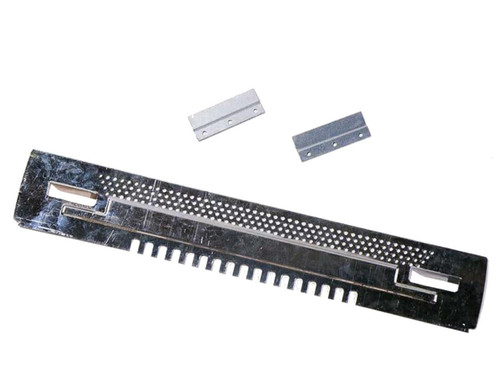
The Adjustable Nuc Bee Hive Metal Entrance Reducer & Mouse Guard is a metal entrance-control and mouse-protection guard designed for 4-frame and 5-frame nuc equipment. Its adjustable design is especially useful for beekeepers managing both nuc sizes because the same guard can be positioned for either configuration.
Lappe's Bee Supply has used this guard on both 4-frame and 5-frame nuc equipment. It installs over the existing wooden entrance reducer and is secured with screws or nails, which are not included.
Product Details
- SKU: WNTS-2374
- Product type: Adjustable nuc entrance reducer and mouse guard
- Construction: Metal
- Nuc configurations: 4-frame and 5-frame
- Adjustable length: 5-3/4" minimum to 7-3/8" maximum
- Height: 1-5/16"
- Thickness: 1/8"
- Small metal bee-access openings: 5/16" long × 1/4" high each
- Installation: Fits over the existing wooden entrance reducer
- Attachment: Secure with suitable screws or nails; fasteners are not included
- Included: One adjustable metal entrance reducer / mouse guard
- Not included: Screws or nails
Why the Adjustable Design Matters
The main advantage of this nuc mouse guard is its ability to adjust between 4-frame and 5-frame equipment. Lappe's Bee Supply finds this particularly useful when managing both nuc sizes because one adjustable guard can serve either configuration instead of requiring separate fixed-size guards for each.
As an entrance reducer, it narrows the nuc opening so the colony has less space to defend while still allowing bees to enter and exit.
The guard also combines two related functions: controlling the nuc entrance and helping protect it against mouse intrusion. Its strongest documented seasonal use is during fall and winter when mouse intrusion is a concern.
Check the Actual Entrance Fit
The mouse guard adjusts from 5-3/4" to 7-3/8" long and measures 1-5/16" high × 1/8" thick. Before ordering, compare this adjustable length and the guard's overall height with your nuc entrance, existing wooden entrance reducer and available mounting area.
“4 & 5 Frame” identifies the two nuc sizes for which this guard is adjustable, but it does not guarantee an identical fit across every manufacturer’s equipment. Because actual nuc entrances can vary, we check the guard’s position, opening alignment, attachment and end gaps after installation rather than relying on frame count alone.
How to Install the Nuc Entrance Reducer & Mouse Guard
- Position the metal guard over the existing wooden entrance reducer.
- Adjust the guard for the applicable 4-frame or 5-frame nuc entrance.
- Align the bee-access openings with the intended entrance.
- Check both ends for unnecessary gaps.
- Secure the guard using suitable screws or nails.
- Confirm that the intended bee-access openings remain correctly positioned and usable.
Lappe's Bee Supply Fastener Tip: We generally prefer screws when installing the guard on an occupied nuc because using a drill avoids the repeated impact of hammering near the bees. Choose a screw length appropriate for the wood at your nuc entrance; fasteners are not included.
Fall and Winter Use
This adjustable nuc mouse guard is especially useful during fall and winter when mouse intrusion is a concern. Seasonal timing varies with local weather and conditions, so there is not one universal calendar date for installation or removal.
During winter, periodically make sure the entrance remains usable. Dead bees, snow, propolis or other debris can obstruct the openings and interfere with normal entrance access.
For broader seasonal guidance, read our Wintering Bees FAQ, which covers food stores, moisture, insulation, feeding and other winter-preparation considerations.
What to Check if the Guard Is Not Working as Intended
Lappe's Bee Supply uses a simple troubleshooting sequence when checking this guard:
- Check position and alignment. Make sure the guard is correctly positioned over the wooden entrance reducer and the bee-access openings align with the intended entrance.
- Check the ends and attachment. Look for unnecessary end gaps and make sure the guard remains securely attached.
- Check for obstructions. Remove entrance obstructions such as dead bees, snow, propolis, or other debris when needed.
If mouse access occurs, inspect the ends of the guard and other possible entry points elsewhere in the nuc. Mouse access by itself does not establish that the mouse passed through the guard's intended openings.
Is This Adjustable Nuc Mouse Guard Right for You?
This product may be a good choice if you use 4-frame nucs, 5-frame nucs or a mixture of both sizes and want an adjustable metal entrance reducer and mouse guard. Its adjustability is particularly useful when both supported nuc sizes are part of your operation.
Beekeepers building or updating a standard 5-frame setup can also explore our 5-frame nuc hives and components.
Frequently Asked Questions
Can I assume it fits every manufacturer's 4-frame or 5-frame nuc?
No. The guard is intended for 4-frame and 5-frame nuc equipment, but frame count alone does not establish universal fit across every nuc configuration. Check the actual entrance fit, alignment, and end gaps during installation.
Does the metal guard replace the wooden entrance reducer?
No. The documented installation places the metal guard over the existing wooden entrance reducer.
Are screws or nails included?
No. The guard can be secured with screws or nails, but the installation fasteners are not included.
Does this mouse guard work with both 4-frame and 5-frame nucs?
Yes. The Adjustable Nuc Bee Hive Metal Entrance Reducer & Mouse Guard is adjustable for 4-frame and 5-frame nuc equipment, and Lappe's Bee Supply has used it on both sizes.
When is this nuc mouse guard most useful?
Its strongest documented seasonal application is during fall and winter when mouse intrusion is a concern. Exact timing can vary with local weather and seasonal conditions.
What should I check if bee access appears restricted?
Check the guard's position and alignment first, then inspect the openings for dead bees, snow, propolis, or other debris. Also make sure the guard remains securely attached and properly positioned over the wooden entrance reducer.
If a mouse gets into the nuc, does that mean the guard failed?
Not necessarily. Lappe's Bee Supply checks for unnecessary gaps around the ends and other possible entry points elsewhere in the nuc rather than assuming the mouse passed through the guard's intended openings.