Welcome to Lappe's Bee Supply's blogs section. We are a trusted beekeeping company in the USA. We give relevant insights, seasonal guidance, and professional advice for beekeepers of all experience levels. From hive management and bee wellness to honey production and equipment guides, we have it all that you will require to thrive. Get updated, motivated, and connected with the beekeeping community through regular news from Lappe's Bee Supply.
Understanding Bee Robbing and Robber Bees
The Buzz About This Post
- Honey Bee Robbing: Signs, Causes and Prevention
- What is the quick answer about robbing?
- What does this guide cover?
- What are the key facts about robbing?
- What is honey bee robbing?
- Why do honey bees rob other hives?
- When is robbing most likely?
- Which colonies are most likely to be robbed?
- How does robbing begin?
- How can you recognize active robbing?
- How does robbing differ from normal foraging?
- Why is robbing dangerous to a colony?
- How should a beekeeper respond to active robbing?
- How can robbing be prevented?
- How does a robbing screen help?
- What should you inspect after robbing has stopped?
- What do beekeepers ask about robbing?
- What is robbing?
- When is robbing most common?
- How can I tell robbing from normal hive activity?
- Do robber bees carry pollen?
- Can a strong colony be robbed?
- Should I close a robbed hive completely?
- Will an entrance reducer stop robbing?
- Can feeding bees start robbing?
- Can honey bee robbing spread pests or disease?
- Can a colony recover after being robbed?
- What is the main lesson about robbing?
- Which sources support this guide?
Honey Bee Behavior and Hive Management
Honey Bee Robbing: Signs, Causes and Prevention
Robbing can turn an active apiary into a confusing rush of fighting and frantic flight. Learning to recognize the behavior early can help protect a vulnerable colony before its stored honey is severely depleted.
Published: July 4, 2025
Last updated: August 4, 2026
Published and reviewed by: Lappe's Bee Supply Team and Lappe's Beekeeping Team
What is the quick answer about robbing?
Robbing occurs when worker bees enter another colony to steal stored honey, usually during a nectar shortage when food competition is high.
What are the key facts about robbing?
- Robbing bees seek stored honey rather than nectar or pollen from flowers.
- Robbing pressure commonly increases when a nectar flow ends or drought reduces available forage.
- Weak, queenless, poorly guarded or pest-stressed colonies are especially vulnerable.
- Fighting, darting flight and bees testing hive seams can distinguish robbing from normal foraging.
- Exposed honey, leaking syrup and prolonged inspections can attract robber bees.
- Entrance reducers and robbing screens can make a vulnerable hive easier to defend.
What is honey bee robbing?
Robbing is the removal of stored honey from one colony by worker bees belonging to another colony.
- Robber bees target honey already stored inside a hive.
- The behavior is performed by worker bees.
- Robbing is different from collecting nectar from flowers.
- It is a survival response, not deliberate wrongdoing by the bees.
The western honey bee, Apis mellifera, normally gathers nectar from flowers and converts it into honey. During robbing, workers bypass that normal foraging process and search for honey stored by another colony. A scout may locate a weakly defended entrance, exposed comb, spilled syrup or another concentrated food source. More bees may arrive when that source proves profitable.
The invaded colony attempts to defend its entrance and food reserves. When the defending population is too small or the attacking force becomes too large, robber bees may repeatedly enter, fill their honey stomachs and carry the stolen food back to their own colony.
Why do honey bees rob other hives?
Honey bees are most likely to rob when natural nectar is scarce and an accessible hive offers a concentrated source of stored food.
- A nectar shortage increases competition among colonies.
- Honey odor can attract investigating workers.
- A poorly guarded entrance provides an opportunity.
- Spilled syrup and exposed comb can intensify searching behavior.
Honey bees gather food efficiently, and stored honey is a valuable source of carbohydrates. When flowers are producing nectar, visiting blooms is usually safer and more productive than attempting to invade another colony. During a dearth, the balance changes. Bees searching for food may investigate hive entrances, cracks, discarded comb, wet supers and feeding equipment.
Robbing is not limited to starving colonies. A strong colony with many foragers can become an aggressive robbing force after its local nectar flow ends. The strength of the attacking colony may therefore increase the pressure placed on a smaller or poorly defended hive.
When is robbing most likely?
Robbing is most likely during a nectar dearth, especially after major summer blooms end, during drought or as colonies prepare for winter.
- Late summer and fall are common robbing periods.
- Drought can cause robbing pressure to begin earlier.
- A local nectar flow matters more than the calendar date.
- Robbing may start immediately after honey or syrup is exposed.
The timing of a nectar dearth varies by climate, rainfall and the plants available near the apiary. In many areas, robbing pressure rises during late summer as major blooms decline. However, a dry spring, crop harvest, hard frost or extended period without rain can change the timing.
Beekeepers should watch colony behavior rather than rely on a specific month. Bees repeatedly inspecting equipment, hovering around stored supers or searching the seams of nearby hives may indicate that natural forage has become limited.
Practical apiary note: The risk of robbing rises whenever concentrated honey or syrup becomes easier to obtain than nectar from flowers.
Which colonies are most likely to be robbed?
Colonies with small populations, reduced guard forces, queen problems or poor health are less able to defend stored honey from intruders.
- Small colonies have fewer bees available for defense.
- Queenless or failing colonies may become disorganized.
- Varroa pressure and disease can weaken adult populations.
- An oversized entrance may be difficult for a small guard force to protect.
A strong colony can repel many individual intruders by identifying and confronting unfamiliar bees at the entrance. A weak colony may not have enough guards to inspect every arrival, especially when the entrance is wide. Once several robbers enter successfully, repeated traffic can attract additional bees and overwhelm the defenders.
Newly created splits, nucleus colonies, queen-mating colonies and colonies recovering from queen loss may require additional protection during a nectar shortage. These colonies are not automatically doomed to be robbed, but their entrance size and food exposure should match their ability to defend themselves.
How does robbing begin?
Robbing often begins when searching bees find exposed honey, leaking syrup or a poorly defended entrance and return repeatedly to the source.
- Searching: Foragers investigate odors, hive entrances, cracks and exposed equipment.
- Testing: Individual bees attempt to pass the guards or enter through an unprotected opening.
- Recruitment: A profitable food source attracts more bees from the robbing colony.
- Escalation: Fighting and confused flight increase around the target hive.
- Removal: Successful robbers fill with honey and repeatedly return until the source is protected or depleted.
Not every unfamiliar bee at an entrance is part of a full robbing event. Drifting workers may enter the wrong hive, and guard bees may briefly challenge legitimate residents. Robbing becomes more likely when searching, fighting and repeated entry attempts increase together.
Once widespread robbing is established, opening the hive can worsen the event by releasing more honey odor and creating a larger access point. Early recognition is therefore important.
How can you recognize active robbing?
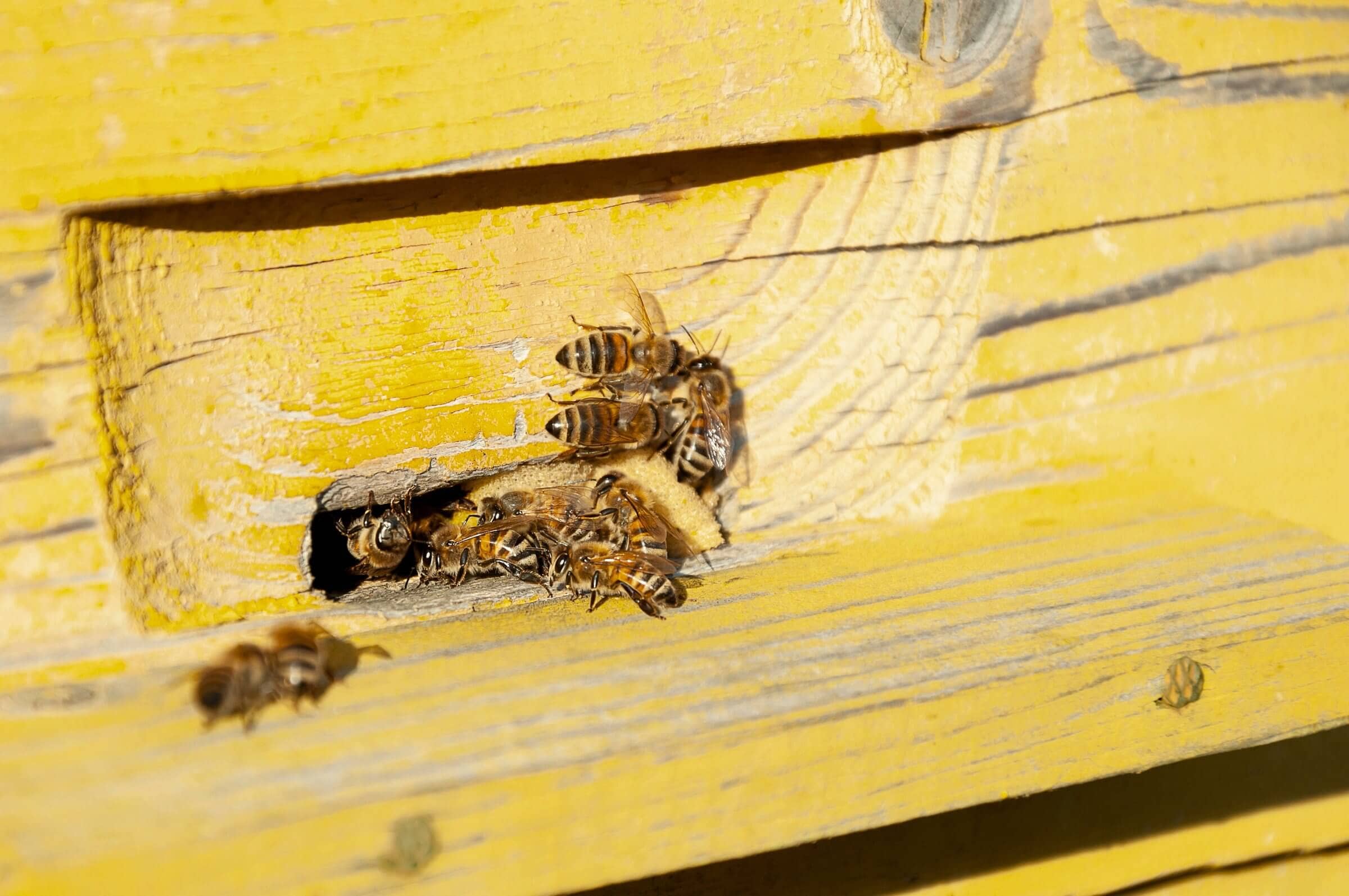
Active robbing often produces fighting, darting flight, bees searching hive seams, wax debris and workers leaving with enlarged abdomens.
- Bees wrestle or sting one another near the entrance.
- Incoming bees hover, dart and approach from unusual angles.
- Workers test corners, lid seams and ventilation openings.
- Bits of wax may collect on the landing board or ground.
- Departing robbers may appear heavy after filling with honey.
Normal colony traffic can be intense during good weather, especially when young bees are taking orientation flights. Orientation flights usually involve many bees facing the hive and circling near the entrance without sustained fighting. Robbing activity appears less orderly. Bees approach cautiously, search for alternate openings and may be chased by guards.
Wax debris can provide another clue. Robber bees may tear open capped cells rapidly, leaving fresh wax particles below the entrance. However, wax debris alone does not prove robbing because colonies also remove damaged comb and other material during routine housekeeping.
How does robbing differ from normal foraging?
Normal foragers travel directly through the entrance, while robber bees often hesitate, fight, search for gaps and leave carrying stolen honey.
| Observation | Normal Foraging | Possible Robbing |
|---|---|---|
| Flight pattern | Mostly direct arrival and departure | Darting, hovering or zigzag approaches |
| Entrance behavior | Bees pass through with limited conflict | Bees hesitate, fight or attempt to rush guards |
| Search behavior | Limited interest in seams and corners | Repeated testing of cracks and alternate openings |
| Pollen loads | Some returning bees carry visible pollen | Robbers are seeking honey rather than pollen |
| Wax debris | Usually limited | Fresh capping debris may accumulate rapidly |
| Colony response | Routine entrance guarding | Persistent defensive activity and fighting |
No single sign should be used by itself. The clearest diagnosis comes from observing several behaviors together, including fighting, suspicious flight patterns, searching along hive seams and rapid loss of stores.
Why is robbing dangerous to a colony?
Robbing can remove essential food, kill defending bees, disrupt colony activity and increase opportunities for pests or pathogens to move among hives.
- A colony may lose honey needed for winter survival.
- Fighting can kill workers from both colonies.
- Repeated attacks can overwhelm an already weak population.
- Movement among colonies creates additional health-management concerns.
- Robbing pressure can spread from one vulnerable hive to others nearby.
The immediate concern is food loss. A heavily robbed colony can lose stored honey much faster than it can replace it, particularly when no nectar is entering the hive. A colony that appears adequately supplied at one inspection may become dangerously light after sustained robbing.
Robbing also creates extensive contact among bees from different colonies. Honey, comb material, adult bees and parasites may move through the apiary during these interactions. This does not mean every robbing event transmits disease, but the additional movement is one reason beekeepers should manage robbing promptly and monitor colony health afterward.
How should a beekeeper respond to active robbing?
Reduce the defensible entrance, add a robbing screen, remove exposed food and avoid reopening the colony until activity becomes orderly.
Immediate response checklist
- Confirm the behavior. Look for fighting, searching and repeated attempts to enter through cracks.
- Reduce the entrance. Give resident guards a smaller opening to protect.
- Install a robbing screen. Separate the visible entrance from the opening used by resident bees.
- Remove attractants. Clean spilled syrup and move wet supers, open comb and feeding equipment away.
- Limit disturbance. Close the hive and postpone unnecessary inspections.
- Reassess later. Once activity settles, determine why the colony could not defend itself.
Avoid leaving the hive open while deciding what to do. An exposed box can release strong honey odors and provide robbers with direct access. Work calmly and make the entrance changes promptly.
Do not seal a populated hive without considering ventilation, temperature and the bees' need to enter and leave. The goal is to make the entrance defensible, not to create overheating or trap large numbers of resident foragers outside.
How can robbing be prevented?
Prevent robbing by matching entrance size to colony strength, containing food odors and keeping every colony healthy enough to defend itself.
| Prevention Practice | Why It Helps |
|---|---|
| Reduce oversized entrances | A smaller opening requires fewer guard bees to defend. |
| Avoid open feeding | Unrestricted syrup can attract many colonies and intensify competition. |
| Prevent feeder leaks | Leaking syrup creates an odor trail and accessible food source. |
| Do not leave comb exposed | Honey residue can attract searching bees within a short period. |
| Shorten inspections during a dearth | Brief inspections limit odors and reduce the time honey is accessible. |
| Monitor Varroa and colony health | Healthy, populous colonies maintain stronger entrance defense. |
| Protect small colonies early | Reducers and screens work best before a large-scale attack develops. |
Feeding practices deserve special attention. Contrary to the idea that an entrance feeder always reduces robbing, a feeder positioned at the entrance may place syrup close to visiting bees and may be easier for outsiders to detect. Feeder choice should limit leaks, exposed syrup and odors outside the colony.
Feed only when the colony needs supplemental food, keep containers from leaking and avoid spilling syrup on hive equipment. If multiple colonies require feeding, manage them consistently so one weak hive is not surrounded by unfed colonies searching for food.
Strong colonies provide the best long-term defense. Maintain viable queens, appropriate food reserves and effective Varroa management. When a colony is too weak to remain viable, combining it with a compatible queenright colony may sometimes be more practical than leaving it unable to protect its resources.
How does a robbing screen help?
A robbing screen separates the familiar entrance location from the protected opening, confusing intruders while resident bees learn the new route.
- Robbers continue searching near the original entrance location.
- Resident bees gradually learn the screened entrance path.
- The screen provides a physical barrier without completely closing the hive.
- A screen is most effective when installed before robbing becomes overwhelming.
Robbing bees commonly orient to the odor and location of the original hive entrance. A screen places mesh or another barrier over that area while providing a protected opening elsewhere on the device. The colony's residents can reorient to the new path, while unfamiliar bees may continue gathering at the blocked location.
A robbing screen is not a substitute for good colony management. The beekeeper should still clean spills, control feeder leaks, reduce unnecessary hive openings and evaluate why the colony was vulnerable.
Learn more about the Ultimate Bee Hive Robbing Screen.
What should you inspect after robbing has stopped?
After activity settles, check colony population, queen status, food reserves, brood condition and pest pressure before choosing the next management step.
- Confirm that the colony is queenright.
- Estimate how much stored food remains.
- Check whether the adult population can cover and defend the comb.
- Evaluate brood condition and signs of disease.
- Monitor Varroa using an appropriate testing method.
- Decide whether the colony should be supported, reduced, combined or otherwise managed.
What do beekeepers ask about robbing?
What is robbing?
Robbing occurs when worker bees enter another colony and remove stored honey instead of collecting nectar from flowers.
When is robbing most common?
Robbing is most common during nectar shortages, which often occur after major summer blooms end or during dry weather.
How can I tell robbing from normal hive activity?
Robbing usually causes darting flight, fighting, bees testing hive seams and wax debris, while normal foragers enter and leave more directly.
Do robber bees carry pollen?
Robber bees are seeking stored honey and generally do not return to the target hive carrying visible pollen loads.
Can a strong colony be robbed?
A strong colony can face robbing attempts, but a populous, healthy colony usually has more guard bees available to defend its entrance.
Should I close a robbed hive completely?
Do not close a colony without considering ventilation and bee access. Reduce the entrance enough to improve defense while maintaining adequate airflow.
Will an entrance reducer stop robbing?
An entrance reducer can help resident guard bees defend the hive, but severe robbing may also require a robbing screen and removal of nearby attractants.
Can feeding bees start robbing?
Feeding can encourage robbing when syrup leaks, is exposed outside the hive or releases odors that attract bees from nearby colonies.
Can honey bee robbing spread pests or disease?
Robbing increases contact and resource movement among colonies, creating opportunities for pathogens and parasites to move through an apiary.
Can a colony recover after being robbed?
A colony may recover when robbing is stopped early, its queen and population remain viable and enough food is available for recovery.
What is the main lesson about robbing?
Early recognition, careful food handling and strong colony management are the most reliable ways to limit honey bee robbing and its consequences.
Robbing is an instinctive response to opportunity and food scarcity. It is not unusual for searching bees to investigate neighboring hives during a nectar dearth, but a small incident can escalate quickly when an entrance is poorly defended or concentrated food remains exposed.
Beekeepers can lower the risk by reducing entrances before vulnerable periods, preventing feeder leaks, avoiding open honey and keeping inspections brief when forage is limited. When robbing begins, prompt action can protect the colony's remaining food and give its guards a manageable entrance to defend.
After the immediate pressure subsides, determine why the colony became vulnerable. Queen status, adult population, food supply, Varroa pressure and general health should all be considered. Addressing the underlying weakness is essential because a screen or entrance reducer can control access, but it cannot restore colony health by itself.
Which sources support this guide?
- Mississippi Beekeeping Calendar — Mississippi State University Extension
- Beginning Beekeeping in Mississippi — Mississippi State University Extension
- Honey Bee Management Throughout the Seasons — Penn State Extension
- A Quick Reference Guide to Honey Bee Parasites, Pests, Predators and Diseases — Penn State Extension
- Protecting Honey Bees from Yellowjacket Wasps — Oregon State University Extension Service
- Honey Bee Viruses — USDA Agricultural Research Service
- The Buzz About Bees — USDA Agricultural Research Service
- Honey Bee Research and Extension Resources — Oregon State University Extension Service