Welcome to Lappe's Bee Supply's blogs section. We are a trusted beekeeping company in the USA. We give relevant insights, seasonal guidance, and professional advice for beekeepers of all experience levels. From hive management and bee wellness to honey production and equipment guides, we have it all that you will require to thrive. Get updated, motivated, and connected with the beekeeping community through regular news from Lappe's Bee Supply.
A Guide to Bee Hive Pests: A Deep Dive into the Threats Facing Honey Bees
The Buzz About This Post
- What are the key facts about beehive pests?
- What does this guide cover?
- What are beehive pests?
- Which pests commonly affect honey bee colonies?
- Why are Varroa mites so dangerous to honey bees?
- How do small hive beetles damage a colony?
- What does wax moth damage look like?
- What should beekeepers know about tracheal mites?
- When do ants and wasps become a problem around beehives?
- What signs may indicate a pest infestation?
- How should a beekeeper inspect a hive for pests?
- How can beekeepers manage hive pests effectively?
- How can beekeepers reduce future pest pressure?
- What is a practical beehive pest management plan?
- What do beekeepers ask about common hive pests?
- What is the most dangerous pest in a honey bee colony?
- How can a beekeeper tell whether a hive has Varroa mites?
- What are the signs of small hive beetles?
- Do wax moths destroy healthy colonies?
- Should every pest sighting be treated with a pesticide?
- Can strong colonies resist hive pests?
- Why must beekeepers follow pesticide labels exactly?
- How often should a beekeeper inspect for pests?
- Can ants and wasps harm a beehive?
- What is integrated pest management in beekeeping?
- What authoritative sources support this guide?
- FAQs
Published: July 3, 2025 | Last updated: August 4, 2026 | By: Lappe's Bee Supply Team
Common Beehive Pests: Identification and Management
Beehive pests can weaken adult bees, damage brood and comb, contaminate stored food, spread pathogens, or overwhelm colonies that are already under stress. Early identification and measured, pest-specific action give a beekeeper the best chance of protecting colony health.
What are the key facts about beehive pests?
Hive pest management begins with correct identification, quantitative monitoring when possible, and a response matched to the pest, season, and colony condition.
- Varroa mites are the most consequential parasite of managed western honey bee colonies in the United States.
- Visible symptoms alone cannot reliably measure a colony's Varroa mite level.
- Small hive beetle larvae can spoil honey and pollen, creating wet, fermented, foul-smelling comb.
- Wax moth damage is most common in weak colonies and improperly protected stored comb.
- Strong colonies can defend hive space better, but strength does not replace Varroa monitoring.
- Any pesticide used in a hive must be legal for that use and applied according to its current label.
What are beehive pests?
Beehive pests are organisms that parasitize honey bees, consume hive resources, damage comb, spread pathogens, or invade colonies for food or shelter.
- A parasite lives on or within a host and obtains resources from that host.
- A hive pest may attack bees directly or damage the nest and stored food.
- A predator kills or consumes bees but may not live inside the hive.
- A disease is caused by a pathogen and should not be confused with a pest.
The distinction matters because different problems require different responses. Varroa mites are external parasites, tracheal mites live inside a bee's respiratory system, small hive beetles reproduce in vulnerable colonies, and yellowjackets act primarily as predators and robbers. A spotty brood pattern, weak population, or unusual odor may signal a problem, but those signs do not identify the cause by themselves. Beekeepers should evaluate the whole colony and use a validated test whenever one is available.
Which pests commonly affect honey bee colonies?
Common hive threats include Varroa mites, small hive beetles, wax moths, tracheal mites, ants, yellowjackets, hornets, mice, and other local predators.
| Pest or predator | Primary target | Common evidence | Primary concern |
|---|---|---|---|
| Varroa destructor | Developing and adult bees | Mites in a sample, damaged emerging bees, declining colony | Parasitism and virus transmission |
| Small hive beetle | Comb, honey, pollen and brood area | Adult beetles, larvae, slime, fermentation and odor | Comb damage and spoiled stores |
| Greater or lesser wax moth | Unprotected comb | Webbing, tunnels, frass and damaged frames | Destruction of comb and woodenware damage |
| Tracheal mite | Adult bee respiratory system | Nonspecific weakness; laboratory examination may be needed | Respiratory impairment and reduced longevity |
| Ants | Honey, syrup and hive shelter | Ant trails, nests in covers or repeated entry | Resource theft and colony disturbance |
| Yellowjackets and hornets | Adult bees and hive stores | Fighting at the entrance, predation and robbing | Losses in weak or poorly defended colonies |
The importance of each pest varies by location, season, colony strength and apiary conditions. Correct identification should come before treatment because a control that works for one organism may be ineffective, illegal or harmful when used for another.
Why are Varroa mites so dangerous to honey bees?
Varroa mites weaken developing and adult bees, reproduce under capped brood, and transmit viruses that can shorten bee life and destabilize colonies.
- Varroa mites feed primarily on honey bee fat body tissue.
- Female mites reproduce inside capped brood cells.
- Varroa mites transmit deformed wing virus and other viruses.
- A colony can have a damaging mite level before obvious symptoms appear.
- Reliable management requires testing, action and follow-up testing.
Varroa is not a pest that can be managed by simply watching for mites on adult bees. Most mites are difficult to see during routine inspection, and part of the population may be reproducing beneath brood cappings. Quantitative monitoring provides a more useful estimate. Penn State Extension describes the alcohol wash as an effective quantitative monitoring method, while regional recommendations may also discuss other sampling techniques. Treatment decisions should follow local extension guidance and the current label of any registered product. The goal is not merely to apply a treatment; it is to verify that mite pressure has been reduced.
Learn more about available options in our bee medications and pest-control collection.
How do small hive beetles damage a colony?
Small hive beetle larvae consume hive materials and contaminate comb, causing honey to ferment, leak, smell sour, and become unsuitable for harvest.
- Adult beetles hide in cracks, corners and areas that worker bees cannot easily reach.
- Beetle larvae feed through comb containing honey, pollen and brood.
- Heavy larval activity can produce wet, slimed and fermented comb.
- Warm conditions and poorly defended hive space can increase risk.
- Strong colonies are usually better able to confine adult beetles.
A few adult beetles do not automatically mean the colony is failing, but their presence should prompt a closer inspection. Evaluate colony population, unused space, queen performance, comb condition and the number of beetles observed. Mechanical beetle traps can be one part of management, but they should not replace correction of underlying colony weakness or excessive hive space. Avoid crushing beetles over comb or honey, and check traps regularly so they do not become ineffective.
What does wax moth damage look like?
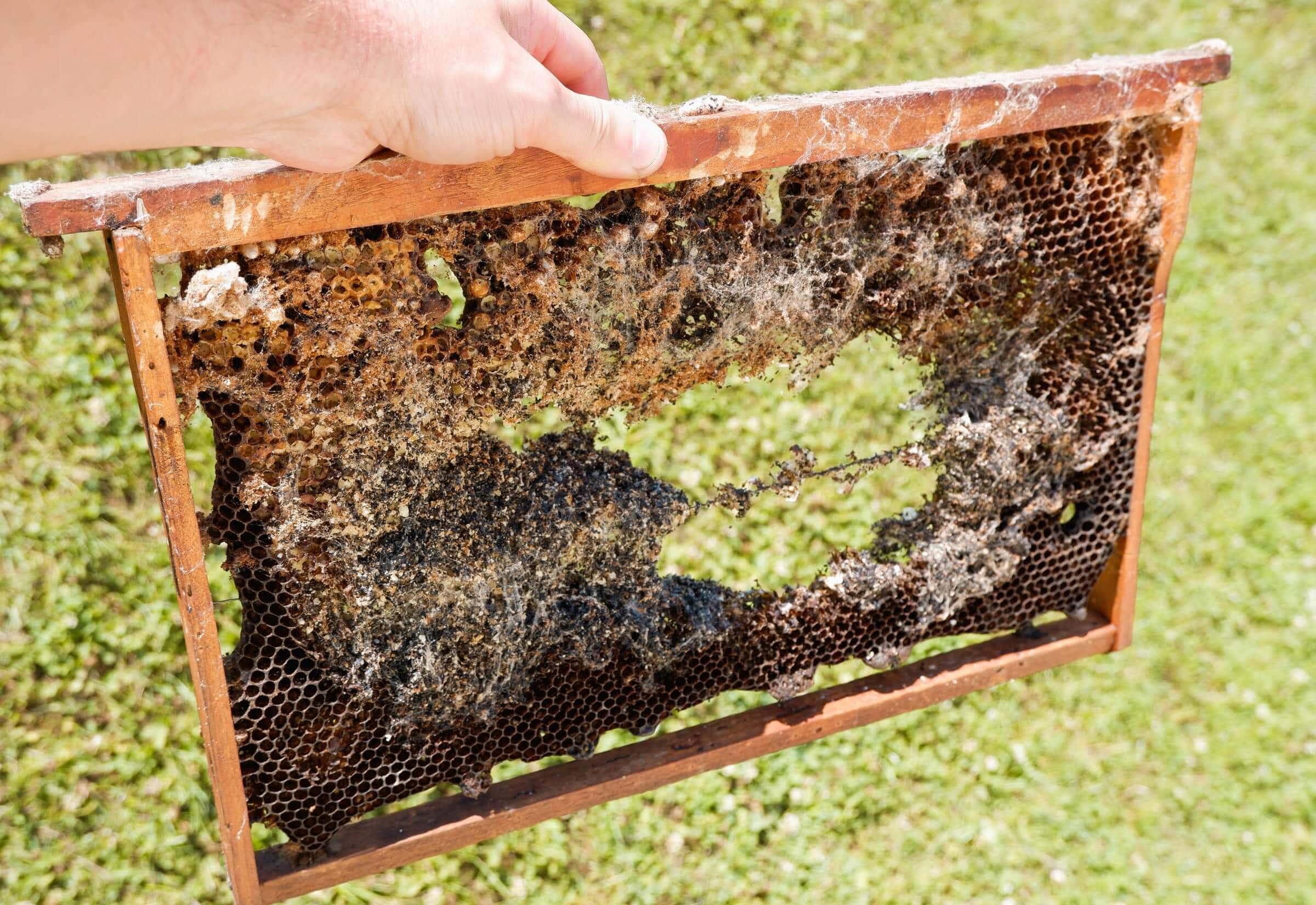
Wax moth larvae leave silken webbing, tunnels, frass and chewed comb, especially in weak colonies or stored frames that bees cannot defend.
- Wax moth larvae tunnel through comb while feeding on comb debris and residues.
- Webbing may bind frames together and conceal damaged cells.
- Dark brood comb is especially attractive because it contains more organic residue.
- Severe infestations can damage wooden frame parts by creating pupation grooves.
- Wax moth activity often reflects weak colony defense or poor comb storage.
Wax moths are usually secondary invaders rather than the original cause of colony decline. In a strong hive, worker bees patrol comb and remove many moth eggs or larvae. When a colony becomes weak, queenless, diseased or too small for the space it occupies, moth larvae gain access to unprotected comb. Stored equipment is also vulnerable. Protect drawn comb using a method appropriate to the storage environment, local regulations and whether the comb will later contact bees or marketable honey.
What should beekeepers know about tracheal mites?
Tracheal mites live inside adult bees' breathing tubes, but their signs are nonspecific and reliable confirmation may require microscopic examination.
- Tracheal mites are microscopic and cannot be diagnosed by ordinary visual inspection.
- Infested bees may show reduced performance or shortened life.
- Crawling or weak bees can have many causes besides tracheal mites.
- Diagnosis may require dissection and examination of the bee's tracheae.
Tracheal mite concerns should not be diagnosed from a single symptom such as crawling, trembling or poor flight. Similar signs can result from cold stress, starvation, pesticide exposure, viruses, queen problems and other conditions. When losses are unexplained, contact an experienced bee inspector, diagnostic laboratory or extension specialist. A confirmed diagnosis prevents unnecessary treatment and helps the beekeeper address the actual cause.
When do ants and wasps become a problem around beehives?
Ants become troublesome when they repeatedly steal feed or occupy equipment, while predatory wasps can rob stores and kill bees at weak entrances.
- Minor ant activity above an inner cover may not require intervention.
- Persistent trails into feeders or brood boxes indicate active resource theft.
- Yellowjackets often become more aggressive robbers when natural food declines.
- Weak colonies and wide entrances are easier for robbers to penetrate.
- Spilled syrup and exposed honey can attract ants, wasps and robber bees.
Begin with sanitation and access control. Clean spilled syrup, repair leaking feeders, avoid leaving exposed comb near the apiary and reduce entrances when colony defense is inadequate. Keep vegetation from creating bridges to hive stands if ants are persistent. Never place an unapproved pesticide where bees can contact it, and do not block normal ventilation or flight while attempting to exclude predators.
What signs may indicate a pest infestation?
Possible warning signs include damaged bees, irregular brood, visible pests, webbing, slime, fermented stores, unusual odors, weak traffic, and entrance fighting.
- Deformed wings may be associated with virus infection linked to Varroa pressure.
- Spotty brood is a warning sign, not a pest diagnosis.
- Slime and fermented honey strongly suggest small hive beetle larval activity.
- Silken tunnels and frass are characteristic of wax moth larvae.
- Fighting at the entrance may indicate robbing or predatory wasps.
- A rapidly shrinking adult population requires prompt investigation.
Beekeepers should interpret signs in context. A brood pattern can become irregular because of disease, poor nutrition, an aging queen, chilled brood or normal brood emergence. Likewise, dead bees at an entrance may reflect pesticide exposure, starvation, weather or normal removal of old workers. Record what is seen, photograph unusual evidence and use a direct test or expert diagnosis before choosing a treatment.
How should a beekeeper inspect a hive for pests?
A complete pest inspection checks the entrance, adult bees, brood, comb, hive corners, stored food, colony strength, and quantitative Varroa results.
- Observe before opening. Watch flight, guarding, fighting, crawling bees and dead bees near the entrance.
- Assess colony population. Determine whether bees cover and defend the comb and equipment provided.
- Inspect brood carefully. Look for a consistent pattern, healthy larvae and pupae, damaged emerging bees and abnormal cappings.
- Check comb and corners. Search for beetles, larvae, webbing, tunnels, frass, slime, mold and unusual odors.
- Monitor Varroa quantitatively. Use a validated sampling method and record the date and result.
- Review food and queen status. Confirm the colony has adequate stores and evidence of a functioning queen.
- Document and follow up. Record the action taken and recheck the colony to evaluate the result.
How can beekeepers manage hive pests effectively?
Effective pest management combines monitoring, prevention, colony management, physical controls, and legally labeled treatments selected for current hive conditions.
- Identify the pest before choosing a control.
- Measure pest pressure when a validated monitoring method exists.
- Use action thresholds recommended for the region and season.
- Match hive space to the number of bees available to defend it.
- Use mechanical controls as part of a broader plan.
- Follow every pesticide label direction, restriction and withdrawal requirement.
This approach is called integrated pest management, or IPM. IPM does not mean avoiding all treatments, nor does it mean applying treatments on an automatic schedule without monitoring. It means combining compatible tools and using the least disruptive effective response at the appropriate time. For Varroa, product choice may depend on temperature, brood status, honey supers, resistance concerns and local recommendations. Never assume that a homemade substance is safe or legal simply because its ingredients are familiar. The U.S. Environmental Protection Agency advises beekeepers to use registered pesticide products in accordance with their labels.
How can beekeepers reduce future pest pressure?
Beekeepers reduce pest pressure by maintaining vigorous colonies, preventing robbing, protecting stored comb, limiting excess space, and monitoring before damage becomes obvious.
- Keep colonies queenright and investigate persistent brood problems.
- Provide only the hive space the colony can occupy and defend.
- Prevent feeder leaks and avoid leaving honey or comb exposed.
- Protect stored drawn comb from moths and rodents.
- Clean reusable traps and remove heavily damaged equipment when appropriate.
- Keep written records of inspections, mite tests and treatments.
- Reassess weak colonies instead of repeatedly treating symptoms without diagnosis.
Good nutrition and sound equipment support colony resilience, but supplemental feed is not a cure for parasites or disease. Feed only when it is needed and manage it so it does not trigger robbing or attract pests. Swarm prevention may help retain colony population, but routinely splitting colonies is not a universal pest-control method and can create weak units if done without adequate bees, brood and resources. Prevention should always be adapted to the colony's biological condition.
What is a practical beehive pest management plan?
A practical plan follows six steps: observe, identify, measure, select, act, and verify, with written records connecting each decision to the result.
- Observe: Record symptoms, visible organisms and colony conditions.
- Identify: Determine which pest, predator, disease or management problem is present.
- Measure: Use a recognized test when one exists, especially for Varroa mites.
- Select: Choose a control compatible with colony condition, season and regulations.
- Act: Apply the control exactly as intended and legally permitted.
- Verify: Reinspect or retest to confirm that the response worked.
What do beekeepers ask about common hive pests?
What is the most dangerous pest in a honey bee colony?
Varroa destructor is generally the most serious pest of managed western honey bee colonies because it damages bees and transmits harmful viruses.
How can a beekeeper tell whether a hive has Varroa mites?
A beekeeper should use a quantitative monitoring method, such as an alcohol wash, rather than relying only on visible mites or damaged bees.
What are the signs of small hive beetles?
Signs include adult beetles running across comb, larvae in the hive, slimed comb, fermented honey and a sour odor.
Do wax moths destroy healthy colonies?
Wax moths usually cause their greatest damage in weak colonies or unprotected stored comb that bees cannot adequately patrol.
Should every pest sighting be treated with a pesticide?
No. The pest should first be identified, measured when possible and managed with an integrated approach appropriate to the colony and season.
Can strong colonies resist hive pests?
Strong colonies can defend comb and hive space more effectively, but colony strength does not eliminate the need to monitor Varroa mites.
Why must beekeepers follow pesticide labels exactly?
The label defines the legal application method, timing, dose, restrictions and precautions needed to protect bees, beekeepers and hive products.
How often should a beekeeper inspect for pests?
Inspection frequency depends on season, colony condition and local risk, but pest checks should be included in routine colony inspections and documented.
Can ants and wasps harm a beehive?
Large ant infestations can steal hive resources, while yellowjackets and other wasps may prey on bees or rob weak colonies.
What is integrated pest management in beekeeping?
Integrated pest management combines monitoring, prevention, cultural controls, mechanical controls and properly selected treatments to keep pests below damaging levels.
What authoritative sources support this guide?
This guide is based on honey bee health information from USDA research, the U.S. Environmental Protection Agency, and university extension specialists.
- Varroosis — USDA Agricultural Research Service.
- The Buzz About Bees — USDA Agricultural Research Service.
- EPA-Registered Pesticide Products Approved for Use Against Varroa Mites in Bee Hives — U.S. Environmental Protection Agency.
- Advisory on Substances Used to Control Varroa Mites — U.S. Environmental Protection Agency.
- Methods to Control Varroa Mites: An Integrated Pest Management Approach — Penn State Extension.
- Alcohol Wash for Varroa Mite Monitoring — Penn State Extension.
- A Quick Reference Guide to Honey Bee Parasites, Pests, Predators, and Diseases — Penn State Extension.
FAQs
What is the most dangerous pest in a honey bee colony?
Varroa destructor is generally the most serious pest of managed western honey bee colonies because it damages bees and transmits harmful viruses.
How can a beekeeper tell whether a hive has Varroa mites?
A beekeeper should use a quantitative monitoring method, such as an alcohol wash, rather than relying only on visible mites or damaged bees.
What are the signs of small hive beetles?
Signs include adult beetles running across comb, larvae in the hive, slimed comb, fermented honey and a sour odor.
Do wax moths destroy healthy colonies?
Wax moths usually cause their greatest damage in weak colonies or unprotected stored comb that bees cannot adequately patrol.
Should every pest sighting be treated with a pesticide?
No. The pest should first be identified, measured when possible and managed with an integrated approach appropriate to the colony and season.
Can strong colonies resist hive pests?
Strong colonies can defend comb and hive space more effectively, but colony strength does not eliminate the need to monitor Varroa mites.
Why must beekeepers follow pesticide labels exactly?
The label defines the legal application method, timing, dose, restrictions and precautions needed to protect bees, beekeepers and hive products.
How often should a beekeeper inspect for pests?
Inspection frequency depends on season, colony condition and local risk, but pest checks should be included in routine colony inspections and documented.
Can ants and wasps harm a beehive?
Large ant infestations can steal hive resources, while yellowjackets and other wasps may prey on bees or rob weak colonies.
What is integrated pest management in beekeeping?
Integrated pest management combines monitoring, prevention, cultural controls, mechanical controls and properly selected treatments to keep pests below damaging levels.