Welcome to Lappe's Bee Supply's blogs section. We are a trusted beekeeping company in the USA. We give relevant insights, seasonal guidance, and professional advice for beekeepers of all experience levels. From hive management and bee wellness to honey production and equipment guides, we have it all that you will require to thrive. Get updated, motivated, and connected with the beekeeping community through regular news from Lappe's Bee Supply.
The Sweet Truth About Honeybees
The Sweet Truth About Honeybees
The Buzz About This Post
- Quick Answer
- Key Takeaways
- What does it mean for a bee to produce honey?
- Do all bees make honey?
- Which bees actually produce honey?
- Why don’t most bees produce honey?
- How do honeybees turn nectar into honey?
- Why are bees important even if they don’t make honey?
- What makes honey different from nectar?
- How can people help all types of bees?
- How do honey-producing bees compare with other bees?
- Frequently Asked Questions
- Do all bees make honey?
- Which bees produce most of the honey people eat?
- Do bumblebees make honey?
- Why do most bees not make honey?
- Why are bees important beyond honey?
- How can people help bees?
- How many bee species are there worldwide?
- What is the main difference between nectar and honey?
- Is stingless bee honey the same as honeybee honey?
- Why do honeybees store honey in comb?
- Sources
Editorial standards: This guide is written for readers who want clear, evidence-led answers. Definitions appear early, claims are kept narrow, and sources are listed at the end.
Quick Answer
No, not all bees make honey. Most bee species gather nectar or pollen, but only a small number produce stored, harvestable honey.
- Honeybees and stingless bees produce most of the honey people harvest.
- Most bees are solitary and do not build long-term honey stores.
- Bees remain essential pollinators whether or not they produce honey.
Key Takeaways
- Only a small share of bee species produce harvestable honey.
- Honeybees and stingless bees are the main bee groups known for meaningful honey production.
- Most bees collect nectar, but nectar collection is not the same as honey production.
- Solitary bees usually provision food for larvae instead of building long-term honey reserves.
- Bees matter far beyond honey because pollination supports ecosystems and agriculture.
Many people hear the word “bee” and think “honey.” That connection makes sense, but it is not accurate for most bee species. In strict biological terms, honey production means converting nectar into a stable, stored food reserve through enzymatic processing and dehydration inside a social nest or colony.
What does it mean for a bee to produce honey?
Honey production means social bees turn nectar into stable stored food using enzymes, evaporation, and colony storage structures.
- Honey is not raw nectar; it is nectar that has been processed and dried.
- Stored honey functions as a long-term food reserve for a colony.
- True honey production depends on coordinated social behavior.
- Nectar gathering alone does not qualify as honey production.
Honey production is a specialized biological process. Worker bees collect nectar from flowers and store it temporarily in a honey stomach, also called a crop. Back at the hive, the nectar is passed between bees and exposed to enzymes. Bees then fan their wings to evaporate excess moisture until the nectar thickens into honey. Encyclopaedia Britannica explains that mature honey contains about 18 percent water, which helps keep it stable and resistant to spoilage. That is why honey is best understood not as sweet flower juice, but as a preserved colony food.
In honeybee colonies, this process is coordinated across thousands of workers. Foragers specialize in collecting nectar, while house bees process and store it. This division of labor allows colonies to convert large volumes of nectar into honey efficiently. Honey serves as a long-term energy reserve that allows colonies to survive periods when flowers are not blooming, especially during winter in temperate climates.
Do all bees make honey?
No. Most bee species collect nectar, but only a few convert it into stored honey in quantities humans can harvest.
- Scientists recognize roughly 20,000 bee species worldwide.
- Most bee species are solitary rather than highly social.
- Most bees do not maintain shared food stores for a colony.
- The idea that all bees make honey is a common myth.
The short answer is no. The Food and Agriculture Organization and the U.S. Geological Survey both describe global bee diversity at roughly 20,000 species, and only a small fraction of those species produce honey that humans can harvest. Most bees do not live in large social colonies with long-term food storage needs. Since honey production is tied to colony life, cooperative processing, and stored reserves, most bees never make true honey at all.
Because the word “bee” is often used broadly in everyday conversation, many people assume all bees behave like honeybees. In reality, bee diversity includes thousands of species with very different nesting behaviors, lifecycles, and food storage strategies. While many species gather nectar for immediate energy or to provision larvae, only a small group evolved the cooperative behaviors needed to create large, stored honey reserves.
Which bees actually produce honey?
Honeybees in the genus Apis and stingless bees in the tribe Meliponini produce most of the honey harvested by humans.
- The Western honeybee, Apis mellifera, produces most commercial honey.
- Stingless bees also make honey, usually in smaller amounts.
- Honeybee colonies can contain tens of thousands of bees during peak season.
- Stingless bee honey often differs in flavor, acidity, and consistency.
The main honey-producing bees are honeybees in the genus Apis and stingless bees in the tribe Meliponini. Mark L. Winston and Dewey M. Caron with Lawrence John Connor both describe honeybees as large social insects that maintain sizeable colonies and organized comb storage, which is why they dominate honey production at scale. Stingless bees also produce real honey, especially in tropical and subtropical regions, but the honey is commonly thinner and produced in smaller quantities.
Why don’t most bees produce honey?
Most bees are solitary and provision nests for larvae, so they do not need large shared food stores or true honey reserves.
- Most bees do not live in large colonies.
- Many solitary bees build individual brood cells instead of hives.
- They gather nectar and pollen as larval provisions rather than colony food.
- Without long-term shared storage needs, honey production offers little advantage.
Most bees follow a very different life strategy from honeybees. The U.S. Forest Service and Pollinator Partnership explain that many native bees nest alone in soil, stems, or cavities and provision individual brood cells for offspring. In that system, stored food is meant for one developing larva, not for a large colony that must survive together through winter or nectar shortages. Since there is no need for a shared pantry, there is little reason for most species to produce true honey.
How do honeybees turn nectar into honey?
Honeybees make honey by collecting nectar, adding enzymes, evaporating water, and sealing the finished food in wax comb.
- Forager bees collect nectar from flowering plants.
- House bees process nectar through transfer and enzyme action.
- Bees fan air across open cells to reduce moisture.
- Finished honey is stored in comb and capped with wax.
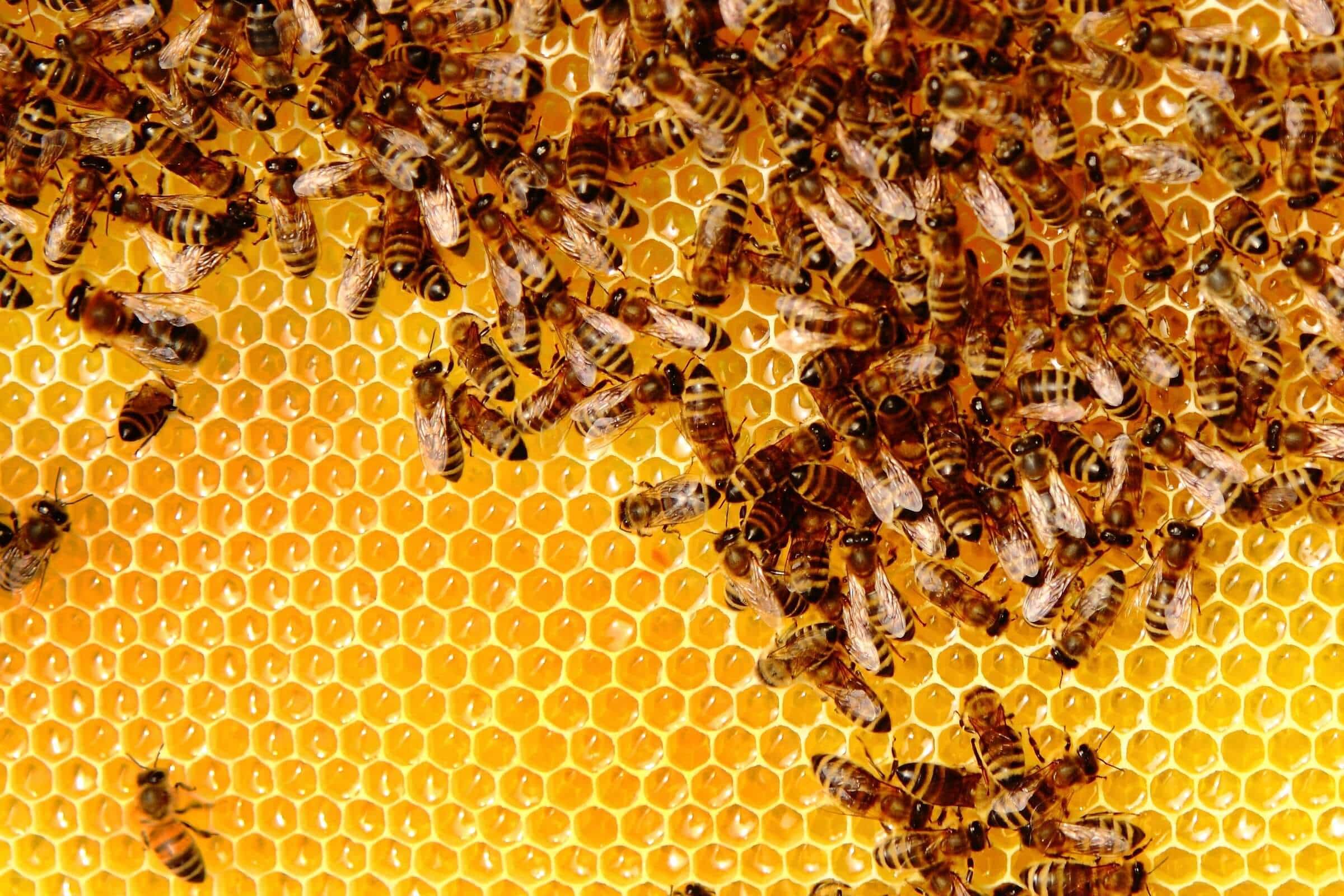
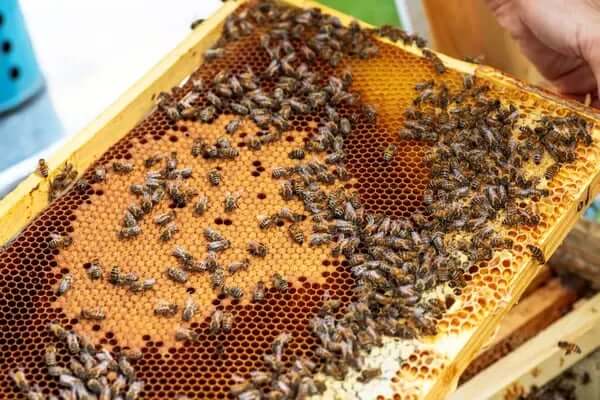
Honey production is a colony process, not a one-bee event. A forager returns to the hive with nectar in her crop and transfers it to house bees. Those bees expose the nectar to enzymes and place it into comb cells. Workers then fan their wings to improve airflow and speed evaporation. As the moisture level drops, the liquid becomes thicker, more stable, and better suited to long-term storage. Once the honey is ready, bees seal the cell with wax, creating a protected food reserve for future use.
Why are bees important even if they don’t make honey?
Bees are critical pollinators supporting plant reproduction, biodiversity, and agricultural productivity whether or not a species makes honey.
- Pollinators contribute to many of the world’s leading food crops.
- Bees help pollinate fruits, vegetables, nuts, and seed crops.
- Native bees often specialize in certain flowers or crop systems.
- Pollination supports ecosystem resilience and plant reproduction.
Focusing only on honey misses the larger ecological story. The Food and Agriculture Organization states that pollinators contribute to 87 of the 115 leading global food crops. The U.S. Forest Service and Pollinator Partnership also note that native bees can be especially effective on certain flowers and crop systems. A bee does not need to make honey to be valuable. In ecological and agricultural terms, many bees matter because they move pollen efficiently and support plant reproduction at scale.
Pollination occurs when bees transfer pollen between flowers while collecting nectar or pollen for food. This process allows plants to reproduce and form fruits and seeds. Crops such as almonds, blueberries, apples, squash, and many seed crops depend heavily on pollinator activity. Because different bee species forage differently, a diverse pollinator community can increase both crop yields and ecosystem resilience.
What makes honey different from nectar?
Nectar is a watery plant sugar, while honey is nectar transformed by bees through enzymes and evaporation into a stable stored food.
- Nectar typically contains far more water than honey.
- Bees add enzymes that change nectar sugars.
- Evaporation thickens nectar into honey.
- Honey stores energy for long periods inside the hive.
Nectar is a liquid sugar solution produced by flowers to attract pollinators. Honey is the result of bees transforming that nectar into a concentrated, shelf-stable food. Bees add enzymes that change the sugar composition and then reduce moisture through airflow and evaporation inside the hive. Once the liquid reaches the right consistency, bees seal the comb with wax. This stored honey becomes a reliable food source that colonies can use when flowers are scarce.
How can people help all types of bees?
People can help bees by planting diverse flowers, protecting nesting sites, reducing pesticide exposure, and supporting habitat health.
- Plant flowers with staggered bloom periods from spring through fall.
- Preserve bare ground, stems, and natural cavities for nesting.
- Use pesticides carefully and only when necessary.
- Support pollinator-friendly gardens, farms, and landscapes.
Helping bees starts with habitat. Different species need different resources, but most benefit from reliable floral forage, safe nesting space, and lower chemical exposure. Ground-nesting bees need undisturbed soil, while cavity-nesting bees need stems, wood, or protected holes. Planting a diverse range of nectar- and pollen-producing flowers extends food availability across the season. Even small choices, such as reducing unnecessary pesticide use or leaving some habitat less manicured, can make a real difference for both managed and wild bees.
How do honey-producing bees compare with other bees?
| Bee group | Social structure | Honey production | Main food storage | Typical human value |
|---|---|---|---|---|
| Honeybees (Apis) | Highly social colonies | Large, harvestable quantities | Wax comb cells | Honey production and pollination |
| Stingless bees (Meliponini) | Social colonies | Smaller, harvestable quantities | Resin or wax pots | Regional honey production and pollination |
| Bumblebees | Seasonal social colonies | Very limited storage | Short-term nectar reserves | Pollination |
| Most solitary bees | Solitary | None | Larval provisions in brood cells | Pollination |
This comparison matters because “bee” is not a single functional category. Different bee groups live differently, store food differently, and contribute to human systems in different ways. Honey production is just one of those roles.
Frequently Asked Questions
Do all bees make honey?
No. Only a small number of bee groups produce harvestable honey, mainly honeybees in the genus Apis and stingless bees in the tribe Meliponini.
Which bees produce most of the honey people eat?
Most honey people eat comes from honeybees, especially the Western honeybee, Apis mellifera.
Do bumblebees make honey?
Bumblebees can store small amounts of sugary food, but they do not make large harvestable honey stores like honeybees do.
Why do most bees not make honey?
Most bees are solitary and provision nests for larvae instead of storing large food reserves for a colony, so true honey production is unnecessary.
Why are bees important beyond honey?
Bees are vital pollinators that support plant reproduction, biodiversity, and the productivity of many food crops.
How can people help bees?
People can help bees by planting diverse flowers, preserving nesting habitat, reducing pesticide exposure, and supporting pollinator-friendly landscapes.
How many bee species are there worldwide?
Scientists recognize roughly 20,000 bee species worldwide, though the exact total changes as new species are described and classifications are revised.
What is the main difference between nectar and honey?
Nectar is a watery sugar solution produced by flowers, while honey is nectar that bees have enzymatically processed and dehydrated for storage.
Is stingless bee honey the same as honeybee honey?
No. Stingless bee honey is still honey, but it is often thinner, more acidic, and produced in smaller quantities than honey from honeybees.
Why do honeybees store honey in comb?
Honeybees store honey in comb because comb lets the colony organize, protect, and cap food reserves for later use.
Sources
- Pollination Services to Agriculture — Food and Agriculture Organization of the United Nations
https://www.fao.org/pollination/about/en - Buzz About Native Bees — U.S. Geological Survey
https://www.usgs.gov/news/featured-story/buzz-native-bees - How Is Honey Made? — Encyclopaedia Britannica
https://www.britannica.com/science/How-Is-Honey-Made - The Biology of the Honey Bee — Mark L. Winston
- Honey Bee Biology and Beekeeping — Dewey M. Caron and Lawrence John Connor
- Bee Basics: An Introduction to Our Native Bees — U.S. Forest Service and Pollinator Partnership
https://www.fs.usda.gov/wildflowers/pollinators/documents/BeeBasics.pdf - The Assessment Report on Pollinators, Pollination and Food Production — IPBES
https://www.ipbes.net/pollination-assessment