

Product Overview
8 Frame Beginner Beekeeping Starter Kit – 1 Deep + 1 Medium, Assembled, Wax Dipped or Painted
Start Beekeeping with an Assembled Hive, Essential Tools, Protective Clothing, and Practical Learning Resources
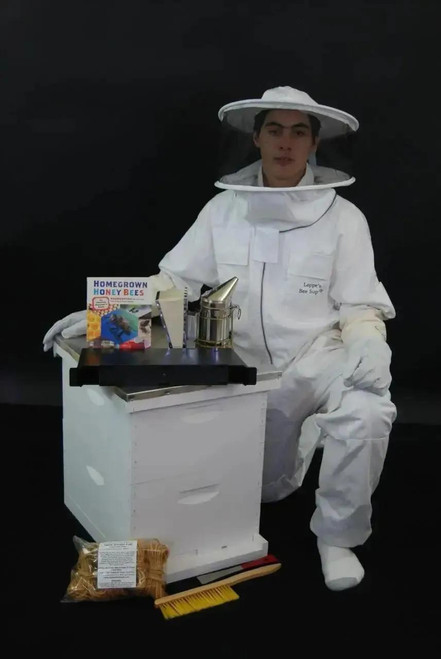
Getting started in beekeeping is easier when your hive equipment, inspection tools, protective clothing, and learning resources are brought together in one package. The 8 Frame Beginner Beekeeping Starter Kit from Lappe's Bee Supply includes an assembled eight-frame Langstroth hive with one deep brood box, one medium honey super, 16 frames with foundation, and essential accessories for establishing and managing your first colony.
Choose painted white or wax-dipped woodenware, a solid or screened bottom board, your preferred frame style, and a bee suit or jacket in your selected size. The eight-frame design provides a narrower hive configuration than a comparable ten-frame system while allowing you to expand with compatible equipment as your colony develops. Live honey bees are not included, and a second deep brood box must be purchased separately if you plan to manage a traditional two-deep brood system.
At Lappe's Bee Supply, our family has been involved in commercial beekeeping since 1978, and we have served beekeepers with equipment and practical beekeeping education since 2017. We believe a good beginner kit should help you understand not only what equipment you are buying, but also how the pieces work together and what your bees may need as the season progresses.
What Lappe's Checks When Preparing Your Beginner Beekeeping Kit
At Lappe's Bee Supply, we pay attention to the condition, finish, and compatibility of the equipment included in our 8 Frame Beginner Beekeeping Starter Kit. When preparing a kit, our team checks the assembled eight-frame deep brood box and medium honey super for visible damage or construction problems. We also verify that the painted white or wax-dipped woodenware matches the customer's selected finish.
Because this kit includes several customer-selectable options, our team checks that the included components correspond to the selections made when ordering. We also physically check the fit of the hive boxes, covers, bottom board, and frames to help ensure the components work together as a compatible eight-frame Langstroth hive system.
These checks are especially important for beginners who may be purchasing their first hive. Our goal is to provide properly matched equipment that customers can confidently prepare for their bees, while understanding that the assembled hive components still require setup before installation.
8 Frame Beginner Starter Kit at a Glance
| Product | 8 Frame Beginner Beekeeping Starter Kit |
| SKU | BGNK-2444 |
| Hive system | Eight-frame Langstroth |
| Brood chamber | One assembled eight-frame deep hive body |
| Honey super | One assembled eight-frame medium super |
| Frames | 16 frames with foundation for the included deep and medium boxes |
| Woodenware finish | Painted white or wax-dipped, selected when ordering |
| Bottom board | Solid or screened, selected when ordering |
| Protective clothing | Customer-selected bee suit or jacket and goatskin gloves |
| Assembly | Hive woodenware arrives assembled; hive setup is still required |
| Live bees | Not included; purchased separately |
What's Included in the Beginner Beekeeping Starter Kit?
This kit brings together hive equipment, inspection tools, feeding supplies, protective clothing, and educational materials so a new beekeeper can begin with a coordinated equipment package.
Hive Equipment
- One assembled eight-frame deep brood box
- One assembled eight-frame medium honey super
- 16 frames with foundation for the deep and medium boxes
- One inner cover
- One telescoping outer cover
- One solid or screened bottom board, according to your selection
- One in-hive frame feeder with cap and ladders
Beekeeping Tools and Protective Clothing
- One stainless steel bee smoker
- Smoker fuel
- One hive tool
- One bee brush
- One bee suit or bee jacket, according to your selection
- Goatskin beekeeping gloves in your selected size
Beekeeping Education
- Homegrown Honey Bees book
- One-year subscription to American Bee Journal or Bee Culture, according to your selection
Important: The 16 included frames correspond to the deep brood box and medium honey super. They are not 16 deep brood frames. The in-hive feeder also occupies space that would otherwise be available for frames when installed.
Why Choose an Eight-Frame Langstroth Hive?
An eight-frame Langstroth hive is a modular beehive system that uses boxes designed to accommodate eight frames across each box. Langstroth frames support removable comb, allowing beekeepers to inspect brood, food stores, and colony condition while managing hive space.
Compared with a ten-frame Langstroth hive of the same box depth, an eight-frame hive is narrower. A comparable eight-frame box generally weighs less when filled because it holds fewer frames and less comb, although a full box can still be heavy.
Eight-frame equipment can be a practical choice for beginners who prefer narrower boxes or want to build their apiary around an eight-frame system. The important consideration is consistency: choose matching eight-frame hive boxes and covers as you expand.
Eight-Frame vs. Ten-Frame Equipment
| Consideration | Eight-Frame | Ten-Frame |
| Box width | Narrower | Wider |
| Frame positions | Eight per box | Ten per box |
| Filled-box weight | Generally lighter at the same depth | Generally heavier at the same depth |
| Expansion | Use matching eight-frame boxes | Use matching ten-frame boxes |
Standard eight-frame and ten-frame hive boxes are not directly interchangeable in a normal vertical hive stack because their widths differ. Standard Langstroth frames of the same depth can generally be transferred between the two systems when frame specifications match.
Understanding the One-Deep, One-Medium Configuration
This starter kit includes two different hive-box depths because the boxes serve different purposes.
Deep Brood Box
The deep hive body provides the initial brood chamber where the queen lays eggs and worker bees care for developing brood. The bees also use comb space for pollen and food stores. This is the primary starting box for establishing the colony.
Medium Honey Super
A medium honey super is a shallower hive box placed above the brood area to provide additional space for honey storage when the colony is strong enough and nectar conditions support it.
The included medium super does not need to be installed immediately when bees arrive. Adding excess space before a colony is ready can make colony management more difficult.
Lappe's Apiary Note: Plan for Brood-Chamber Expansion
This beginner kit includes one eight-frame deep brood box and one eight-frame medium honey super. If you plan to manage your colony using a traditional two-deep brood system, you will need to purchase a second compatible eight-frame deep hive body separately.
When expanding to a two-deep brood system, choose an additional 8-frame, 9-5/8" deep hive body that matches your existing hive equipment. Lappe's Bee Supply offers assembled deep brood boxes in both wax-dipped and painted white finishes, with or without frames.
- 8 Frame Double Wax Dipped Deep Hive Body with Triple Wax Coated Frames – Assembled
- 8 Frame Double Wax Dipped Deep Hive Body – Assembled
- 8 Frame Painted Deep Hive Body with 8 Wax-Coated Frames – Assembled
- 8 Frame Painted White Deep Hive Body – Assembled
Choosing your additional brood box: If you do not already have compatible deep frames and foundation, choose a deep hive body with frames included. If you already own the appropriate frames, a hive body without frames may be a better option. Match the finish to your existing starter kit if you prefer a consistent appearance.
Expansion tip: Evaluate colony strength, brood development, food stores, and available comb space before adding another box. When approximately seven of the eight frames are substantially occupied, evaluate whether additional brood space is needed.
Choose the Right Options Before Ordering
This kit includes several customer-selectable options. Review each selection carefully so the equipment and protective clothing match your preferences and intended hive-management system.
Painted White or Wax-Dipped Woodenware?
Both finishes provide a prepared exterior surface for the wooden hive equipment, but their appearance and maintenance expectations differ.
- Painted white: A traditional exterior finish. Inspect the paint over time and prepare and repaint affected exterior areas when necessary.
- Wax-dipped: An alternative finish that generally does not require routine exterior repainting. Continue inspecting wood condition, joints, moisture exposure, and overall equipment condition.
Neither finish makes hive equipment maintenance-free. Choose based on your preferred appearance, maintenance approach, and available ordering options.
Solid or Screened Bottom Board?
The bottom board supports the hive and forms its lower entrance area. A solid bottom board has a continuous floor, while a screened bottom board incorporates screening into its construction.
Your choice should reflect your preferred management approach and local conditions. A screened bottom board is not a substitute for monitoring and managing Varroa mites.
Bee Suit or Bee Jacket?
A full bee suit provides integrated upper- and lower-body coverage. A bee jacket provides upper-body coverage and requires separate clothing for the legs.
Select the garment style and size that suit your coverage preferences. Use the applicable garment size chart, consider clothing worn underneath, and allow room for bending, reaching, and lifting during inspections.
Check that the veil maintains appropriate separation from your face and that closures can be secured correctly. Protective beekeeping clothing can reduce sting exposure but is not sting-proof.
Frame Style, Feeder, and Other Selections
Frames and foundation: The kit includes 16 frames with foundation, sized for the eight-frame deep brood box and medium honey super. Available frame-style options include assembled wooden frames with triple-wax-coated foundation and one-piece plastic frames with triple-wax coating. Review the available frame and foundation color selections when ordering to choose your preferred configuration.
In-hive frame feeder: The kit includes a 9-5/8" Deep In-Hive Frame Feeder with Cap and Ladders that holds up to 96 fluid ounces (3/4 gallon) of liquid feed. The feeder measures 2-1/4" wide by 8-7/8" deep and may occupy approximately 1-1/2 to 2 frame positions in some hive configurations. Its cap and ladder system is designed to help bees access the liquid feed while reducing drowning risk and limiting unwanted comb construction inside the feeder. When installing the feeder in your eight-frame deep brood box, adjust the number of brood frames according to the feeder's actual fit and available space.
Additional selections: Choose your goatskin glove size and select a one-year subscription to either American Bee Journal or Bee Culture.
What Else Will You Need to Start Beekeeping?
Live honey bees are sold separately. You will need to obtain bees and coordinate their arrival with your hive setup. Common starting options include package bees and nucleus colonies, often called nucs.
- Package bees: A group of bees supplied for installation without established brood frames.
- Nucleus colony: A smaller established colony generally supplied with a queen, brood, bees, and food stores on frames. Confirm that the nucleus uses compatible Langstroth deep frames before purchasing.
Depending on your colony's development and your management plans, you may also need additional eight-frame hive bodies and frames, supplemental feed, Varroa monitoring and management supplies, honey-harvesting equipment, and other seasonal accessories.
Explore Lappe's live honey bees and queens, compare nucleus colony options, or read our nucleus colony vs. package bees guide before deciding how to establish your first hive.
Getting Your Starter Kit Ready for Bees
What Does "Assembled" Mean for This Starter Kit?
The eight-frame deep brood box and medium honey super arrive assembled, eliminating the need to construct these wooden hive boxes from individual wooden pieces.
However, assembled woodenware does not mean the entire hive arrives stacked and ready for bees. You will still need to prepare a suitable hive location, position the bottom board and brood box, arrange the frames, install the covers, and prepare the feeder if you plan to use it.
Live honey bees are purchased separately and must be installed after the hive is prepared.
- Prepare the hive location. Choose a stable, level hive stand with suitable drainage, practical inspection access, and consideration for nearby people and property. Review applicable local beekeeping requirements.
- Position the bottom board and brood box. Make sure the components sit securely and align properly.
- Check the frames. Confirm that frames are seated correctly, are of the appropriate depth, and maintain proper spacing.
- Prepare the feeder. Check the cap and ladders, inspect for leaks or damage, and arrange the brood frames to accommodate the feeder if it will be used.
- Check the covers. Make sure the inner cover and telescoping outer cover fit properly.
- Prepare protective clothing and tools. Inspect garment closures and veil mesh, check your smoker and hive tool, and have the equipment ready before installation.
- Coordinate bee installation. Confirm the bee source, arrival arrangements, installation method, and compatibility with the hive equipment.
The correct installation process differs for package bees and nucleus colonies. If transferring nucleus frames, verify frame depth and the space available inside the brood box, especially when using the in-hive feeder.
What to Expect During Your First Beekeeping Season
Starting with the right equipment is important, but colony growth depends on the bees, queen condition, forage availability, weather, feeding decisions, and ongoing management.
Establishing the Colony
After installation, inspect at appropriate intervals to evaluate queen activity, brood development, food stores, and colony condition. Newly installed bees may need supplemental feeding depending on available resources and the colony's needs.
Recognizing When More Space Is Needed
As your colony develops, monitor brood production, adult bee population, food stores, and available comb space. Add compatible brood equipment or the included medium honey super when colony strength, seasonal conditions, and your management approach justify additional space.
If feeding sugar syrup, manage feeding and honey supers carefully to avoid harvesting stored feed as honey.
Managing Colony Health
Routine beekeeping includes monitoring Varroa mites, evaluating brood and queen condition, maintaining adequate food stores, and preparing the colony for seasonal changes. The included equipment does not replace these management responsibilities.
Will You Harvest Honey the First Year?
A first-season honey harvest is possible under favorable conditions, but it is not guaranteed. New colonies often need much of their available resources to establish comb, raise brood, and build food reserves. Colony health and sufficient stores should take priority over an early harvest.
Equipment Care and Maintenance
Regular equipment inspections help identify problems before they interfere with hive management.
- Woodenware: Check joints, fit, warping, moisture damage, and exterior finish condition. Maintain painted surfaces when needed and inspect wax-dipped equipment for deterioration.
- Frames and foundation: Check frame joints and comb support. Evaluate damaged or contaminated comb and protect stored equipment from pests.
- Frame feeder: Remove feed residue as appropriate, check the cap and ladders, and inspect for leakage or cracking. Store clean and dry.
- Covers and bottom board: Inspect fit, structural condition, and signs of unwanted moisture intrusion.
- Smoker and tools: Clean accumulated residue as needed, inspect working parts, and allow the smoker to cool completely before storage.
- Protective clothing: Inspect seams, zippers, veil mesh, and closures before use. Follow the care instructions for the specific garment selected.
Store unused equipment in a dry, protected location. Drawn comb may require additional pest-management precautions during storage.
Is This Beginner Beekeeping Kit Right for You?
This starter kit is a practical option for someone beginning with an eight-frame Langstroth system who wants assembled hive woodenware along with feeding equipment, inspection tools, protective clothing, and educational resources.
Consider this kit if:
- You are starting beekeeping and do not already own most of the included equipment.
- You prefer the narrower eight-frame hive configuration.
- You want to select your woodenware finish, bottom board, protective garment, and other ordering options.
- You plan to expand with compatible eight-frame equipment as your colony grows.
Another purchasing approach may be better if:
- You already use ten-frame hive equipment and want to maintain one consistent box system.
- You want two deep brood boxes included from the beginning.
- You already own protective clothing, inspection tools, and other accessories included in the package.
The best starter kit is the one that matches your intended colony-management system and the equipment you will actually use.
Frequently Asked Questions
Does the 8 Frame Beginner Beekeeping Starter Kit include live honey bees?
No. Live honey bees are not included. Package bees or a compatible nucleus colony must be purchased separately.
Does the kit arrive fully assembled?
The eight-frame deep brood box and medium honey super arrive assembled, but the hive still requires setup before installing bees.
Can I install a nucleus colony in this eight-frame hive?
Yes, when the nucleus contains compatible standard Langstroth deep frames. Confirm the frame dimensions before purchase and account for the space occupied by the in-hive feeder.
Will I need another deep brood box?
If you plan to manage a traditional two-deep brood system, you will need another compatible eight-frame deep box. The included medium honey super is not automatically a substitute for the second deep. Expansion timing depends on colony development.
Should I add the medium honey super as soon as I install bees?
Not necessarily. Add the medium super when colony strength, available space, and nectar conditions justify additional honey-storage space.
Can I use ten-frame hive boxes with this kit?
Standard eight-frame and ten-frame hive boxes have different widths and are not directly interchangeable in a normal vertical hive stack. Standard Langstroth frames of matching depth can generally transfer between systems when their specifications are compatible.
Does the included frame feeder take up brood-frame space?
Yes. The included 9-5/8" deep in-hive frame feeder is 2-1/4" wide and may occupy approximately 1-1/2 to 2 frame positions, depending on the hive configuration. Adjust the remaining brood frames according to the feeder's actual fit and available space.
Is wax-dipped woodenware maintenance-free?
No. Wax-dipped equipment generally does not require routine exterior repainting, but it still needs inspection for moisture damage, warping, deteriorating joints, and other wear.
Will this kit produce honey during my first season?
A first-season harvest is possible, but it is not guaranteed. Colony strength, forage, weather, available stores, and management decisions determine whether surplus honey can be harvested.
Start with the Equipment and Knowledge to Grow
The 8 Frame Beginner Beekeeping Starter Kit combines an assembled hive, essential beekeeping tools, feeding equipment, protective clothing, and learning resources in one configurable package. Its eight-frame Langstroth format gives you a starting system that can grow with your colony using compatible hive equipment.
Before ordering, review your woodenware finish, bottom board, frame style, protective-clothing sizes, and magazine subscription selection. Plan separately for your live bees and any additional brood equipment your management approach may require.
For supplemental feeding equipment and supplies, explore our honey bee feed and feeders.