Welcome to Lappe's Bee Supply's blogs section. We are a trusted beekeeping company in the USA. We give relevant insights, seasonal guidance, and professional advice for beekeepers of all experience levels. From hive management and bee wellness to honey production and equipment guides, we have it all that you will require to thrive. Get updated, motivated, and connected with the beekeeping community through regular news from Lappe's Bee Supply.
How to Mark a Honey Bee Queen
The Buzz About This Post
- 🐝 How do you mark a honey bee queen?
- ✅ What are the key takeaways?
- 📋 What does this queen-marking guide cover?
- What is queen marking?
- Why should a honey bee queen be marked?
- What color should be used to mark a queen bee?
- What tools are needed to mark a queen bee?
- When is the best time to mark a queen?
- How can a beekeeper find the queen?
- How do you safely mark a honey bee queen?
- What should happen after the queen is marked?
- What queen-marking mistakes should be avoided?
- How does queen marking support hive management?
- What queen information should a beekeeper record?
- How should common queen-marking problems be handled?
- Is marking a queen necessary for successful beekeeping?
- Frequently Asked Questions About Marking Queen Bees
- Sources and Further Reading
- FAQs
How to Mark a Honey Bee Queen
Marking a honey bee queen places a small, visible paint dot on her thorax so she can be identified more quickly during future hive inspections.
Queen marking can help beekeepers locate the queen, track her approximate age and maintain more accurate colony records. The process must be completed gently because the queen is essential to the colony and can be injured by rough handling, excessive pressure or misplaced paint.
Written by: Lappe's Bee Supply Team |
This educational guide combines practical beekeeping experience with recommendations from university Extension programs, agricultural agencies and established beekeeping references.

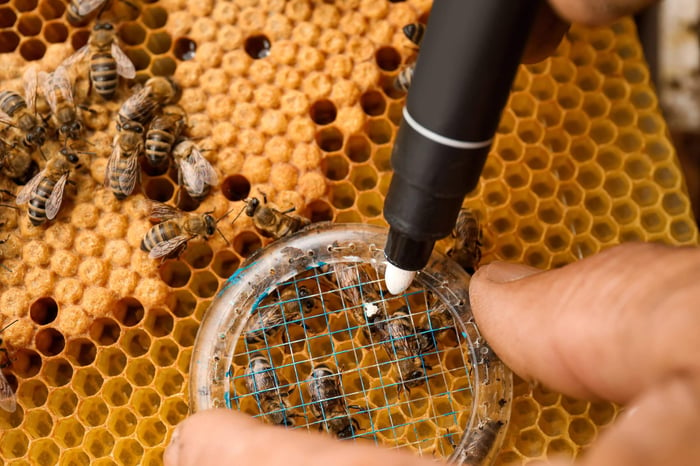
🐝 How do you mark a honey bee queen?To mark a queen bee, gently secure her in a queen-marking tube, place one small dot of bee-safe paint on the center of her thorax and allow the paint to set before releasing her. Do not place paint on the queen's head, wings, legs or abdomen. Use the international queen-marking color for the year when age tracking is desired. |
✅ What are the key takeaways?
|
What is queen marking?
Queen marking is the practice of placing a small, visible dot on a queen bee's thorax so she can be identified during later inspections.
- The thorax is the middle section of the queen's body.
- The mark is used for identification and recordkeeping.
- The paint dot should be small, centered and dry before release.
- Marking does not change the queen's genetics or mating status.
A queen honey bee is the primary reproductive female in a honey bee colony. Her abdomen is usually longer than that of a worker bee, but she can still be difficult to locate when thousands of bees are moving across the comb.
A contrasting paint dot provides a visual reference that may allow the beekeeper to identify her more quickly.
Important distinction: Queen marking is not the same as clipping a queen's wing. Marking adds a visible identification dot. Wing clipping removes a small portion of one wing for a separate management purpose. |
Why should a honey bee queen be marked?
A marked queen can be easier to find, easier to identify and easier to connect with accurate colony-management records.
- Marking can reduce the time spent searching for the queen.
- A yearly color can help identify her approximate age.
- A known mark may help confirm whether the original queen remains in the colony.
- Queen records can be compared with brood pattern and colony performance.
Finding the queen is not necessary during every hive inspection. Fresh eggs, young larvae and an organized brood pattern can indicate that a laying queen was present recently.
However, the beekeeper may need to see her when creating a split, moving brood frames, preparing to requeen or confirming whether the original queen remains in the colony.
Remember: A visible paint mark helps identify the queen, but it does not prove that she is fertile, healthy or producing a strong brood pattern.
What color should be used to mark a queen bee?
The international queen-marking system uses white, yellow, red, green and blue in a repeating five-year cycle based on the final digit of the year.
| Year Ends In | Marking Color | Example Years |
|---|---|---|
| 1 or 6 | White | 2021, 2026, 2031 |
| 2 or 7 | Yellow | 2022, 2027, 2032 |
| 3 or 8 | Red | 2023, 2028, 2033 |
| 4 or 9 | Green | 2024, 2029, 2034 |
| 5 or 0 | Blue | 2025, 2030, 2035 |
How can you remember the queen-marking colors?
A traditional memory aid is:
Will You Raise Good Bees?
- Will = White
- You = Yellow
- Raise = Red
- Good = Green
- Bees = Blue
Under this system, a queen marked during 2026 receives a white dot. A queen marked during 2027 receives a yellow dot.
Important: A color should not be treated as absolute proof of a queen's age. She may have been remarked, incorrectly marked or identified using a beekeeper's personal color system. |
What tools are needed to mark a queen bee?
A beekeeper needs bee-safe marking paint, a secure queen-holding device and normal hive-inspection equipment before beginning.
| Tool | Purpose |
|---|---|
| Queen-marking pen or paint | Creates the visible identification dot. |
| Queen-marking tube | Holds the queen gently against a mesh surface. |
| Queen catcher | Helps lift or isolate the queen from the comb. |
| Hive tool | Separates boxes and removes frames. |
| Smoker | Helps manage colony behavior during the inspection. |
| Protective clothing | Protects the beekeeper while working the colony. |
| Hive record | Documents the marking date, color and observations. |
Only a very small amount of paint is required. Before capturing the queen, test the marker on cardboard, wood or another disposable surface.
Testing confirms that the paint flows properly and shows how large a dot the applicator will produce.
Review available queen-marking tools and supplies before opening the hive so everything is ready when the queen is found.
When is the best time to mark a queen?
Mark a queen during calm, suitable inspection weather when the beekeeper can work carefully without exposing the colony to unnecessary stress.
- Avoid severe cold, heavy rain and strong wind.
- Do not mark a queen while the colony is unusually defensive.
- Avoid working during active robbing pressure.
- Prepare all equipment before opening the hive.
- Work over the open colony whenever practical.
Weather alone does not determine whether marking is appropriate. Colony temperament, wind, forage availability, robbing pressure and the beekeeper's experience also matter.
A newly mated queen should be handled with particular care. Many beekeepers prefer to confirm that she is laying before marking her.
How can a beekeeper find the queen?
Search brood frames methodically, watch how workers move and look for the queen's long abdomen rather than searching only for a paint mark.
Use this simple search pattern:
- Begin with frames containing eggs, larvae and capped brood.
- Hold each frame over the open hive.
- Scan from one upper corner to the opposite lower corner.
- Check the frame edges and bottom bar.
- Watch for workers facing toward or moving around one bee.
- Return each frame carefully before inspecting the next one.
The queen may move away from light, smoke or vibration. Excessive smoke can cause her and the workers to run across the comb, making her harder to follow.
Helpful reminder: A queen excluder can restrict a queen to part of a hive in certain management arrangements, but it does not instantly reveal which frame she occupies. |
How do you safely mark a honey bee queen?
Secure the queen gently, expose the top of her thorax, apply one small paint dot, allow it to set and return her carefully.
Queen-Marking Checklist☐ Prepare and test the marker ☐ Open the hive calmly ☐ Locate the queen ☐ Secure her gently ☐ Position the thorax beneath the mesh ☐ Apply one small paint dot ☐ Allow the paint to set ☐ Release the queen onto a brood frame ☐ Close the colony carefully ☐ Record the marking details |
1. Prepare the equipment
Place the marker, holding tube, queen catcher, hive tool and record sheet within reach. Test the marker before opening the colony.
2. Open the hive calmly
Use only enough smoke to manage the bees. Remove frames slowly and avoid crushing bees between boxes or frame rests.
3. Locate the queen
Search brood frames methodically while holding each frame over the open hive.
4. Secure the queen
Guide her into a queen-marking tube or capture her with a suitable queen catcher. Never squeeze or grasp her abdomen.
5. Position the queen
Bring her gently against the mesh until the top of her thorax is accessible. The device should hold her securely without compressing her body.
6. Apply the mark
Place one small dot in the center of the thorax.
Keep paint away from the:
- Head
- Eyes
- Antennae
- Wings
- Wing bases
- Legs
- Abdomen
7. Allow the paint to set
Keep the queen protected inside the marking device until the dot no longer appears wet. Do not blow forcefully on her or leave her confined longer than necessary.
8. Return the queen
Release her gently onto a brood frame or allow her to walk from the device. Do not throw or shake her into the hive.
9. Close the colony
Return the frames carefully, confirm that no bees are being crushed and close the hive calmly.
10. Record the details
Write down the date, color, colony number and observations about the queen or brood pattern.
Lappe's Field Note: Always test the marker before capturing the queen. A marker that releases too much paint can turn a controlled procedure into an emergency while the queen is restrained.
What should happen after the queen is marked?
The queen should return to the comb normally while workers recognize her through colony odors and queen-produced chemical signals.
- Release the queen gently near brood.
- Watch briefly for unusual aggression.
- Avoid reopening the hive repeatedly to check the mark.
- Confirm normal queen activity during a later inspection.
A few workers touching or surrounding the queen does not automatically mean they are rejecting her. Workers often inspect or antennate the queen after she is returned.
However, a tight ball of biting or stinging workers may indicate a problem. If workers appear to be attacking her, protect the queen in a cage and reassess the colony's queen status before releasing her again.
What queen-marking mistakes should be avoided?
The greatest risks come from rough handling, excessive paint, incorrect paint placement and releasing the queen before the mark has set.
| Mistake | Why It Matters | Safer Practice |
|---|---|---|
| Applying too much paint | Paint may spread onto wings, legs or other body structures. | Test the applicator and use one small dot. |
| Marking the abdomen | The abdomen is soft, flexible and essential to egg laying. | Mark only the top center of the thorax. |
| Restraining too tightly | Excessive pressure can injure the queen. | Use a proper holding device and minimal pressure. |
| Releasing wet paint | The paint may smear or transfer to workers. | Allow the paint to set before release. |
| Using unsuitable paint | An unverified coating may contain harmful solvents. | Use paint suitable for queen marking. |
| Working away from the hive | An escaped queen may be difficult to recover. | Work over the open hive whenever practical. |
| Assuming color proves age | A queen may have been remarked or incorrectly marked. | Confirm the mark with written records. |
If the queen is moving quickly or the colony becomes difficult to manage, return her safely and try again under better conditions. Protecting the queen is more important than completing the paint mark.
How does queen marking support hive management?
Queen marking supports identification and recordkeeping, but colony decisions should still be based on brood, population and overall performance.
- A marked queen can help confirm whether the original queen remains in the hive.
- An unmarked queen may indicate supersedure or colony replacement.
- Age records can help organize planned requeening decisions.
- Queen identity can be compared with brood pattern and temperament.
A colony may replace its queen without direct beekeeper involvement. This process is commonly called supersedure.
If a colony previously contained a marked queen and later contains an unmarked laying queen, the change may indicate that the colony raised or accepted a replacement.
Do not judge queen quality by the paint mark alone. Evaluate egg placement, brood pattern, colony population, temperament and signs of pests, disease or nutritional stress. |
What queen information should a beekeeper record?
Record the marking date, color, queen source, colony identity and performance observations so the mark has useful management context.
| Hive or Colony Number | [ENTER HIVE NUMBER] |
|---|---|
| Marking Date | [ENTER DATE] |
| Marking Color | [ENTER COLOR] |
| Queen Source | [ENTER SOURCE] |
| Queen Type | Purchased, raised, supersedure or introduced |
| Brood Pattern | [ENTER OBSERVATION] |
| Colony Temperament | [ENTER OBSERVATION] |
| Queen Cells Present | Yes or No |
| Follow-Up Date | [ENTER DATE] |
Written records reduce uncertainty when paint fades or when more than one person manages the apiary.
Records also help when comparing colonies, evaluating queen sources or determining whether the colony replaced its queen.
How should common queen-marking problems be handled?
Stop and protect the queen whenever weather, colony behavior, equipment problems or handling difficulty make safe marking uncertain.
What should you do if the bees become defensive?
Return exposed frames carefully, close the colony and try again during better conditions. Continuing while bees are highly defensive increases the risk of dropping or injuring the queen.
What should you do if you cannot find the queen?
Do not keep the hive open indefinitely. Look for eggs and young larvae, close the colony and return during another suitable inspection.
What should you do if the queen flies away?
Remain calm and avoid rapid movements. Keep the hive open briefly and watch the entrance, frame tops and surrounding equipment because the queen may land nearby or return toward the colony.
What should you do if too much paint is applied?
Do not attempt aggressive cleaning that could injure the queen. Protect her in a suitable cage and seek assistance if paint has reached her wings, head, legs or breathing openings.
What should you do if the paint wears off?
The queen can be remarked if she is healthy and can be restrained safely. Update the colony record so the new mark is not mistaken for proof of a different queen.
Is marking a queen necessary for successful beekeeping?
Queen marking is a useful management option, but a colony can be inspected and managed successfully without marking its queen.
- Marking is optional rather than biologically required.
- Eggs and young brood can confirm recent queen activity.
- A queen should not be placed at unnecessary risk merely to add a paint dot.
- Good inspection habits remain important whether the queen is marked or unmarked.
Beginners sometimes believe they must find the queen during every inspection. Many routine questions can instead be answered by examining brood, food stores, colony population, queen cells and signs of pests or disease.
A beekeeper who is not comfortable handling a queen can ask an experienced mentor, queen producer or bee supplier for assistance.
Frequently Asked Questions About Marking Queen Bees
Does marking hurt a queen bee?
Correct marking should not harm the queen when she is restrained gently and one small dot of suitable paint is placed on her thorax.
Where should the paint be placed on a queen bee?
Place the paint on the top center of the thorax. Do not place paint on the queen's head, wings, legs or abdomen.
What color is used to mark a queen in 2026?
White is the international queen-marking color for 2026 because white is used for years ending in 1 or 6.
What color is used to mark a queen in 2027?
Yellow is the international queen-marking color for 2027 because yellow is used for years ending in 2 or 7.
How large should a queen's paint mark be?
The mark should be a small, visible dot confined to the top of the thorax. It should not spread onto nearby body parts.
How long should queen-marking paint dry?
Allow the mark to set according to the product directions before releasing the queen. Drying time varies by product and environmental conditions.
Can a queen be marked while she is on the comb?
Direct marking on the comb is possible but provides less control. A queen-marking tube usually limits movement and improves paint placement.
Can workers reject a queen after she is marked?
A properly marked established queen normally returns without difficulty, but rough handling, injury or strong unfamiliar odors can complicate her return.
Does a marked queen still need to be evaluated?
Yes. A paint mark identifies the queen but does not prove that she is fertile, healthy or producing an acceptable brood pattern.
Should every honey bee queen be marked?
No. Marking is optional, although many beekeepers use it to simplify identification, age tracking and colony recordkeeping.
Sources and Further Reading
- The Basics of Queen Management in Beekeeping Operations — University of Florida Institute of Food and Agricultural Sciences.
- An Introduction to Queen Honey Bee Development — Penn State Extension.
- Raising Quality Queen Bees — University of Arkansas System Division of Agriculture.
- Honey Bee Inspections and Recordkeeping — University of Tennessee Institute of Agriculture.
- Beekeeping in Northern Climates Manuals — University of Minnesota Bee Lab.
- Honey Bee — USDA Natural Resources Conservation Service.
- Atlas of the Honey Bee — USDA Agricultural Research Service.
FAQs
Does marking hurt a queen bee?
Correct marking should not harm the queen when she is restrained gently and one small dot of suitable paint is placed on her thorax.
Where should the paint be placed on a queen bee?
Place the paint on the top center of the thorax. Do not place paint on the queen's head, wings, legs or abdomen.
What color is used to mark a queen in 2026?
White is the international queen-marking color for 2026 because white is used for years ending in 1 or 6.
What color is used to mark a queen in 2027?
Yellow is the international queen-marking color for 2027 because yellow is used for years ending in 2 or 7.
How large should a queen's paint mark be?
The mark should be a small, visible dot confined to the top of the thorax. It should not spread onto nearby body parts.
How long should queen-marking paint dry?
Allow the mark to set according to the product directions before releasing the queen. Drying time varies by product and environmental conditions.
Can a queen be marked while she is on the comb?
Direct marking on the comb is possible but provides less control. A queen-marking tube usually limits movement and improves paint placement.
Can workers reject a queen after she is marked?
A properly marked established queen normally returns without difficulty, but rough handling, injury or strong unfamiliar odors can complicate her return.
Does a marked queen still need to be evaluated?
Yes. A paint mark identifies the queen but does not prove that she is fertile, healthy or producing an acceptable brood pattern.
Should every honey bee queen be marked?
No. Marking is optional, although many beekeepers use it to simplify identification, age tracking and colony recordkeeping.