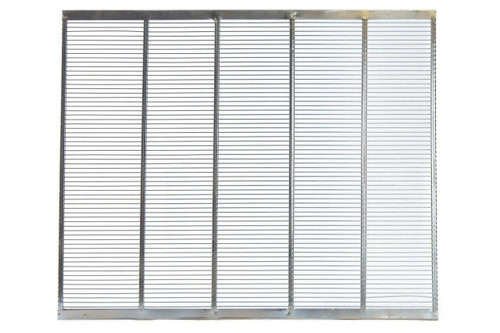

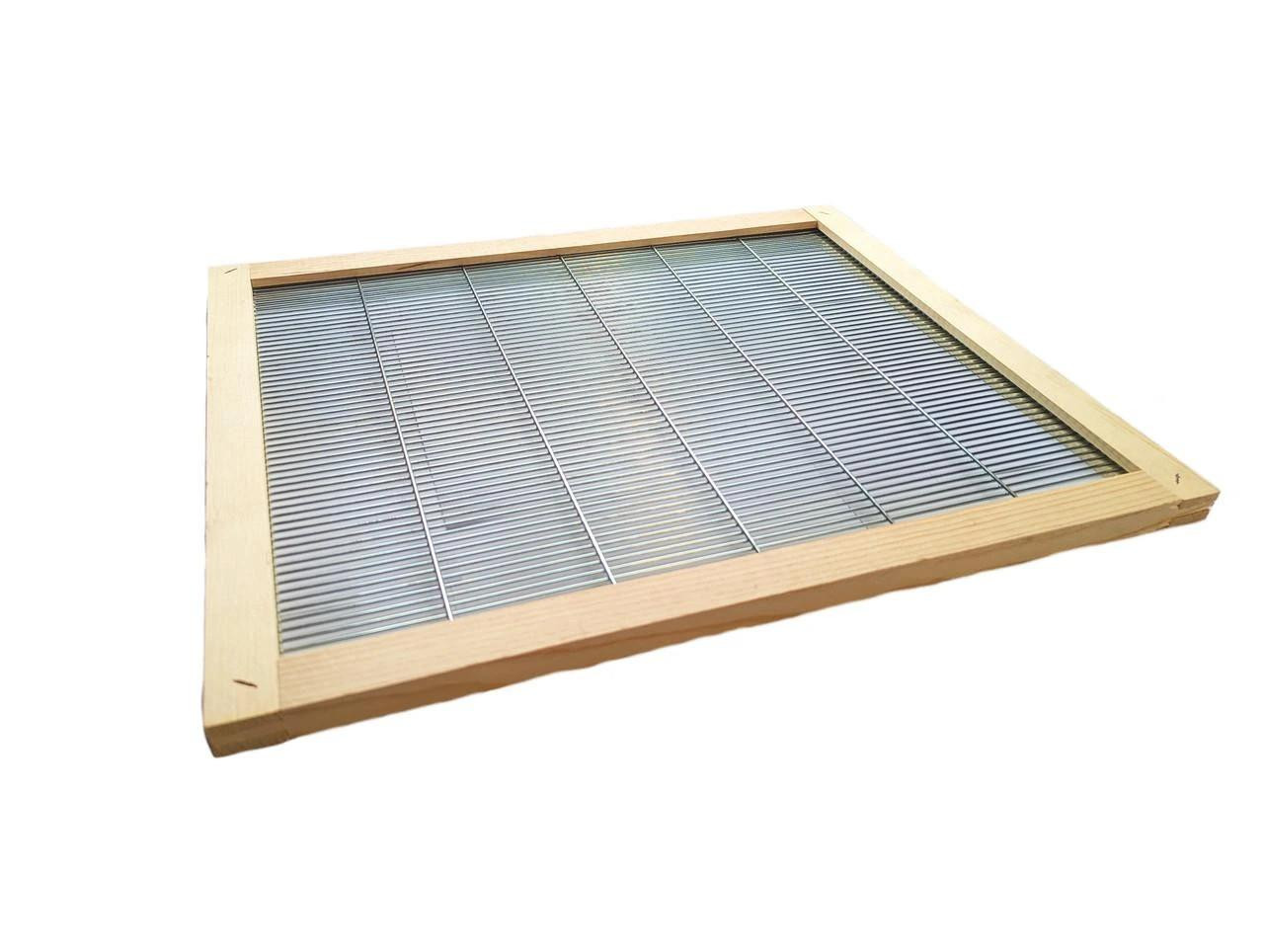


Product Overview
At-a-glance summary for 10-frame wood bound metal queen excluder for Langstroth hives
Keep brood out of honey supers for cleaner, easier honey harvests
This 10-frame wood-bound metal queen excluder helps keep the queen in the brood chamber while allowing worker bees to move into honey supers. That helps maintain brood-free honey frames, simplifies harvest prep, and keeps hive management more organized during the season.
- Fits: Standard 10-frame Langstroth hives
- Use it to: Keep brood out of honey supers
- Build: Welded metal grid with rigid wood-bound perimeter
- Best for: Beekeepers who want cleaner, brood-free supers
Quick fit check: If you use standard 10-frame Langstroth brood boxes and supers, this is the correct size. It is not for 8-frame equipment.
What is a queen excluder?
A queen excluder is a beekeeping tool placed between the brood chamber and honey supers to keep the queen below while allowing worker bees to pass through.
Beekeepers use queen excluders to help keep brood out of honey supers, improve honey frame organization, and make harvests cleaner and easier to manage. In a standard Langstroth hive, the excluder helps separate brood rearing from surplus honey storage.
Quick Answer: Why do beekeepers buy this queen excluder?
Beekeepers use a queen excluder to keep the queen in the brood chamber while allowing worker bees to move upward into honey supers. That helps keep honey frames cleaner and easier to harvest.
This 10-frame wood-bound metal queen excluder installs between the brood chamber and honey supers. Its 0.25 inch wire spacing allows worker bees through while blocking the larger queen, helping keep upper boxes brood-free for cleaner extraction and more predictable hive organization.
For beekeepers using standard 10-frame Langstroth equipment, it is a simple, durable upgrade that supports cleaner supers and more efficient honey production.
What does a queen excluder do?
It helps keep the queen out of honey supers while still allowing worker bees to move upward and store honey.
Do I need a queen excluder?
Not every beekeeper uses one, but many choose one to keep brood out of honey supers and make harvests more organized and market-ready.
Does a queen excluder reduce honey production?
Not necessarily. Strong colonies during a nectar flow usually move through an excluder well, but weak colonies or poorly timed installation may slow movement into supers.
Is this the right size for my hive?
Yes, if you use standard 10-frame Langstroth equipment. No, if you use 8-frame equipment or non-Langstroth hive systems.
People also search: queen excluder questions beekeepers ask
Beekeepers comparing a queen excluder often want quick answers about size, material, and when to use one. These common questions can help you decide whether this 10-frame wood-bound metal queen excluder is the right fit for your hive setup.
10-frame vs 8-frame queen excluder: what is the difference?
The main difference is hive compatibility. A 10-frame queen excluder fits standard 10-frame Langstroth hive bodies, while an 8-frame queen excluder fits standard 8-frame equipment. Using the correct size helps ensure proper alignment and helps prevent gaps between boxes.
Metal vs plastic queen excluder: which is better?
Many beekeepers prefer metal queen excluders for their rigidity, flatter fit, and long-term durability. Plastic queen excluders are lightweight and easy to handle, but metal styles are often chosen when dependable fit and strength matter most during inspections and honey season.
Do I need a queen excluder for my hive?
Not every beekeeper uses one, but many choose a queen excluder to help keep brood out of honey supers and make honey harvests cleaner and easier to manage. It is especially useful for beekeepers who want brood-free honey frames and more organized super management.
When should I use or avoid a queen excluder?
Queen excluders are usually installed when adding honey supers during a nectar flow and when colonies are strong enough to move upward well. They may be less effective on weak colonies or when nectar flow is poor, since bees can hesitate to cross the excluder under those conditions.
Quick specs about this 10-frame wood bound metal queen excluder
- Fits standard 10-frame Langstroth hive bodies
- Approximate dimensions: 19 7/8 inches x 16 1/4 inches
- Wire spacing: 0.25 inch (6.35 mm)
- Welded metal wire grid
- Wood-bound perimeter frame
- SKU: CMPS-6897
Will this fit your hive?
This queen excluder is designed for standard 10-frame Langstroth hive equipment.
It works with standard 10-frame brood boxes and honey supers, but it is not designed for 8-frame Langstroth equipment or non-Langstroth hive systems. If you run standard 10-frame gear, this is a straightforward fit with no guesswork.
When to use a queen excluder
They work best when colonies are strong and actively moving into upper boxes. Installing one at the right time can make honey supers easier to manage throughout the season.
Who typically uses this type of queen excluder?
This 10-frame wood-bound metal queen excluder is commonly chosen by beekeepers who want more control over brood placement and cleaner honey supers.
- Hobbyist beekeepers: Good for small apiaries where cleaner frame separation makes inspections and honey harvests easier.
- Sideline beekeepers: Helpful for standardizing super management across multiple 10-frame hives.
- Honey-focused beekeepers: Useful when the goal is to keep brood out of honey supers for cleaner extraction and more organized harvest prep.
It may be less appealing to beekeepers who prefer unrestricted brood movement or who do not use excluders as part of their management style.
Apiary management notes for queen excluders
The standard 0.25 inch spacing allows worker bees through while restricting the queen.
Worker bees may hesitate to pass through a newly installed excluder, but strong colonies typically adjust quickly.
Proper box alignment is important, as gaps can allow bees to bypass the grid and build burr comb. A rigid wood-bound edge helps the excluder sit more securely and stay easier to position during inspections.
An excluder does not force bees upward—colony strength, nectar flow, drawn comb, and management all influence usage. During strong nectar flows, bees typically move through an excluder without issue. For beekeepers who want brood-free supers, it remains one of the simplest tools for improving harvest organization.
Compare queen excluder types before you buy
Not every queen excluder is built the same. The right choice depends on your hive size, handling preference, and how much rigidity you want during inspections and honey season.
| Excluder Type | Best For | Main Advantage | Tradeoff | Shop This Style |
|---|---|---|---|---|
| 10-frame wood-bound metal queen excluder | Beekeepers who want durability, flat fit, and easier handling | Better rigidity and edge support in standard 10-frame Langstroth equipment | Heavier than plastic options | |
| 10-frame metal queen excluder | Beekeepers who want a durable all-metal option | Strong welded construction with metal-bound edges | Less edge cushioning than wood-bound styles | Shop now |
| 10-frame plastic queen excluder | Beekeepers who want a lightweight, budget-friendly option | Lower cost and easy handling | Can flex more than metal styles | Shop now |
| 8-frame wood-bound metal queen excluder | Beekeepers running 8-frame Langstroth equipment who want the same rigid wood-bound build | Wood-bound support sized for lighter 8-frame setups | Not compatible with 10-frame boxes | Shop now |
| 8-frame metal queen excluder | Beekeepers who want an all-metal 8-frame option | Durable construction for 8-frame hives | Less perimeter support than wood-bound styles | Shop now |
| 8-frame plastic queen excluder | Budget-minded 8-frame beekeepers | Lightweight and economical | Less rigid than metal or wood-bound styles | Shop now |
If you want the most dependable combination of strength, handling, and fit for a standard 10-frame Langstroth hive, a wood-bound metal queen excluder is often the best all-around choice.
Common beginner mistakes when using a queen excluder
Using a queen excluder on a weak colony can reduce movement into honey supers and slow honey storage.
Poor box alignment can create gaps that let bees bypass the excluder, and installing one too early—before strong buildup or nectar flow—can reduce its effectiveness. Used at the right time, however, a queen excluder can be a simple upgrade for cleaner supers and more predictable brood placement.
What this queen excluder includes
- One 10-frame wood bound metal queen excluder that fits standard 10-frame Langstroth hives
Compatibility with standard hive equipment
This queen excluder is compatible with standard 10-frame Langstroth brood boxes and honey supers.
It is not designed for 8-frame Langstroth equipment or non-Langstroth hive systems. If you are running standard 10-frame equipment, this is a straightforward fit that helps avoid compatibility guesswork.
Installation of the queen excluder into a standard hive system
This excluder installs between the brood chamber and honey supers in a 10-frame Langstroth hive.
It works alongside other hive components to separate brood rearing from honey storage, making super management cleaner and more efficient during the honey season.
Proper box alignment is important, as gaps can allow bees to bypass the grid and build burr comb. A rigid wood-bound edge helps the excluder sit more securely and stay easier to position during inspections.
Why choose wood-bound metal? Quick comparison summary
Wood-bound metal queen excluders combine a durable welded wire grid with a rigid perimeter that helps them stay flat and align well between boxes.
Compared with plastic or unbound metal styles, they offer better edge support, easier handling during inspections, and a more dependable fit in standard 10-frame Langstroth equipment.
Many experienced beekeepers prefer wood-bound metal styles because they offer a dependable balance of strength, handling, and fit in standard Langstroth equipment.
- Better rigidity and flatter fit
- More edge support than unbound metal
- Less likely to flex than plastic styles
- Easier to position during inspections
Compare all Lappe's queen excluder options
If you are still deciding, compare frame size and material across the rest of our queen excluder lineup.
- 10-frame metal queen excluder
- 10-frame plastic queen excluder
- 8-frame wood-bound metal queen excluder
- 8-frame metal queen excluder
- 8-frame plastic queen excluder
Internal resources for choosing the right hive equipment
If you are comparing equipment or building out a full hive setup, these related categories can help you make a better decision and keep your apiary components compatible.
- Browse all 10-frame hive components if you want matching equipment for a standard Langstroth setup.
- Shop beekeeping supplies for tools, accessories, and seasonal essentials.
- See compatible honey supers if you are adding upper boxes during nectar flow.
- Explore bee hive accessories for other hive management add-ons.
- Read the beekeeping equipment FAQ for additional practical answers about timing, hive setup, and equipment choices.
Who this 10-frame queen excluder is best for
Best for beekeepers using standard 10-frame Langstroth hives who want controlled brood placement and brood-free honey supers.
Commonly used by hobbyist and sideline beekeepers focused on cleaner harvests and efficient use of beekeeping supplies. It is especially useful for beekeepers who want a simple, proven way to keep honey frames more market-ready and easier to process.
When this queen excluder may not be the best choice
Not suitable for 8-frame hives or non-Langstroth systems.
Beekeepers who prefer unrestricted brood movement or non-traditional honey production methods may choose not to use an excluder. But for standard managed honey production, many beekeepers consider it a practical piece of equipment to keep on hand during the season.
Maintenance and storage
Remove burr comb and excess propolis to keep grid openings clear.
Store dry and flat during the off-season to protect the wood frame and maintain proper fit. With basic care, a wood-bound metal excluder can provide reliable service season after season.
Key beekeeping terms related to queen excluders
Queen excluder: A grid that blocks the queen while allowing worker bees through.
Brood chamber: The hive area where the queen lays eggs and brood develops.
Honey super: A box above the brood area where bees store surplus honey.
Langstroth hive: A modular hive system with stackable boxes and removable frames.
Nectar flow: A period when plants produce abundant nectar for honey storage.
Frequently asked questions about this 10-frame queen excluder
What is the 10 Frame Wood Bound Metal Queen Excluder?
A wood-bound, welded metal excluder designed for standard 10-frame Langstroth hives that helps keep the queen out of upper boxes while allowing worker bees through.
Will this fit an 8-frame hive?
No. It is designed specifically for 10-frame Langstroth equipment.
What are the dimensions of this 10-frame queen excluder?
Approximately 19 7/8 inches x 16 1/4 inches.
What is the wire spacing on this queen excluder?
0.25 inch (6.35 mm), which is standard queen-excluding spacing.
Is this queen excluder all metal?
No. It has a welded metal grid with a wood-bound perimeter.
What comes with this product?
One 10-frame wood bound metal queen excluder.
Where should a queen excluder be placed?
Above the brood chamber and below the first honey super.
When should I install a queen excluder?
When adding honey supers during an active nectar flow with a strong colony.
How should I maintain or store a wood-bound metal queen excluder?
Scrape off burr comb or propolis as needed and store the excluder dry and flat during the off-season to help protect the wood edge.
Do worker bees always move through a queen excluder right away?
Not always. Some colonies hesitate at first, especially if the colony is weak or nectar flow is limited, but strong colonies usually adjust quickly.
Do I need a queen excluder for every hive?
Not always. Some beekeepers use queen excluders regularly for cleaner honey supers, while others choose not to depending on their management style and honey production goals.
Does a queen excluder hurt honey production?
Not when used correctly with a strong colony during a nectar flow. However, weak colonies or poorly timed installation can reduce movement into upper boxes.
About Lappe's Bee Supply
Lappe's Bee Supply provides beekeeping equipment and practical guidance for beekeepers across the United States.
We focus on reliable hive components that fit standard Langstroth systems used in real apiary conditions. Our goal is to help new and experienced beekeepers choose equipment with less guesswork and better field-ready understanding.
Explore more beekeeping supplies, 10-frame equipment, and honey supers at Lappe's Bee Supply.
Share your experience with this queen excluder
If you’ve used this product in your apiary, your feedback can help other beekeepers.
Even short reviews are valuable.
Free shipping on most beekeeping supplies orders over $100
Most beekeeping supplies orders over $100 qualify for free shipping from Lappe's Bee Supply.